
Adobe Patents a Way to Stop Animated Characters from Moving Like Robots
Keyframe animation has always been a game of connect-the-dots — you set a start pose, an end pose, and hope the software fills in the middle gracefully. Adobe's new patent tries to make that 'filling in' a lot less ugly.
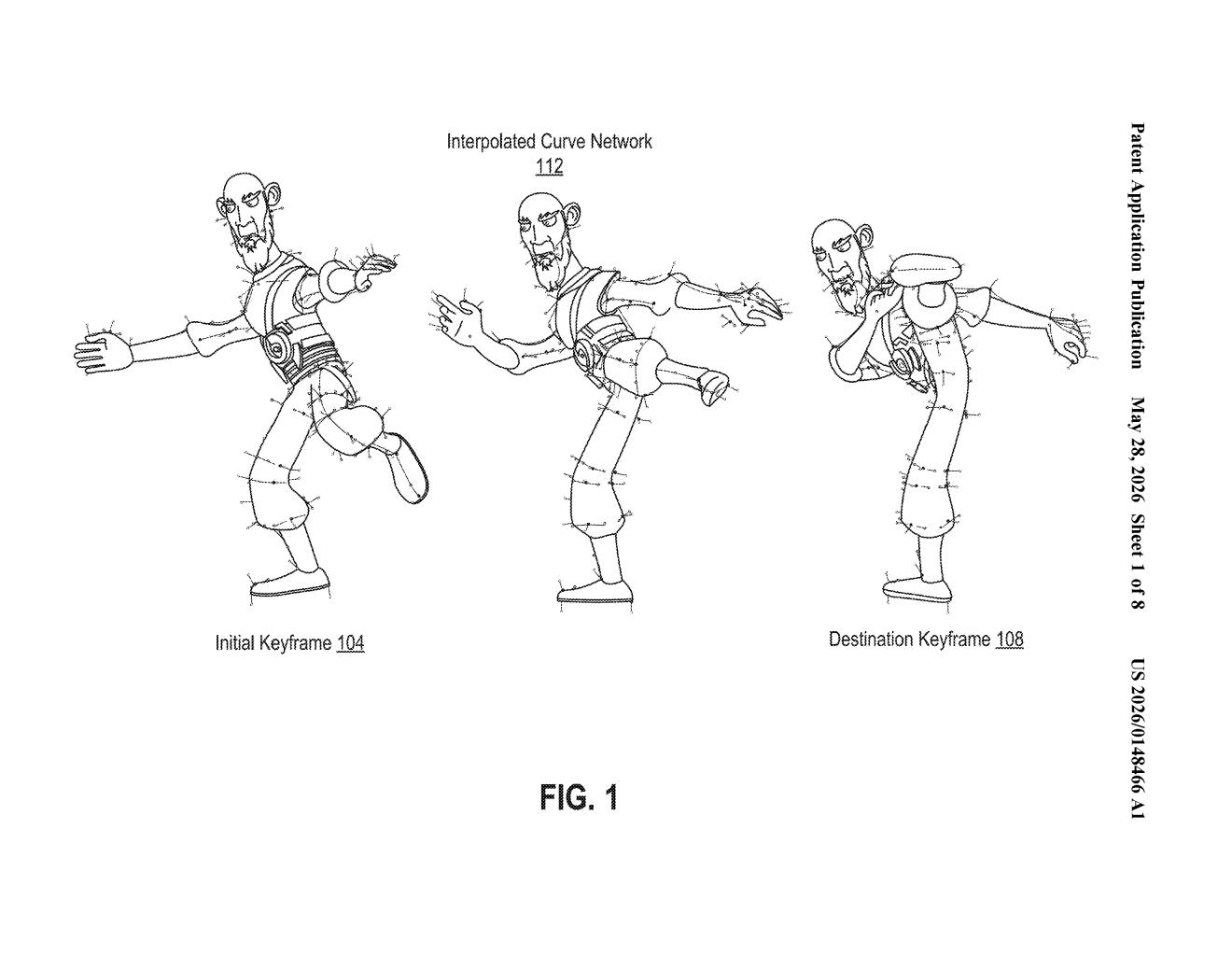
What Adobe's curve-network animation approach actually does
Imagine you're animating a character throwing a punch. You draw the wind-up pose, then the follow-through pose, and your software is supposed to figure out all the frames in between. The problem is that standard linear interpolation — basically 'just average the two poses' — often produces stiff, robotic motion that looks nothing like how a real body moves.
Adobe's patent describes a system that uses a curve network — a web of lines drawn directly onto the surface of a 3D character — as a guide for generating those in-between frames. Instead of blindly averaging joint positions, the system uses the curve network's geometry to figure out how the shape should deform as it moves from one keyframe to the next.
The result is that your animated character's skin, muscles, and silhouette should hold together more naturally across the motion — without you having to manually place dozens of intermediate keyframes yourself. It's aimed squarely at the tedious 'cleanup' work that eats hours in a professional animation pipeline.
How the curve network interpolates between keyframe poses
The core idea is binding a curve network — a structured mesh of curves laid onto a character's rest pose (the neutral, default position) — to the object before animation begins. Think of it like drawing guidelines on a balloon before you twist it: the lines help predict how the surface will stretch and compress.
When an animator sets an initial keyframe (the starting pose) and a destination keyframe (the ending pose), the system doesn't just linearly blend the vertex positions between them. Instead, it uses the curve network's topology to drive a non-linear interpolation — meaning the path from one pose to the other follows a physically plausible arc rather than a straight geometric average.
The system then generates a sequence of intermediate curve networks, each representing the object's shape at a moment between the two keyframes. Those intermediate networks are rendered frame-by-frame to produce the final animation segment.
- Rest pose binding: Curve network is anchored to the character's neutral geometry before any animation starts.
- Keyframe intake: System reads start and end poses as two states of the same curve network.
- Non-linear interpolation: In-between poses are computed along a curved path in pose space, not a straight line.
- Render output: All frames — start, intermediates, and end — are rendered into a complete animation clip.
What this means for 3D animation workflows in Adobe tools
For professional animators, the unglamorous truth is that a huge chunk of production time goes into fixing the frames a computer generates automatically between keyframes — volume loss, candy-wrapper twists, collapsing geometry. If Adobe's curve-network approach actually delivers on its premise, it could meaningfully reduce that cleanup work inside tools like Adobe Substance 3D or a future version of Character Animator.
For the broader pipeline, this also hints at Adobe pushing further into procedural and geometry-aware animation — territory currently dominated by tools like Houdini and Maya's rigging ecosystem. Whether this becomes a user-facing feature or stays as infrastructure under the hood, it signals that Adobe is investing seriously in the math of how 3D shapes move.
This is solid, focused R&D work from a team that clearly knows computational geometry — the inventor list includes researchers with published work in mesh processing and geometric animation. It's not a flashy AI play, but curve-network-based deformation is a real unsolved pain point in animation, and a good solution here would have genuine workflow impact. Worth keeping an eye on if you work in 3D content creation.
There are more where this came from
We read every patent application Big Tech publishes and send you the ones worth knowing. Plain English, free, every week.
Want this weekly breakdown for a company we don't cover? Patentlyze Pro →