
Adobe Patents a Tool That Shows Photographers What Their Display Can Actually Show
When you edit a photo, some of the detail you're working on might be invisible to anyone who views it on a standard screen. Adobe's new patent is about making that problem visible, in real time.
What Adobe's HDR editing visualizations actually do
Imagine you're editing a photo of a sunset. The raw file captures an enormous range of brightness, from deep shadows to a blazing sky. But the screen you're working on, or the screen your audience is using, might not be able to show all of that. Right now, it's easy to edit detail that will simply disappear for most viewers.
Adobe's patent describes a set of editing tools designed to tell you, as you work, exactly which parts of your image fall inside or outside what a given display can actually reproduce. Think of it like a weather map for brightness: areas your screen can handle are shown one way, areas that are beyond its reach are flagged differently.
The tools include updated histograms, tone curve editors that span both standard and high dynamic range (HDR) brightness levels, and a preview mode that simulates how an HDR image will look when converted down for older screens. It's a practical toolkit for a real problem that gets more common as HDR cameras and displays spread.
How Adobe maps luminance values across HDR and SDR ranges
The patent describes a system built around a core idea: take the luminance values (the brightness levels) inside a digital image and compare them against the capabilities of a target display, then show the photographer where the gaps are.
The system works through five types of visualization:
- An HDR-aware histogram that extends the traditional brightness graph to cover the full HDR range, not just the standard range most editors show today.
- A capability indicator that marks which brightness levels a connected display can actually render.
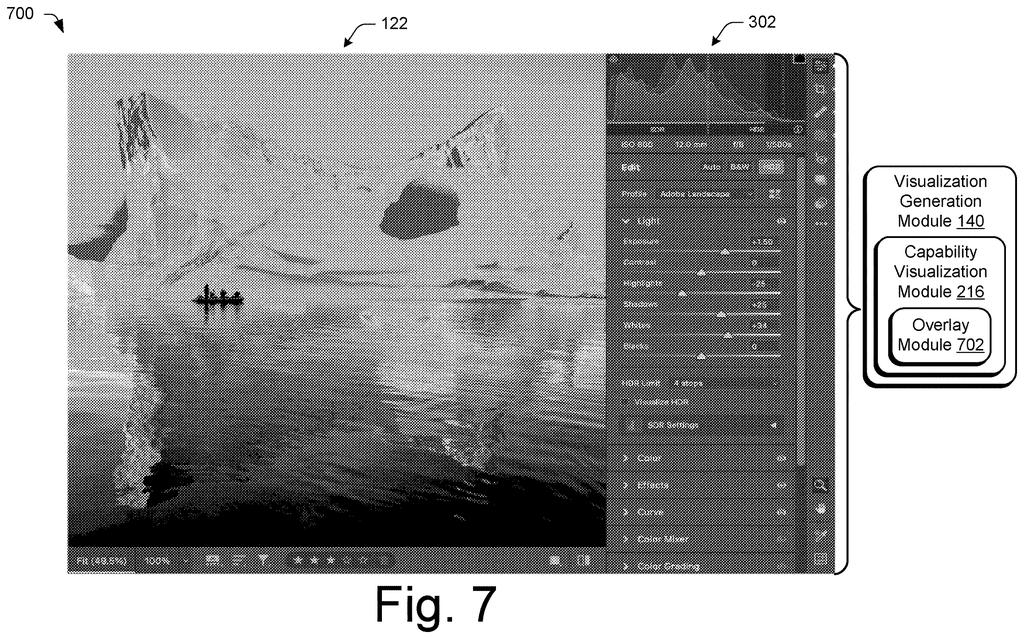
- A luminance range overlay that highlights regions of the image that fall into specific brightness zones, similar to focus-peaking on a camera.
- An extended tone curve that lets editors define how input brightness values map to output values across both standard dynamic range (SDR) and HDR simultaneously.
- A soft-proof preview that simulates how the image will look after being converted from HDR down to SDR, so editors can check the result before committing.
The claim specifically covers detecting which luminance values in an image are supported by a display's HDR capabilities and which are not, then generating a visualization to show the difference. That's the core technical contribution.
What this means for photographers editing on HDR screens
HDR displays are now common in phones, televisions, and professional monitors, but most editing software still treats the HDR-to-SDR gap as an afterthought. Photographers and video editors routinely export work without a clear sense of how it will look on a screen with different capabilities. Adobe's tools, if they ship, would bring the same kind of display-awareness that print designers have had for decades (using soft-proofing for paper and ink) into brightness editing.
For Adobe Lightroom and Photoshop users, this would mean less guesswork when preparing images for social media, streaming, or HDR-capable print. The tone curve extension is particularly meaningful: right now, most curve editors stop at the top of the standard range, leaving HDR headroom as an invisible territory.
This is a sensible, well-scoped patent from people who clearly understand the editing workflow. Thomas Knoll is one of Photoshop's original creators, so this isn't a speculative research filing. The five visualizations described are exactly the tools working photographers wish existed. It's not a flashy concept, but it solves a real problem that affects anyone editing images for HDR output today.
There are more where this came from
We read every patent application Big Tech publishes and send you the ones worth knowing. Plain English, free, every week.
The drawings
16 drawing sheets from US 2026/0212550 A1 · click any drawing to enlarge


Want this weekly breakdown for a company we don't cover? Patentlyze Pro →
Be the first to weigh in