
Google Files Patent for a Tighter Way to Compress Video Motion Data
Every time a video compresses movement on screen, it has to store a tiny record of how far and in which direction things moved. Google's new patent is about squeezing those records into fewer bits without losing accuracy.
How Google's motion data compression actually works
Imagine your phone is streaming a soccer match. The compression software doesn't store every pixel of every frame, instead, it tracks how things moved between frames and stores instructions like 'that player shifted 12 pixels to the right.' Those movement instructions take up space, and the more efficiently you can write them, the smaller the video file.
Google's patent covers a specific method for compressing those movement instructions more tightly. Instead of storing the full horizontal and vertical shift as two separate numbers, it reorganizes the data into a kind of coordinate system that maps naturally onto how movement tends to cluster in real video, mostly small shifts, occasionally large ones.
The result is a compression scheme that uses fewer bits on average to describe the same movement, which could mean smaller video files, faster streaming, or better quality at the same file size.
How the shell-index and quadrant encoding cuts bits
Video encoders track motion between frames using motion vectors, pairs of numbers describing how far a block of pixels moved horizontally and vertically. Rather than store the exact motion vector, encoders store a motion vector difference (MVD): the gap between the predicted motion and the actual motion. Smaller gaps need fewer bits to store.
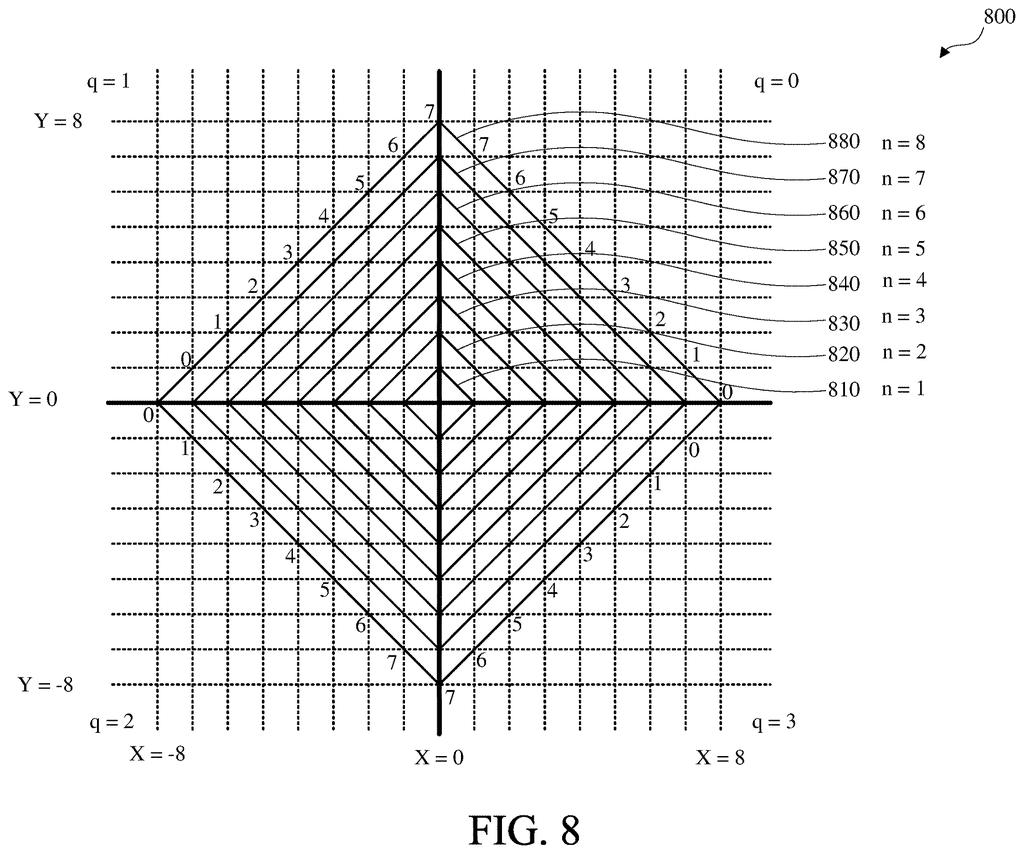
This patent encodes that MVD using a structure called pyramid lattice vector quantization. The core idea: instead of treating the horizontal and vertical components independently, it computes a shell index (the sum of their absolute values) which identifies which 'shell' in a diamond-shaped grid the vector sits on. Each shell contains a fixed number of possible vectors.
From there, the method breaks the encoding into steps:
- Shell index: which diamond ring the vector is on
- Quadrant value: which quarter of that ring (using adaptive entropy coding, meaning common quadrants get shorter codes)
- Distance value: where exactly within the quadrant (using quasi-uniform coding sized to the shell)
Adaptive entropy coding (think of it as giving frequent answers shorter names) and quasi-uniform coding (roughly equal-length codes for choices within a shell) together keep the average bit cost low across typical video content.
What this means for streaming video quality and bandwidth
For anyone who streams, uploads, or stores video, compression efficiency directly translates to cost and quality. A more efficient motion-vector encoding reduces the bits spent on overhead data, freeing bandwidth for actual image detail. At scale, think YouTube, Google Meet, or Android video recording, even small per-frame savings add up fast.
This patent fits into the broader competition around next-generation video codecs like AV1 and its successors, where Google has been an active contributor. Tighter motion-data encoding is one of several areas where codec designers compete for incremental gains, and this method targets one of the more common data structures in any modern video stream.
This is deep codec plumbing, the kind of patent that never shows up in a product announcement but affects every video Google touches. It's not flashy, but Google's investment in codec efficiency is real and ongoing, and this is a technically coherent contribution to that effort.
There are more where this came from
We read every patent application Big Tech publishes and send you the ones worth knowing. Plain English, free, every week.
The drawings
9 drawing sheets from US 2026/0222583 A1 · click any drawing to enlarge


Want this weekly breakdown for a company we don't cover? Patentlyze Pro →
Be the first to weigh in