
Nvidia Patents a Neural Network That Rewrites Sentences by Swapping Grammar
What if an AI could take a frustrated one-star review and automatically rewrite it as a question, a suggestion, or even an optimistic statement — without changing the underlying meaning? That's exactly what Nvidia's latest patent describes.
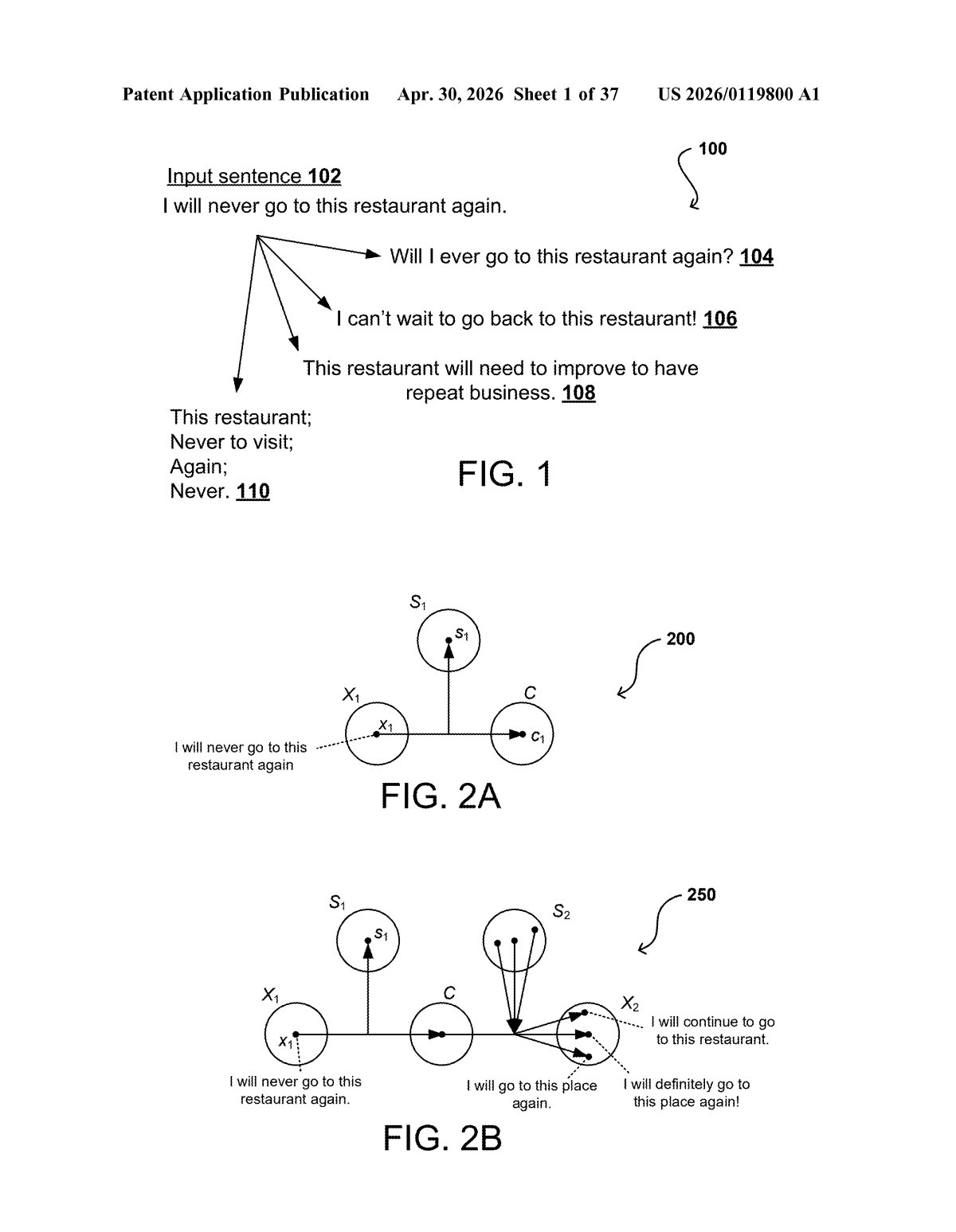
How Nvidia's grammar-transfer network rewrites sentences
Imagine you write, "I will never go to this restaurant again." A grammar transfer system could take that same sentiment and automatically rewrite it as a question ("Will I ever go to this restaurant again?"), a hopeful statement ("I can't wait to go back to this restaurant!"), or a neutral business critique ("This restaurant will need to improve to have repeat business.") — all without you lifting a finger.
That's the core idea in Nvidia's new patent. A neural network learns to separate the meaning of a sentence from its grammatical form, then reassemble the meaning inside a completely different grammatical structure. It's like pouring the same liquid into differently shaped containers.
The patent's own example does all the heavy lifting: one angry sentence becomes four distinct rewrites, each with a different tone and structure, but all circling the same core idea. Nvidia is essentially teaching AI to be a fluent grammatical shape-shifter.
How the neural network maps grammar across sentence forms
The patent describes a system for grammar transfer — the task of translating a sentence into one or more target sentences that share the same semantic content but use a different grammatical construction.
The abstract is deliberately high-level, but the illustrative example reveals the mechanics. Given the input "I will never go to this restaurant again," the system produces outputs like:
- "Will I ever go to this restaurant again?" (interrogative)
- "I can't wait to go back to this restaurant!" (positive exclamation)
- "This restaurant will need to improve to have repeat business." (third-person neutral)
The system appears to decompose the input into semantic content (what is being said) and grammatical structure (how it is being said), then recombine the content with a target grammar pattern. This is analogous to how style transfer works in image generation — separating content from style, then blending them at will.
Because Claim 1 wasn't available, the precise architectural choices — whether this uses an encoder-decoder transformer, a disentangled latent space, or conditioning signals for grammar — remain unclear from the filing alone. The inventors, Ming-Yu Liu and Kevin Lin, are well-known for multimodal generative work at Nvidia Research, which hints at a sophisticated neural approach rather than a rule-based one.
What grammar transfer means for AI-generated text
Grammar transfer has obvious applications in AI content generation: chatbots that can modulate tone on the fly, writing assistants that reframe negative feedback constructively, or data augmentation pipelines that multiply training examples by varying sentence form without altering meaning. For Nvidia, whose AI ambitions span large language models and inference hardware, a patented approach to controlled text rewriting could feed into enterprise NLP products or be used to improve synthetic training data quality.
For you as an end user, the practical payoff could be subtle but real — imagine a customer-service AI that automatically softens an angry complaint before routing it, or a writing tool that suggests five grammatically distinct versions of your draft sentence. The ability to control grammatical structure independently of meaning is a longstanding hard problem in NLP, and any robust solution to it would be genuinely useful.
This is a niche but legitimately interesting NLP research patent — grammar transfer is a real, unsolved problem and the example in the abstract is unusually concrete and illustrative for a patent filing. The absence of Claim 1 makes it hard to assess how broadly Nvidia is trying to protect the idea, which is the one frustrating gap here. Worth watching if you follow NLP or synthetic data generation.
There are more where this came from
We read every patent application Big Tech publishes and send you the ones worth knowing. Plain English, free, every week.
Want this weekly breakdown for a company we don't cover? Patentlyze Pro →