
Samsung published 84 patent applications in one week this month. Google routinely publishes dozens. OpenAI’s entire footprint in our corpus, which tracks every patent the major tech companies have published since we started reading them, is five. Not five this month. Five, total.
That scarcity is the story. AI labs historically publish papers, not patents; the field’s culture treats openness as recruiting currency, and for years OpenAI filed almost nothing while shipping the most-used AI products on earth. So when a company like that starts filing, each application is a deliberate flag planted in ground it considers strategic enough to own. Two of those five flags are planted in silicon.
Two chip filings, one enemy: the memory wall
Modern AI hardware has a dirty secret: the expensive part is not the math, it is the commute. Chips spend enormous time and energy shuttling data between memory and processor, a bottleneck engineers call the memory wall. Both of OpenAI’s hardware filings attack it, from two different directions.
The first describes a custom AI chip that stacks memory directly on top of the processor (US 2026/0161359). Picture a library where the librarian walks half a mile to fetch every book, then picture the books shelved an arm’s length away. Stacking memory physically on top of the processor is the arm’s-length version: the data’s commute shrinks from a cross-chip journey to a vertical hop measured in micrometers.
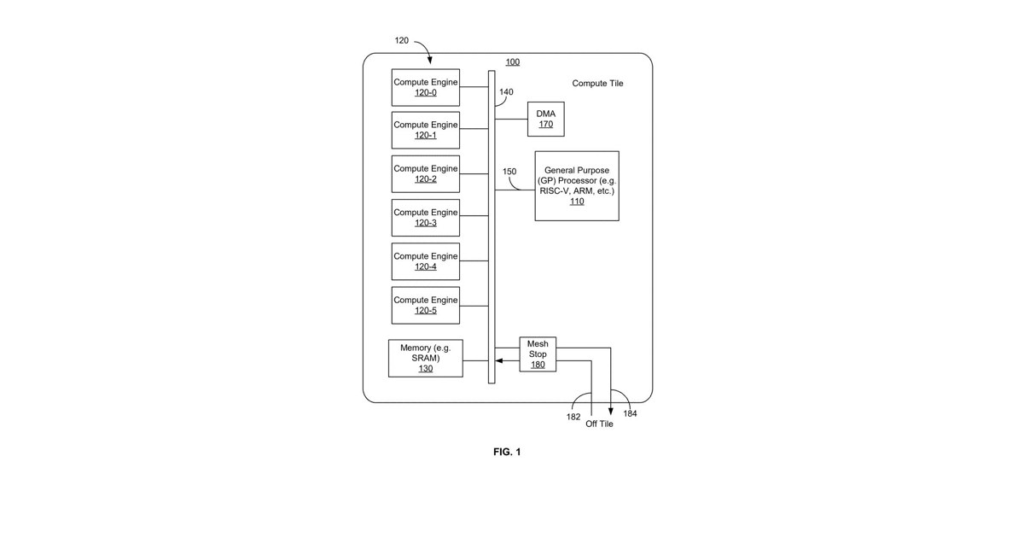
The second goes further. It covers a tiled chip architecture that does AI math inside the memory itself (US 2026/0154218), a grid of compute tiles where much of the math happens inside the memory itself, so the data barely travels at all. If the first filing shortens the commute, the second one moves the office into the librarian’s house.
A company files these when it intends to design hardware, or at minimum wants leverage over the partners who design it for them. OpenAI’s interest in custom silicon has been widely reported for years, and inference compute is one of the largest operating costs in the industry. The filings put engineering specifics behind the business logic: whoever solves the memory wall owns the cost curve of AI, and OpenAI does not intend to rent its position on that curve forever.
The refusal patent is stranger and more interesting
The most unusual filing of the five has nothing to do with hardware. It covers a way to make its AI actually think before refusing a request, a method for making a model reason about its safety policies before saying no, instead of pattern-matching its way to a reflexive refusal. Anyone who has asked a chatbot a reasonable question and received a canned lecture understands the problem. The filing describes the fix the way a thoughtful company would build it: teach the model the reasoning behind the rules, so it can tell a gray area from a violation.
What makes this notable is not the technique. It is that OpenAI considers refusal quality patentable intellectual property. Safety behavior is usually framed as policy, a cost center, the thing you do to keep regulators calm. Filing it as an invention reframes it: how gracefully a model says no is a competitive feature, the same category of asset as a faster chip. Given how many users pick their chatbot based on which one feels less preachy, that framing is probably correct, and OpenAI appears to have decided it first.
The other two filings build the storefront
The remaining pair is quieter plumbing with an obvious commercial shape. One covers forcing AI responses into strict structured formats, so that when a developer asks for a customer record, the model returns clean machine-readable data instead of a friendly paragraph that breaks the app parsing it. The other describes a schema system for connecting outside services to a chatbot, the mechanics of letting an assistant book your table through a restaurant’s system or check your flight through an airline’s, by teaching it what each outside service can do and what it needs to do it safely.
Put those together and you get the app-store layer of ChatGPT: standardized, safe ways for thousands of outside businesses to plug into the assistant. Platforms have a habit of patenting their connective tissue right before they invite the world to build on it. Apple did it around the App Store era, and the parallel here is hard to miss: these two filings are dated from the period when OpenAI was turning ChatGPT from a chatbot into a platform with apps, agents, and checkout flows.
Why an AI lab patents at all
It is worth pausing on the posture change. Patents cut against the research culture OpenAI grew out of, where the currency is the paper and the flex is giving the technique away. Three rational reasons explain the shift. Defense: as AI litigation heats up, a portfolio is a deterrent, and five filings is a portfolio seed. Leverage: if you co-design chips with partners, owning the architecture patents changes who needs whom. And valuation: intellectual property is one of the few assets an AI company can show that does not depreciate the moment a competitor’s model leapfrogs yours.
Whichever mix is true, the selection effect works in our favor as readers. A company that patents everything tells you nothing with each filing. A company that patents five things has told you its priorities almost perfectly: the cost of intelligence, the experience of being refused, and the business of plugging the world into one assistant.
What to watch next
Five filings are a small sample, and patents are options rather than announcements; plenty of patented designs never ship. But sample size cuts both ways. When Samsung published 84 applications in a single June week, no single one of them meant much. When OpenAI publishes anything, it means something, and the next one will tell us which thread it is pulling. Another memory-adjacent chip design would say the custom silicon program is real and iterating. More agent-platform plumbing would say the storefront is the priority. We read every batch the week it publishes, and OpenAI’s sixth filing is now one of the things we read for.
Get lists like this in your inbox
We read every patent application Big Tech publishes and send you the ones worth knowing. Plain English, free, every week.