
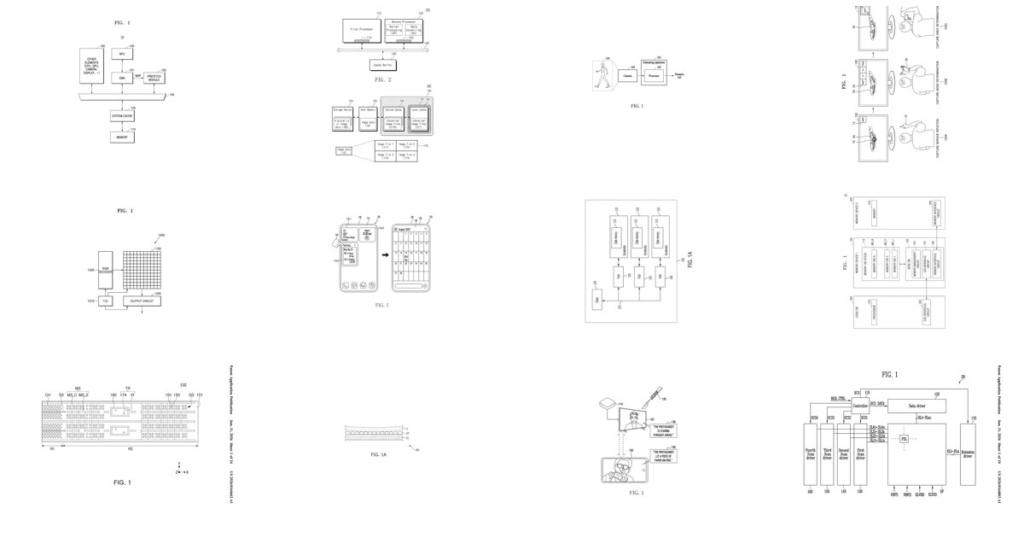
Patent coverage usually works one filing at a time: a folding screen here, a battery trick there. That framing hides the most interesting thing about a company like Samsung, which is the sheer coordinated breadth of what it files. In the batch of applications published on June 11, we counted 84 from Samsung alone. That is one company, one week. Read together, they stop being separate inventions and start describing a single device, plus the constellation of gadgets meant to orbit it.
For scale: 84 filings in a week is more than OpenAI has published in our entire corpus, and it works out to a new invention disclosure every two hours, around the clock, including weekends. Samsung does this most weeks. This particular week just happened to cover so much of one phone’s anatomy that the batch deserves to be read as a blueprint.
The usual caveat applies, and we mean it: patents are options, not promises. Companies file for plenty that never ships. But when one week covers the screen, the camera, the silicon, the radio, the security model, and the accessories, the overlap with a real roadmap gets hard to dismiss. Here is the phone those 84 filings describe, subsystem by subsystem.
The screen: cameras you cannot see and pixels that dim on command
Three filings attack the same goal of an uninterrupted front face. There is a structural fix for the blur that plagues under-display cameras, a display that can capture images through its own screen, and a touch-correction system for the screen region above a hidden camera. Taken together they describe a phone whose camera has fully disappeared behind the display, with the optics, the image processing, and even the touch layer all compensating for the hardware hiding underneath.
Around those sit a display that selectively darkens parts of itself for glare and privacy, a fix for brightness flicker when display speed changes when refresh rates shift, and a drive circuit that keeps OLED brightness consistent to keep brightness stable as panels age. The foldable line gets its own entry through a layered cushion system aimed at foldable screen creases, which we covered in depth alongside what the foldable iPhone patent trail shows.
The camera: optics designed at the nanometer scale
Samsung’s image-sensor division had a loud week. Filings include an image sensor that splits light with nanoscale lenses to sharpen autofocus, deliberately mismatched color filters that trade symmetry for sharper photos, a nano-optical lens layer for future camera sensors, and a dual-storage pixel design that captures more light in less space. There is even a camera chip that shields its own light-capturing circuits, protection for the sensor’s own light-capturing circuits, and a two-layer shield for stacked camera sensor chips for the stacked sensor chips that make modern zoom systems possible.
The pattern worth noticing: almost none of this is about megapixels. The fight moved inside the pixel years ago, into how cleverly each photon gets caught, split, and counted. These filings are what that fight looks like in 2026.
The silicon: memory that thinks and storage that fights back
The densest cluster is in chips and storage, and it has one unifying theme: stop moving data around. Samsung filed for a memory chip that performs its own AI calculations, running calculations inside storage chips themselves, an AI chip that pre-loads data before it is asked for, and memory that shuffles data between fast and slow tiers automatically. A related filing covers a system that sends AI tasks to the fastest available chip, deciding in real time which processor core deserves each AI task. If you want to know why phone chips keep getting faster while batteries stay the same size, this cluster is the answer: the energy cost of AI is mostly the cost of moving data, and Samsung is patenting ways to make the data stay put.
Storage also gets defensive. One filing describes a drive that baits and slows ransomware attacks at the hardware level, hardware that recognizes the access pattern of file-encrypting malware and throttles it mid-attack. Another covers flash that quietly reroutes data around its own defects. A third catches electrical leaks in flash memory before data gets written to a failing cell. Your next phone’s storage may be doing security work no app will ever show you.
The radio: satellites as a feature, not a stunt
Connectivity filings point past the cell tower. Samsung published a system that hands your phone from cell towers to satellites without dropping the connection, an AI that predicts 5G signal decay before it happens, and a way to run 5G inside frequency bands too narrow for current standards. There is also a tighter way to filter antenna options in multi-tower 5G for crowded multi-tower environments. Satellite messaging entered phones as an emergency feature. Filings like these are what it looks like when a company plans to make it ordinary: not a glowing SOS screen but a connection that quietly reroutes through orbit when the towers thin out.
The software wrapped around the hardware
A second cluster describes the intelligence layer that ties the components together. There is a router for voice commands that reads what is on your screen, which decides where your voice command should go based on what is on screen. There is an AI that rewrites its own task plan mid-execution, an AI agent that rewrites its own task plan mid-execution when a step fails. On the creative side, a method that makes AI image generators produce sharper detail than they were built for pushes image generators past the resolution they were trained for, and a way to keep important objects visible at screen edges keeps important objects visible when video gets reframed.
The sleeper of the entire batch sits here too: a way to run AI queries without the server ever seeing your data. That is the kind of privacy engineering that usually only ships after a scandal forces it. Filing it in advance suggests Samsung sees on-device AI and cloud AI converging, and wants an answer ready for the obvious question.
Around the phone: a ring, a watch, and glasses
The accessory filings sketch the rest of the body. There is a two-piece smart ring that shines light through your finger, a health sensor split across two stacked bands. There is a smartwatch that stays on course when GPS fails, which borrows position data from a second wearable when GPS drops. The glasses get smart glasses with displays that physically slide to fit your eyes and a companion trick where the phone’s camera turns hand gestures into controls for them. Around the home, a point-and-pair method for connecting smart-home devices simplifies device setup to a pointing gesture, and an AI that automatically groups devices around you clusters your smart-home devices around whoever is actually in the room.
What the batch tells you that no single filing can
Assemble the week: a foldable with no visible camera and a managed crease, optics sharpened at the nanometer level, silicon that runs AI inside its own memory, storage that defends itself, a connection that fails over to satellites, and a ring, watch, and glasses orbiting the whole thing. Even the odd filings fit the pattern: starting a private chat by photographing someone’s avatar and a screenshot tool that captures moving objects mid-action are the kind of social-layer details a company files when the hardware questions feel settled.
No single application guarantees a feature. Eighty-four of them in one week, pointed at the same device, is as close as patent reading gets to a product brief, and it is a brief no leaker can match for sourcing: every page of it came from Samsung’s own engineers, under oath, with diagrams.
We read every Big Tech patent the week it publishes. The next batch lands Thursday, and if it looks anything like this one, we will assemble that phone too.
Get lists like this in your inbox
We read every patent application Big Tech publishes and send you the ones worth knowing. Plain English, free, every week.