
Samsung Patents a Chip That Automatically Adjusts How Colors Appear at Each Brightness Level
Every time your phone screen dims or brightens, the colors can shift in ways you never quite notice but always feel. Samsung Display is patenting a dedicated chip that recalibrates those color curves for every brightness level, in real time.
What Samsung's brightness-correction chip actually does
Imagine turning your phone down to its lowest nighttime setting and noticing that whites look a little yellow or dark grays seem to flatten out. That color drift happens because screens are typically tuned for one specific brightness level, and everything else is an approximation.
Samsung Display's patent describes a small processor whose only job is to fix that. Whenever the display's brightness changes, the chip looks up how the screen actually behaves at that new level and rebuilds the color correction table from scratch so every shade from black to white stays accurate.
The result is that your screen's colors stay consistent whether you're reading at full outdoor brightness or squinting at it in a dark room. It's the kind of under-the-hood work that doesn't show up in a spec sheet but makes a display feel noticeably more polished.
How the gamma compensator rebuilds its lookup table
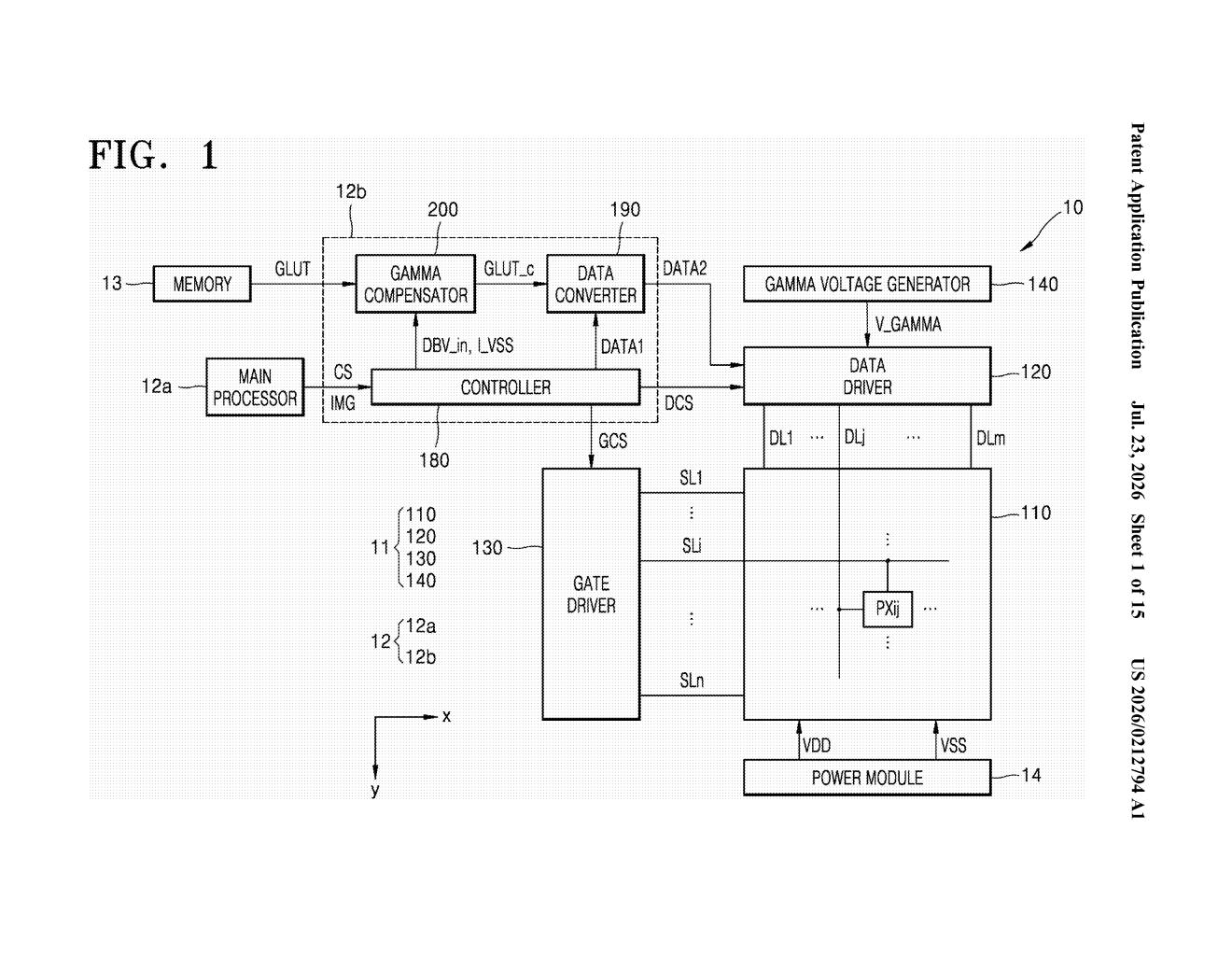
The patent describes an auxiliary processor, a dedicated chip sitting alongside the main display driver, made up of three parts working in sequence.
- Controller: Takes the incoming image data and the current brightness setting (expressed as a digital value) and converts them into a working signal the chip can process.
- Gamma compensator: This is the core of the invention. It starts from a reference gamma look-up table (a pre-set map of how pixel values translate to actual light output at a standard brightness) and then modifies it using two inputs: the set voltage value (the electrical drive level the panel needs at the current brightness) and freshly calculated compensation parameters derived from how the panel actually measures luminance at each gray level for that brightness setting. The output is a new, corrected table built specifically for the current conditions.
- Data converter: Applies that corrected table to the image signal before it reaches the display panel, so every pixel is drawn with the right color and brightness relationship.
The key insight is that rather than storing a separate correction table for every possible brightness level (which would require enormous memory), the chip calculates adjustments on demand from a single reference, using real measured luminance data.
What this means for OLED display accuracy
OLED and AMOLED panels are already known for color accuracy, but that accuracy is usually validated at a specific target brightness. As display makers push toward higher peak brightness and lower minimum brightness (for always-on features and battery savings), the range of operating conditions grows and static calibration tables struggle to keep up. A chip that recalibrates per brightness level is a direct answer to that problem.
For you as a user, this matters most in two places: high-end phones where color fidelity is a selling point, and wearables or tablets with always-on displays that spend most of their life at very low brightness. If Samsung's approach works in practice, it could mean less eye strain from inconsistent colors and more faithful image rendering across the full brightness range.
This is solid, unglamorous display engineering. Samsung Display isn't reinventing screens here, but the problem it's solving, color accuracy across a wide brightness range, is a real and growing one as OLED panels expand their dynamic range. The approach of computing corrections on demand rather than storing massive calibration tables is practical and worth watching as a signal of where premium display silicon is heading.
There are more where this came from
We read every patent application Big Tech publishes and send you the ones worth knowing. Plain English, free, every week.
The drawings
15 drawing sheets from US 2026/0212794 A1 · click any drawing to enlarge


Want this weekly breakdown for a company we don't cover? Patentlyze Pro →
Be the first to weigh in