Samsung
Samsung · Display · Filed Feb 19, 2026 · USPTO published Jul 2, 2026 · Jul 2 release
Samsung Patents Technology That Trims Phone Battery Drain by Slowing Unused Screen Sections
Your phone's screen doesn't redraw everything at the same speed all the time, and Samsung wants to get much more surgical about when to slow it down.
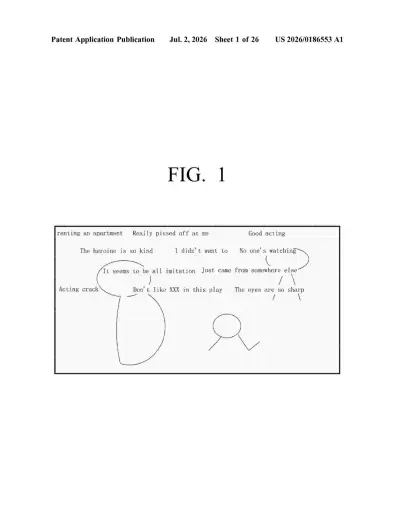
- Publication number
- US 2026/0186553 A1(US20260186553A1)
- Applicant
- Samsung Electronics Co., Ltd.
- Filed · Published
- Feb 19, 2026 · Jul 2, 2026
- Inventors
- Mujun ZHANG, Zhongmin HUANG, Xiaojun QIN, Kaiming CHEN
- Status when we published
- Waiting for an examiner
- Document
- 20 claims
- US classification
- 345/629
- Parent application
- Continuation of PCT/IB2024/060070 (filed Oct 15, 2024)(PCTIB2024060070)
How Samsung's per-layer refresh trick saves battery
Imagine your phone's screen as a stack of transparencies layered on top of each other. One layer might be a scrolling list, another is a static background, and another is a spinning loading icon. Right now, most phones refresh all those layers at the same rate, even when some of them aren't really moving.
Samsung's patent describes a system that looks at each layer individually and decides whether it actually needs a high refresh rate at any given moment. A background that isn't changing? Slow it down. An animation that's actively moving? Keep it fast. The phone uses a small AI model (called a decision tree) to make those calls automatically, without you doing anything.
The result is that your screen burns less power during apps where parts of the display are just sitting still, which adds up to real battery savings over the course of a day.
How the decision tree classifies each app layer
The patent describes a pipeline with a few distinct steps:
- Target selection: The system first identifies which running app is consuming more power than expected, then drills down to find which specific rendering layer inside that app is a candidate for a refresh rate adjustment.
- Layer classification: A decision tree model (a type of AI that works like a flowchart of yes/no questions) analyzes the layer and assigns it a type, for example static content, slow animation, or fast-moving UI element.
- Refresh rate adjustment: If the layer is classified as a "power consumption adjustable" type, its refresh rate is lowered. Layers that need smooth motion are left at their current rate.
- Screen rate calculation: The system then figures out the correct overall screen refresh rate based on all the adjusted layers combined, and the app runs at that new rate.
The patent also notes that a broader AI model could handle the entire process end to end, suggesting Samsung is leaving room to replace the decision tree with a more capable system later.
What this means for Galaxy phone battery life
High refresh rate screens (90Hz, 120Hz) are now standard on mid-range and flagship phones, but they are one of the biggest contributors to battery drain. Most adaptive refresh systems today work at the whole-screen level, dropping the entire display to a lower rate when nothing is moving. Samsung's approach goes one level deeper, targeting individual layers inside a single app, which means savings are possible even when part of the screen is still active.
For Galaxy phone users, this could translate to longer screen-on time in everyday apps like news readers, social feeds, or productivity tools, where plenty of UI layers are static at any given moment. It also positions Samsung to differentiate its display power management without sacrificing the smooth-scrolling experience people actually notice.
Source: US 2026/0186553 A1 at the USPTO (PDF). Full patent text and figures are in the official publication.
Get our take in your Top Stories
Liked this breakdown? Add Patentlyze as a preferred source on Google, and our plain-English take shows up more often in your Top Stories the next time Samsung patent news breaks.
Add Patentlyze on Google
One click.
There are more where this came from
We read the new patents from Big Tech, carmakers and more and send you the ones worth knowing. Plain English, free, every week.
More from Samsung
All 1,662 Samsung patents →
More in Cell phone
All 496 Cell phone patents →
Samsung
Samsung's New Patent Fixes the Tiny Circuits That Keep Screen Pixels at the Wrong Brightness
Samsung
Samsung's New Patent Tries to Shrink the Black Border Around Phone Screens
Samsung
Samsung Display Patents Screen Coating That Cuts Glare Without Leaving Fingerprint Smears
Qualcomm