
Adobe Files Patent for Turning and Moving Objects Inside AI-Generated Images
Ask an AI to turn a car in your picture and it often hands back a different car. Adobe's patent application describes a fix that moves the object in 3D while keeping it recognizable.
What Adobe's 3D-aware image editing actually does
Every time you ask an AI image tool to nudge one thing in a picture, you risk getting a different picture back. Ask it to turn a car a little, and the car can return with new curves and new shading, or the whole scene can drift.
Adobe's patent application describes a way around that. You would drag sliders to move, rotate or resize an object, and the system would work out how far away each part of the object is, move it in 3D, and then redraw the picture. The goal is that the car stays the same car and the beach stays the same beach, with the car shifted to one side and turned about 30 degrees.
It is meant to work on ordinary photos, drawings and scans too, not only AI-made images. In some versions, the result would show up fast enough to feel interactive.
… generating one or more transformed 3D representations of the image by applying a 3D transformation to each of the one or more 3D representations …
Translation: The system rotates or repositions the 3D data extracted from the picture.
How Adobe lifts an image into 3D and back
The system starts with an image and a text description of it. It builds on a diffusion model (an AI that makes pictures by gradually cleaning up random noise). First it "inverts" the picture: it works backward to recover the starting noise and a blank-text setting that would make the model recreate the same image.
Then it regenerates the image while recording the model's activations (snapshots of what the model's internal layers are computing as it draws). A depth map (a map of how far each point is from the camera) lets the system lift those snapshots into 3D coordinates. The object is found with detection and segmentation models, then rotated, scaled or moved, and the result is flattened back into the image's 2D layout.
Those edited snapshots steer a final drawing pass:
- An object guidance term pulls the object's region toward the edited snapshots.
- A background guidance term keeps the rest of the scene's overall look close to the original.
- A second depth map, built by removing the object and placing it at its new spot, tells the model the new layout.
The filing says this can use off-the-shelf models with no extra training, and the model itself fills in any gaps the move uncovers.
Techniques for implementing 3D-aware transformations using a diffusion model are disclosed.
Translation: The filing details methods for editing flat AI pictures using three-dimensional awareness.
What this means for editing AI-generated images
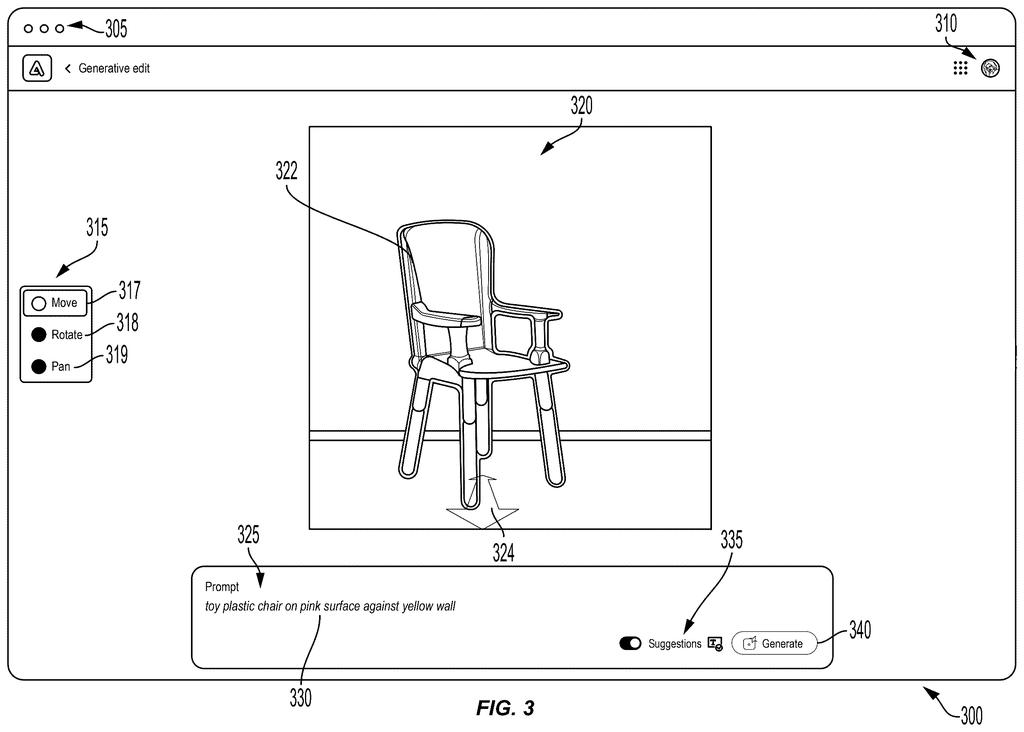
If you edit AI-generated art or photos, the pain point is familiar: you change one thing and the whole picture drifts. A tool built on this filing could let you slide a chair across a room or turn a car a few degrees with simple controls, while the object keeps its shape, shading and identity. The filing's own example interface has sliders and drag arrows for exactly that.
For Adobe, the appeal is working with existing AI models as they come. The filing says it needs no extra training or special data, and it lists image generators from several outside companies as usable options. It also says the edit could appear in near-real-time in some versions, which would make dragging an object feel like using any other editing tool.
Adobe's 39th filing we've tracked for controllable AI images since May builds on earlier applications like posing a person by description and fixing garbled text in images.
The big cost here is accuracy. The system never builds a true 3D model of the scene. It guesses how far away things are from a flat picture, and every edit sits on top of that guess. The filing itself admits that big rotations get shaky, because turning a car far enough reveals sides the picture never showed.
What Adobe gets in return is simplicity. There is no retraining of the AI and no rebuilding of the scene, and the model fills gaps with its own best guess. For a quick nudge or a modest turn, that looks like a fair trade.
Expect it to work best on small moves. Spin an object a full half-turn and you are asking the AI to invent a back end it has never seen.
Get our take in your Top Stories
Liked this breakdown? Add Patentlyze as a preferred source on Google, and our plain-English take shows up more often in your Top Stories the next time Adobe patent news breaks.
There are more where this came from
We read every patent application Big Tech publishes and send you the ones worth knowing. Plain English, free, every week.
The drawings
7 drawing sheets from US 2026/0350951 A1 · click any drawing to enlarge


Want this weekly breakdown for a company we don't cover? Patentlyze Pro →
Be the first to weigh in