
Adobe Patents a Way to Turn a Text Description Into a Walkable 3D World
Type a description of a place, and Adobe's patented system would build a fully navigable 3D world around you. No modeling software, no 3D artists required.
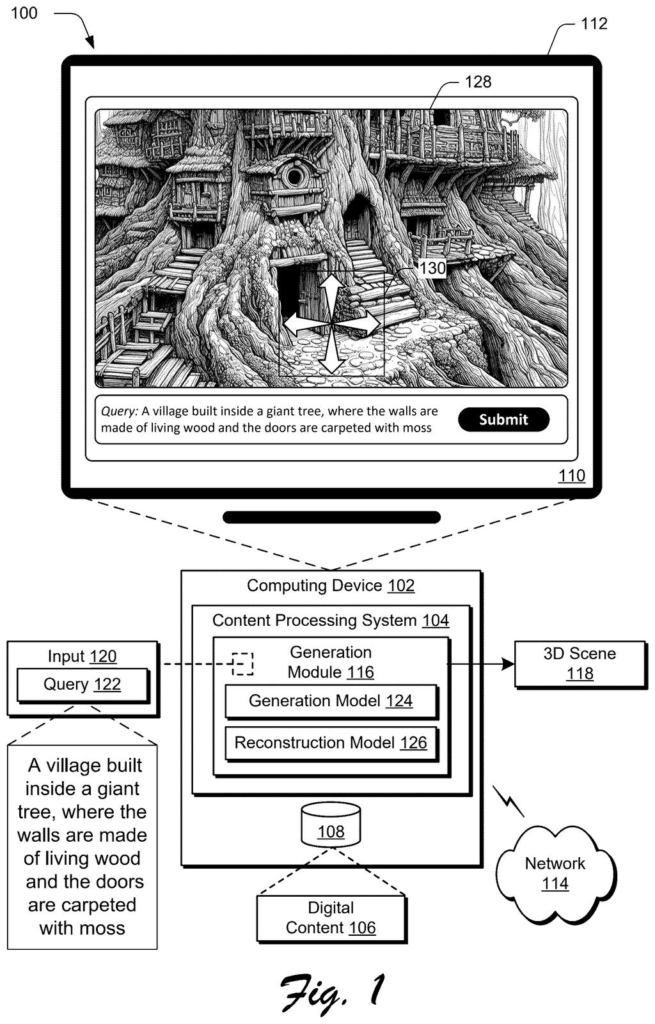
What Adobe's text-to-3D scene generator actually does
Imagine typing "a foggy Japanese garden at dusk" and getting back a fully walkable 3D environment you can explore from any direction. That's the core idea in this Adobe patent.
Right now, building that kind of interactive 3D scene takes teams of artists and hours of work. Adobe's approach would let a machine learning model read your text description, build an intermediate "spherical" picture of what the space should look like from all directions, and then expand that into a navigable 3D environment.
The result is something you can move through and look around in, not just a static image. Think of it as the difference between a photograph of a room and actually being able to walk into it.
receiving, by a processing device, a text-based query that specifies a visual aspect to be included in a three-dimensional scene; generating, by processing the text-based query using one or more machine learning models, a spherical representation of the three-dimensional scene …
Translation: AI takes your text prompt and turns it into a wrap around visual blueprint.
How Adobe converts a text prompt into a navigable space
The system works in two main stages, both driven by machine learning models.
Stage one: spherical representation. When you submit a text prompt (say, "a sunlit cathedral interior"), the model generates what the patent calls a spherical representation of the scene. Think of this like placing a camera at the center of a room and photographing every direction at once, producing a complete 360-degree picture of the space before any 3D geometry exists.
Stage two: scene construction. That spherical picture is then fed back into the machine learning pipeline, which uses it as a blueprint to construct actual traversable 3D geometry. The word traversable here just means you can navigate through it, moving forward, backward, and sideways, rather than simply rotating a static object.
The output slots into a three-dimensional environment that supports viewing from multiple perspectives, so the scene holds together visually no matter where you position yourself inside it.
The patent does not describe a specific model architecture, so the approach is written to be model-agnostic, meaning Adobe could swap in different AI systems as the underlying technology improves.
The traversable scene is output as part of a three-dimensional environment that allows navigation and viewing from multiple perspectives.
Translation: The final result is a virtual world you can explore from all angles.
What this means for 3D creators and virtual environments
For designers, game developers, and filmmakers, building a convincing 3D environment from scratch is one of the most time-consuming parts of any project. A tool that generates a navigable scene from a text prompt could compress that early concepting phase from days to minutes, letting creators focus on refinement rather than construction.
The broader implication is for virtual and augmented reality. As headsets become more common, there is growing demand for 3D environments that can be generated on demand, personalized, or procedurally varied. Adobe's run of generative-media filings suggests the company is positioning its creative tools for a future where AI does more of the heavy lifting in content creation.
Adobe's 24th filing we've tracked on controllable AI images since May adds to earlier work, like one that fixes garbled text and one using cursor hover for prompts.
The path from this patent to a shipping product is longer than it might look. The claim covers the high-level pipeline, but the hard engineering work is in the details: getting the spherical representation to be geometrically consistent, avoiding the warped or blurry geometry that plagues today's text-to-3D tools, and making the navigation feel smooth rather than disorienting.
Adobe already ships generative image and video features inside products like Firefly, so the distribution channel exists. The missing piece is whether the output quality is high enough that a working designer would trust it over building a scene by hand, and this patent gives no evidence on that front.
If the underlying models can handle geometric consistency well, this could fit naturally into Adobe's existing Substance or Firefly ecosystem. If they cannot, the feature risks becoming a novelty demo rather than a daily tool.
There are more where this came from
We read every patent application Big Tech publishes and send you the ones worth knowing. Plain English, free, every week.
The drawings
9 drawing sheets from US 2026/0301328 A1 · click any drawing to enlarge


Want this weekly breakdown for a company we don't cover? Patentlyze Pro →
Be the first to weigh in