
Nvidia Patents a Method to Build 3D Objects From Smaller, Faster Data Files
Building a 3D object from scratch is slow and storage-hungry. Nvidia's new patent describes a system that compresses a 3D shape into stacked 2D snapshots, then trains an AI to reconstruct full objects from that compact data.
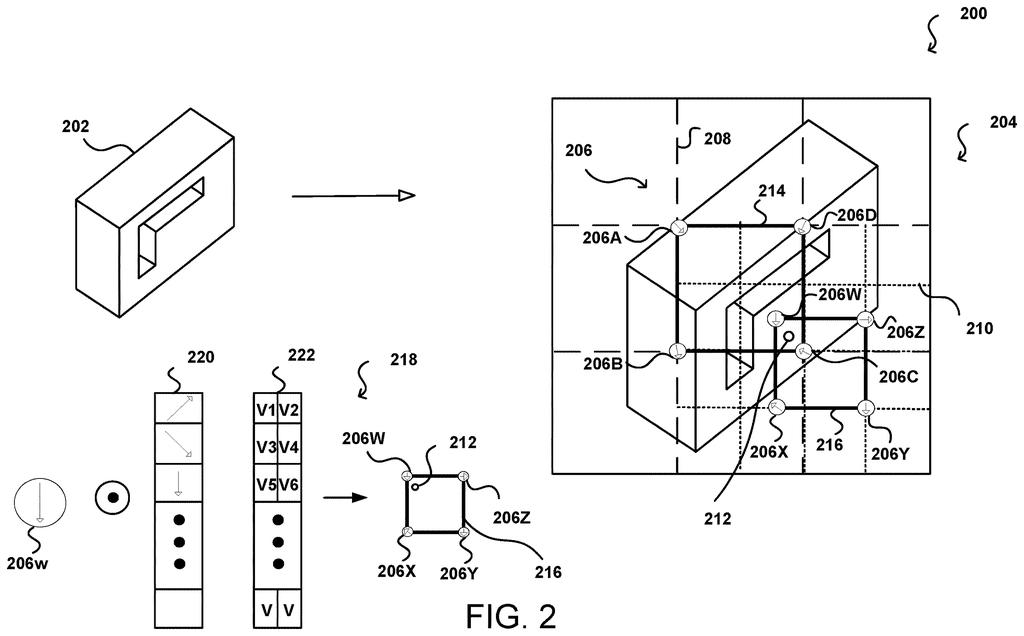
How Nvidia's AI sketches a 3D shape from a grid of data
Creating detailed 3D objects for games, movies, or design software today requires storing enormous amounts of geometric data, and the process of generating new objects from scratch is painfully slow. Nvidia's patent describes a way to squeeze that information down into something much smaller and hand it to an AI.
The idea is to take a 3D shape and represent it as a stack of flat, 2D grids at different levels of detail, from a rough outline to fine surface features. Each grid holds a summary of the shape at that zoom level. An AI model learns to read those stacked grids and piece the full 3D form back together.
The result is that you can store or transmit a compressed description of a 3D object, then ask an AI to produce the full thing on demand. That could mean faster generation of 3D assets in creative tools or game engines, without needing to keep massive raw geometry files on disk.
… encode a three-dimensional (3D) object as a plurality of two-dimensional (2D) projections over a plurality of levels of detail, wherein each 2D projection encodes 3D coordinates of the 3D object at a level of detail …
Translation: It breaks 3D shapes down into flat 2D layers across multiple zoom levels.
How the hash table and layered projections reconstruct 3D forms
The patent describes a pipeline for encoding and regenerating 3D shapes using a technique called neural implicit representations (rather than storing every polygon, the AI learns a mathematical function that can recreate the surface at any resolution).
The encoding step converts a 3D object into a set of 2D projections across multiple levels of detail. Think of it like photographing a sculpture from directly above, from the front, and from the side, then doing that at several different zoom levels. Each projection is stored as a grid of learned values called embeddings (numbers that encode meaningful features, similar to how word-embedding models encode meaning in language AI).
A hash table is used to store and look up these embeddings efficiently. Hash tables are a standard data-structure trick: instead of searching through everything, a formula (the hash function) points you straight to where a value lives. Here, the hash function is itself learned as part of training, so the AI figures out the best way to organize and retrieve shape information.
A decoder network then takes any point in 3D space, looks up the relevant embeddings from the nearby grid cells (filling gaps by interpolating between neighbors), and predicts whether that point is inside or outside the object's surface. Repeat that across many points and you reconstruct the full shape.
A 3D shape for an object may be encoded to a multi-layered grid and represented by a series of embeddings, where given point within the grid May be interpolated based on the embeddings for a given layer …
Translation: Objects are stored in a stacked grid format so computers can fill in the missing details.
What faster 3D generation means for games and design tools
For anyone who works with or plays games built on real-time 3D, this kind of technology is about reducing the time and storage it takes to get a high-quality object onto your screen. If an AI can reconstruct a detailed 3D asset from a compact compressed description, studios can store more assets in less space, and generative tools can produce new objects faster without expensive geometry processing.
Nvidia's long bet on AI-driven 3D content fits a pattern where the same hardware company selling GPUs to game studios also wants to own the software pipeline those studios depend on. A patent like this sits in that stack, potentially feeding into tools like Nvidia Omniverse that let designers create and simulate 3D environments.
Nvidia's 23rd filing we've tracked on our text-to-3D character work since May builds on earlier applications covering poseable 3D bodies and animating faces from audio.
The practical upside, if this works, is speed and variety: a design tool or game that can conjure a believable 3D object in a second rather than a minute, without the underlying file growing to an unmanageable size.
For most people, this would arrive invisibly. You would not see a setting change or a new button. You would simply notice that a generative tool stopped making you wait, or that it offered more convincing options without crashing your machine.
That is the honest shape of this work. It is foundational plumbing, and plumbing only matters when it fails or when someone finally fixes it.
There are more where this came from
We read every patent application Big Tech publishes and send you the ones worth knowing. Plain English, free, every week.
The drawings
19 drawing sheets from US 2026/0301322 A1 · click any drawing to enlarge


Want this weekly breakdown for a company we don't cover? Patentlyze Pro →
Be the first to weigh in