
Intel Patents an LLM That Scores Its Own Confidence Before Writing Chip Code
Getting an AI to write code is one thing — getting it to flag when it's probably wrong is another. Intel's new patent tackles exactly that problem, but for chip design, where a bad guess can mean months of wasted silicon.
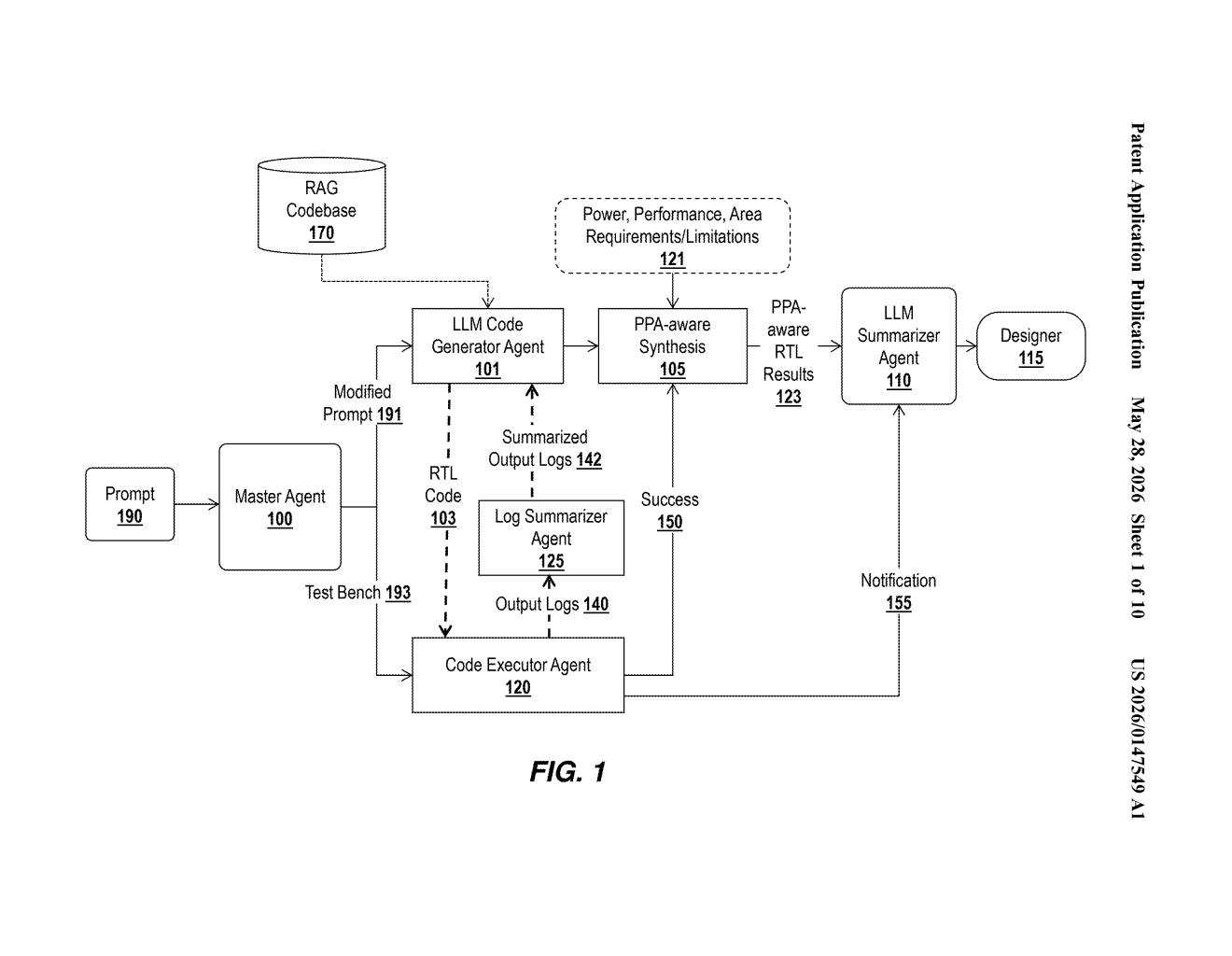
What Intel's uncertainty-aware RTL generator actually does
Imagine asking an AI to draft a blueprint for a new room in your house — and instead of handing you one plan, it gives you a dozen variations, then tells you which ones it's confident about and which ones it's basically guessing on. Intel's patent applies that same idea to designing computer chips.
Chip designers use a language called RTL (Register-Transfer Level) to describe how digital circuits should behave before they're built. Writing good RTL is painstaking work. Intel's system lets an LLM generate many candidate RTL code blocks at once, then groups the similar ones together and flags clusters where the AI's outputs are inconsistent — a signal that it doesn't really know what it's doing in that area.
The upshot: instead of blindly trusting whatever the AI spits out, the system can automatically decide not to proceed with synthesis when uncertainty is too high. That's a meaningful safety net in an industry where a flawed chip design costs millions of dollars to fix.
How the clustering and uncertainty pipeline filters RTL code
The patent describes a pipeline with several distinct stages. First, an LLM code generator produces multiple candidate RTL (Register-Transfer Level) code blocks in response to a single design prompt. RTL is the hardware description language — think Verilog or VHDL — used to specify digital logic before it's compiled into actual transistor layouts.
Once those candidates exist, the system measures two kinds of similarity between every pair of blocks:
- Syntactical similarity — are the two blocks structurally alike at the token or grammar level?
- Semantic similarity — do they describe the same functional behavior, even if written differently?
Those similarity scores are used to cluster the candidates into groups (think k-means or hierarchical clustering — algorithms that bin similar items together). The diversity within a cluster becomes the uncertainty signal: if the LLM generated a tight, consistent cluster, it's probably confident; if the cluster is spread out and noisy, it's probably not.
Finally, the system uses those uncertainty estimates to gate synthesis — the expensive step of turning RTL into a physical gate-level netlist. High uncertainty can trigger a loop back to the LLM, a request for human review, or an outright halt. The patent also references a PPA-aware (Power, Performance, Area) synthesis step, suggesting the system weighs chip efficiency targets alongside uncertainty when picking which block to commit to.
What this means for AI-assisted chip design workflows
Chip design is one of the most expensive, error-intolerant engineering domains on the planet. If AI tools are going to meaningfully accelerate it, they can't just generate plausible-looking code — they need to know when to stop and raise a flag. This patent describes a principled way to extract a confidence signal from an LLM without requiring it to explicitly say 'I don't know,' which current models are notoriously bad at doing honestly.
For Intel specifically, this fits neatly into a broader push to automate parts of its chip design process at a time when the company is under significant competitive pressure from TSMC-fabbed rivals. If this kind of uncertainty-gating actually works in practice, it could reduce the number of costly re-spins — tape-out corrections — that stem from subtle RTL bugs introduced during AI-assisted design.
This is genuinely interesting infrastructure work, not a flashy demo. The core insight — use output diversity across an ensemble as a proxy for model uncertainty — is a well-established technique in Bayesian deep learning, but applying it rigorously to RTL generation and tying it to a synthesis go/no-go gate is a practical, valuable contribution. Intel isn't reinventing the wheel here; it's putting the wheel somewhere useful.
Get our take in your Top Stories
Liked this breakdown? Add Patentlyze as a preferred source on Google, and our plain-English take shows up more often in your Top Stories the next time Intel patent news breaks.
There are more where this came from
We read every patent application Big Tech publishes and send you the ones worth knowing. Plain English, free, every week.
Want this weekly breakdown for a company we don't cover? Patentlyze Pro →