
Disney Patent Covers Animated Robots That Continuously Rethink Their Own Movement Goals
Getting an animated robot to move in a way that looks natural is harder than it sounds, because every movement involves dozens of competing priorities. Disney's latest patent describes an AI that doesn't just pick one motion strategy and stick with it, but constantly re-evaluates and rebalances those priorities in real time.
How Disney's AI keeps robot characters moving naturally
Imagine a theme park robot that needs to wave, keep its balance, avoid bumping into guests, and still look expressive, all at the same time. These goals can pull against each other: a dramatic wave might throw off its balance. Normally, an engineer would set fixed rules about which goal matters most. Disney's patent describes a different approach.
Instead of fixed rules, an AI watches the robot's current pose and situation, then decides on the fly how much weight to give each goal at that exact moment. A split second later, it checks the new pose and adjusts those weights again. The result is movement that adapts to whatever is happening, rather than following a rigid script.
The system applies to any jointed, moving object, not just humanoid robots. Think articulated arms, puppet characters, or mechanical creatures. Disney is essentially teaching its machines to prioritize intelligently, the way a skilled performer naturally shifts focus mid-movement.
How the model reweights motion goals at every step
The patent describes a multi-objective reinforcement learning system, a type of AI training where the agent is rewarded for multiple different goals simultaneously, rather than a single score. The trick is that different goals often conflict, and you need a way to balance them.
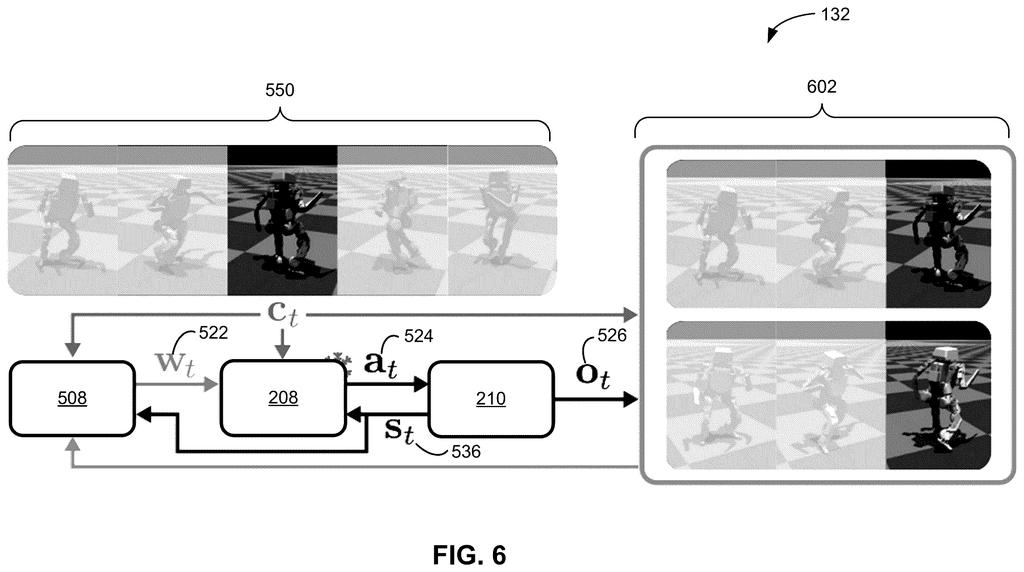
Disney's approach adds a second layer on top of the usual motion-control AI. At each moment in time, the system:
- Reads the current physical state of the object (joint angles, velocity, position, etc.)
- Runs a machine learning model that outputs a set of weights, one for each reward signal (balance, expressiveness, speed, etc.)
- Uses those weights to decide what movement to make next
- Reads the new state that results, and runs the model again to get a fresh set of weights
The key insight is that the weights themselves are dynamic outputs of the AI, not static parameters set by a human. The model learns when to prioritize balance over style, or speed over precision, based on context. This is sometimes called conditional weighting in the research literature.
The patent covers any "articulated object" with linked, jointed parts, a broad category that includes animatronic characters, legged robots, and mechanical puppets.
What this means for Disney's physical animatronics and robots
Disney operates some of the most complex animatronic and robotic characters in the world, from the free-roaming Groot robot to full-scale Audio-Animatronic figures. Getting those machines to move in ways that feel alive rather than mechanical is an ongoing engineering challenge. A system that automatically rebalances movement priorities could mean characters that handle unexpected situations, like a guest bumping into them, without locking up or falling back on a canned response.
More broadly, this kind of adaptive motion control is a real problem across robotics. Fixed reward weightings are one of the main reasons trained robots behave well in the lab but awkwardly in the real world. If Disney's approach works in practice, it's the kind of technique that could show up in academic robotics as quickly as it shows up on a theme park floor.
This is a genuinely interesting robotics patent, not just a theme park curiosity. The idea of using AI to continuously renegotiate motion priorities, rather than baking them in at training time, addresses a real limitation in how motion-control AI is built today. Whether it ships in a Disney park or gets published as research first, it's worth tracking.
There are more where this came from
We read every patent application Big Tech publishes and send you the ones worth knowing. Plain English, free, every week.
The drawings
7 drawing sheets from US 2026/0212200 A1 · click any drawing to enlarge


Want this weekly breakdown for a company we don't cover? Patentlyze Pro →