
Adobe Patents a Neural Network System for Cleaner Subject-Selection Masks
Anyone who has tried to cut out a subject with multiple disconnected parts — like a person holding a fork — knows that auto-selection tools often blur the fine details on smaller regions. Adobe's new patent targets exactly that problem.
What Adobe's split-and-refine masking actually does
Imagine you're in Photoshop and you use Select Subject to isolate a person sitting at a table. The tool draws a rough outline — a mask — around them, but it also needs to capture their hand, a fork they're holding, and maybe a stray lock of hair. All of those are separate, disconnected blobs in the mask, and the AI often handles them with a one-size-fits-all approach that loses edge detail on the smaller pieces.
Adobe's patent describes a smarter pipeline. Instead of refining the whole messy mask at once, the system finds each disconnected region, crops it into its own little bounding box, and sends each chunk to a neural network for individual cleanup. The refined pieces are then stitched back together into a single polished mask.
The practical upside is that smaller, harder-to-refine regions — fingertips, wisps of hair, thin straps — get the same focused attention as the main body of the subject, rather than being overwhelmed by the larger region around them.
How Adobe's neural net refines each region mask separately
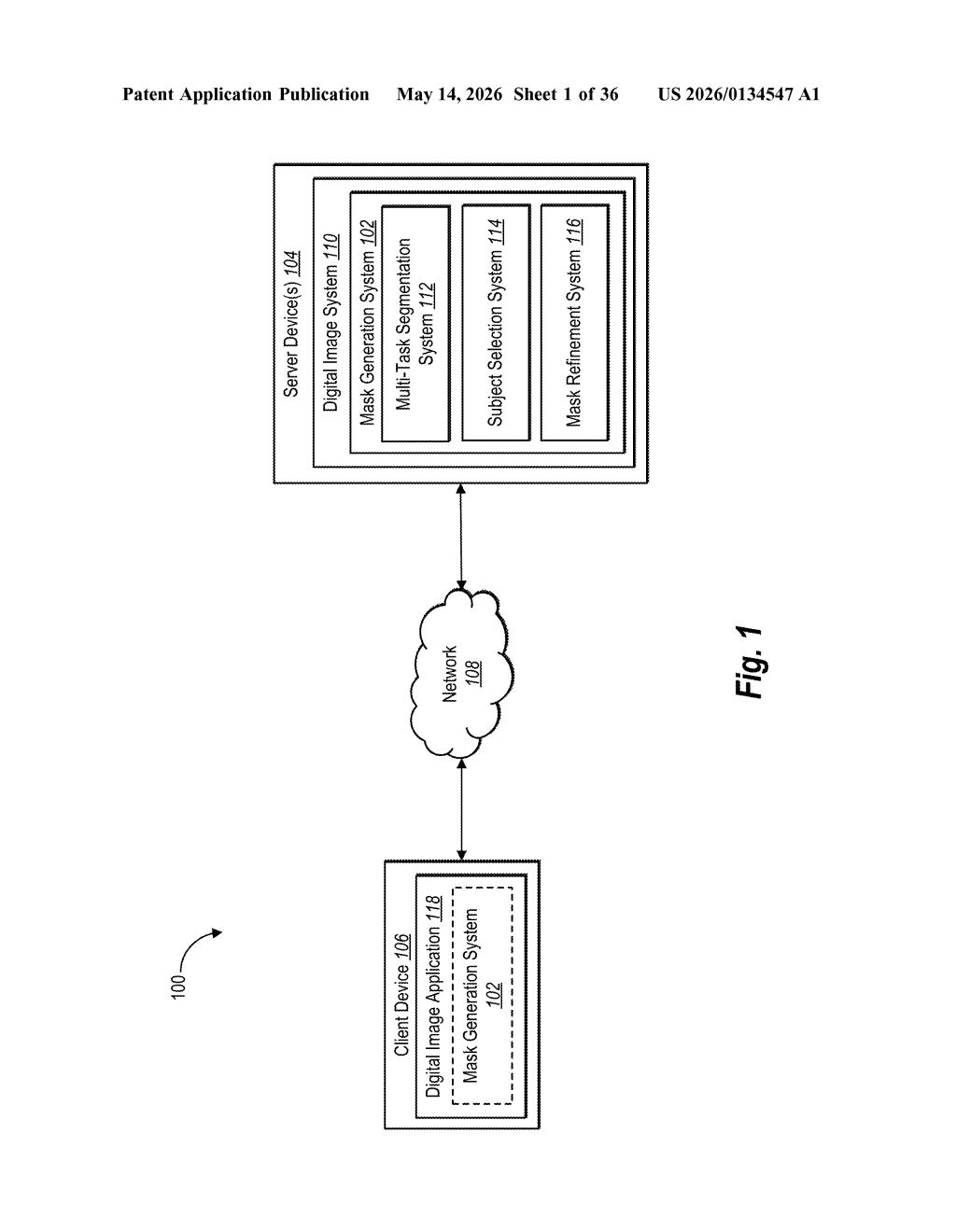
The patent describes a four-step pipeline for mask refinement inside what Adobe calls a Subject Selection System.
- Step 1 — Find the blobs: The system analyzes a base mask (the rough initial selection) and identifies all separate connected regions — meaning distinct, non-touching islands of selected pixels. Each one gets its own bounding box.
- Step 2 — Crop into region masks: Each bounding box is used to extract a separate region mask — essentially a zoomed-in crop that isolates just that one blob, giving the refinement model a clean, focused view.
- Step 3 — Neural network refinement: A mask refinement neural network processes each region mask independently. By working on one region at a time, the model can sharpen edges and recover fine details without being distracted by the spatial relationships between distant parts of the image.
- Step 4 — Recombine: All the individually refined region masks are merged back into a single final mask that covers the full image.
The key insight is decomposition: global mask refinement struggles when a model must simultaneously handle a large torso and a tiny ring on a finger. Splitting the problem makes each sub-task tractable. The recombination step ensures the separate regions are composited back into a coherent whole without seams or misalignment.
What this means for Photoshop's Select Subject tool
For everyday Photoshop and Express users, better subject selection means less time spent manually painting corrections into masks — especially on complex subjects like people with flyaway hair, glasses, or objects they're holding. The Select Subject and Remove Background tools are among Adobe's most-used AI features, so incremental accuracy gains here touch millions of workflows.
From a product strategy angle, this patent fits neatly into Adobe's broader push to make Firefly-powered generative tools — like Generative Fill — less dependent on perfect user-drawn selections. If the system can automatically produce cleaner masks on disconnected regions, the downstream generative results get more accurate without the user having to do anything extra.
This is a focused, practical patent rather than a splashy AI demo — it's the kind of unglamorous plumbing that actually makes creative tools feel magical. The decompose-refine-recombine approach is sensible computer vision engineering, and it addresses a real, well-known pain point in automated masking. Worth tracking as a signal of where Adobe is investing in its selection toolchain.
There are more where this came from
We read every patent application Big Tech publishes and send you the ones worth knowing. Plain English, free, every week.
Want this weekly breakdown for a company we don't cover? Patentlyze Pro →