
IBM Files Patent for an AI Helper That Answers Questions From Databases and Outside Apps
Ask an AI one question and IBM wants it to pull the answer from a company database and a live outside service at the same time. The trick is making the outside service look like just another table of data.
What IBM's database-plus-apps AI actually does
A plant manager types a question into a company chatbot: why did Pump 7 shut down last night, and how hot is it right now? The answer lives in two places. The shutdown history sits in a database, and the live temperature sits behind a separate service that only another program can ask.
Most AI helpers are built to handle one kind of source or the other. IBM's patent application describes a layer that sits between you and the AI and lets it use both at once. The AI writes its request in the standard database language and treats the live service as if it were just another table of data.
Then IBM's software swaps that pretend table for a real call to the outside service, checks the request for mistakes, and runs it. You get one answer assembled from both places.
… intercepting, by a database management application, a user input query transmitted to a target system, the user input query written in a natural language format …
Translation: The system catches everyday typing before it reaches the main software.
How IBM rewrites a question into a database call
The system starts with an integrated database built from mixed sources: ordinary database tables, outside services reached through an API (a standard way for one program to ask another for data), and even sets of documents. A map of all these sources is turned into one relational layout where every source looks like a table. The outside services appear as virtual tables, stand-ins that act like tables but are not stored in the database.
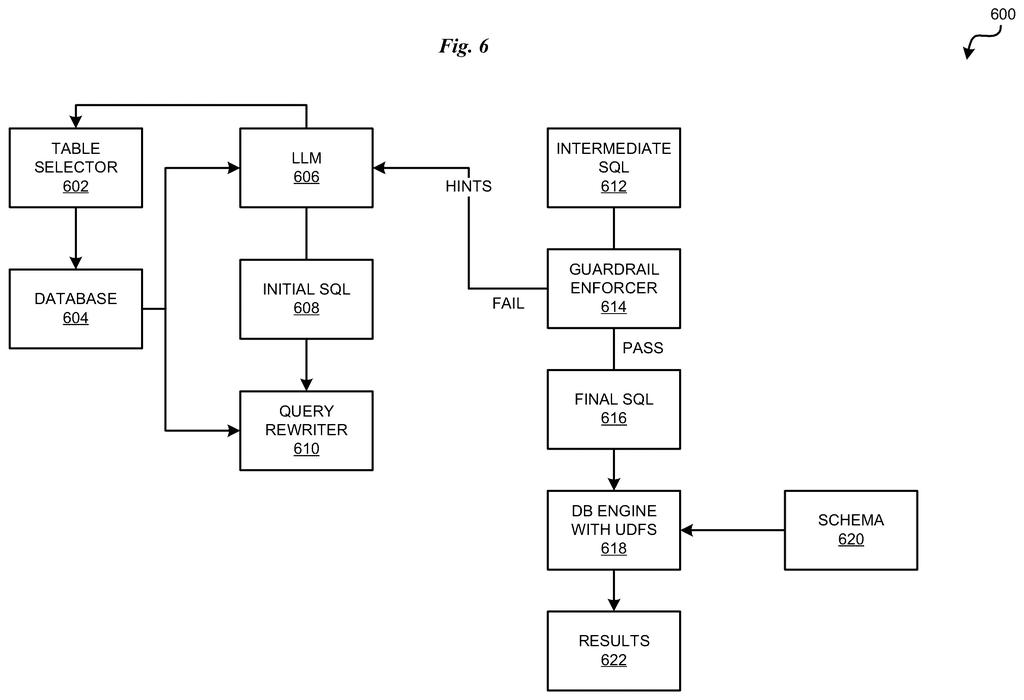
When you ask a question in plain language, the software intercepts it. A language model first picks which tables matter (the filing names Mixtral 8x7b as one option), then writes a query in SQL, the standard language databases understand. At this point the AI sees everything as a table.
Next comes the step the claims center on. A query rewriter swaps each virtual table name for a user-defined function (UDF, a small reusable program stored in the database) that wraps the real API request. In the filing's example, a table called "performance" becomes "performance_udf". The software also reads the query to work out which values to hand to that function.
A guardrail module checks the query for problems such as made-up column names or invalid API settings, and sends hints back to the AI so it can fix them. The final query runs, the result is checked, and one answer goes back to you.
… transforms, by a natural language model within the database management application, the user input query into a structured query based on a relational schema …
Translation: An AI translates normal speech into commands databases can understand.
Why approval matters for IBM's business AI
If you use a company chatbot at work, the practical hope is fewer half-answers. A question like "what happened on this machine last week and what is it doing now" needs stored records and live readings together, and the filing says existing AI tools are usually aimed at just one type of source. This design gives one AI a single way to reach both, with checks before anything runs.
The patent office has approved this application, and once IBM pays the final fee it should be issued as a granted patent. The filing uses industrial and sensor-heavy settings as its main example, so the likeliest audience is businesses wiring AI into the systems they already have.
IBM's 51st filing we've tracked in our Enterprise AI coverage since May adds to a run that includes one on comment filter safety and one on building models by typing.
If you have ever asked a work chatbot a question and gotten a confident answer that ignored half the facts, this patent targets that failure. You would notice it as answers that account for both the stored history and the live numbers, with no need to ask twice in two different tools.
The guardrail step matters most to you in practice. It catches invented column names and bad API settings before the query runs, so mistakes get fixed behind the scenes before they reach your screen.
Most people will never see any of this, and the filing offers no speed or accuracy figures. As plumbing for business AI it is sensible and clearly described. Its value to you depends on whether your employer's data is spread across many systems, and at large companies it usually is.
Get our take in your Top Stories
Liked this breakdown? Add Patentlyze as a preferred source on Google, and our plain-English take shows up more often in your Top Stories the next time IBM patent news breaks.
There are more where this came from
We read every patent application Big Tech publishes and send you the ones worth knowing. Plain English, free, every week.
The drawings
7 drawing sheets from US 2026/0329851 A1 · click any drawing to enlarge


Want this weekly breakdown for a company we don't cover? Patentlyze Pro →
Be the first to weigh in