
AMD Patents a Two-Step Data Conversion That Keeps AI Calculations More Precise
Every time an AI chip converts a number from one format to another, tiny rounding errors can sneak in and compound. AMD's new patent describes a two-step conversion process designed to guarantee only one rounding error ever occurs, no matter how many format changes a value goes through.
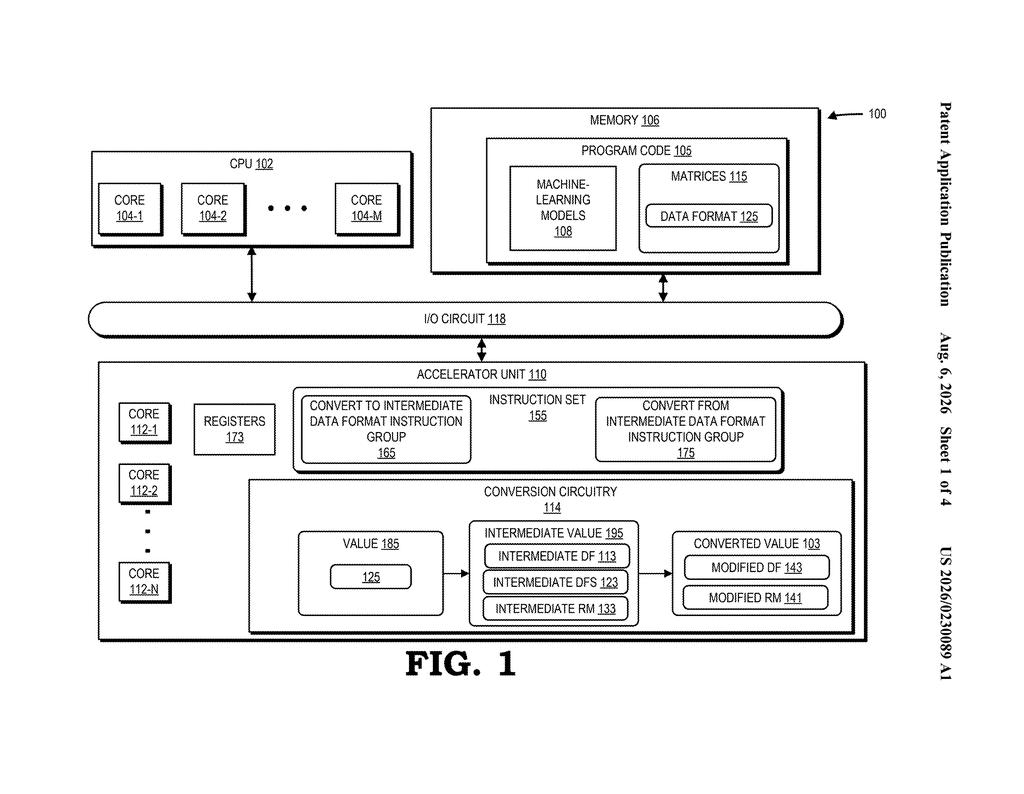
What AMD's number-format trick does for AI accuracy
Imagine you're converting a measurement from inches to centimeters and then rounding to the nearest millimeter. If you round at the wrong step, your final number ends up slightly off, and in a long chain of calculations, those small errors stack up. AI chips deal with this constantly because they shuffle numbers between different formats to balance speed and precision.
AMD's patent describes a smarter conversion path that routes numbers through a carefully chosen middle format before landing in the final one. The key rule: the chip only rounds once, at a controlled point in the process. That single rounding guarantee keeps errors from multiplying across operations.
This matters most for tensor operations, the core math behind AI models. Cleaner number handling at this level can mean more accurate model outputs without needing more memory or slower, higher-precision formats across the board.
converting the value from the first data format to an intermediate data format in an intermediate data format style; and converting the value from the intermediate data format in the intermediate data format style to the second data format in the first data format style; …
Translation: The chip changes data formats in two separate steps using a middle step to protect the math.
How the intermediate format limits conversion errors
The patent describes a system where an accelerator unit (AMD's term for a dedicated AI or compute chip) needs to convert a numerical value from one data format to another. Different formats trade off between range (how big a number can be) and precision (how many decimal places it can hold).
Instead of converting directly and rounding once at the end, or rounding multiple times during an ad-hoc conversion, the system uses a two-instruction approach:
- A first instruction converts the value into a controlled intermediate data format, chosen specifically to avoid precision loss at that stage.
- The value is then rounded according to a defined intermediate rounding mode (a rule for how to handle fractions, like always rounding toward zero).
- A second instruction converts from the intermediate format to the final target format, applying a final modified rounding mode.
The claim's core guarantee is that the entire two-step journey introduces only a single rounding error, equivalent to what a perfect direct conversion would produce. The converted value is then ready for tensor operations, the matrix and vector math that powers neural networks.
… such that converting the value from the initial data format to the modified data format introduces a single rounding error.
Translation: This careful process creates only one rounding mistake instead of several adding up.
What this means for AI chip precision
AI accelerators like AMD's Instinct GPU line constantly juggle multiple numerical formats. Formats like FP8, FP16, BF16, and FP32 each have different precision characteristics, and models often mix them to save memory or speed up computation. Every format conversion is a potential source of small errors, and at scale those errors can degrade model quality in ways that are hard to trace back to the source.
A hardware-enforced single-rounding guarantee gives chip designers and AI framework developers a predictable, reliable conversion primitive. You get model outputs that behave consistently, without needing to pad everything with extra precision as a safety buffer. That could translate to more efficient use of chip memory and throughput in production AI workloads.
This is infrastructure-level chip math, not a headline feature, but it's exactly the kind of low-level correctness guarantee that separates reliable AI hardware from chips that produce subtly wrong answers under mixed-precision workloads. AMD is clearly shoring up the numerical foundations of its AI accelerator stack, and that's a sensible engineering priority as precision requirements for large model inference get stricter.
There are more where this came from
We read every patent application Big Tech publishes and send you the ones worth knowing. Plain English, free, every week.
The drawings
4 drawing sheets from US 2026/0230089 A1 · click any drawing to enlarge


Want this weekly breakdown for a company we don't cover? Patentlyze Pro →
Be the first to weigh in