
Apple Patents Adaptive Radio Link Monitoring for Air-to-Ground Cellular Networks
Keeping a phone connected to a ground cell tower from a cruising aircraft is a fundamentally different problem than staying connected on the ground — and Apple is filing patents to handle that difference properly.
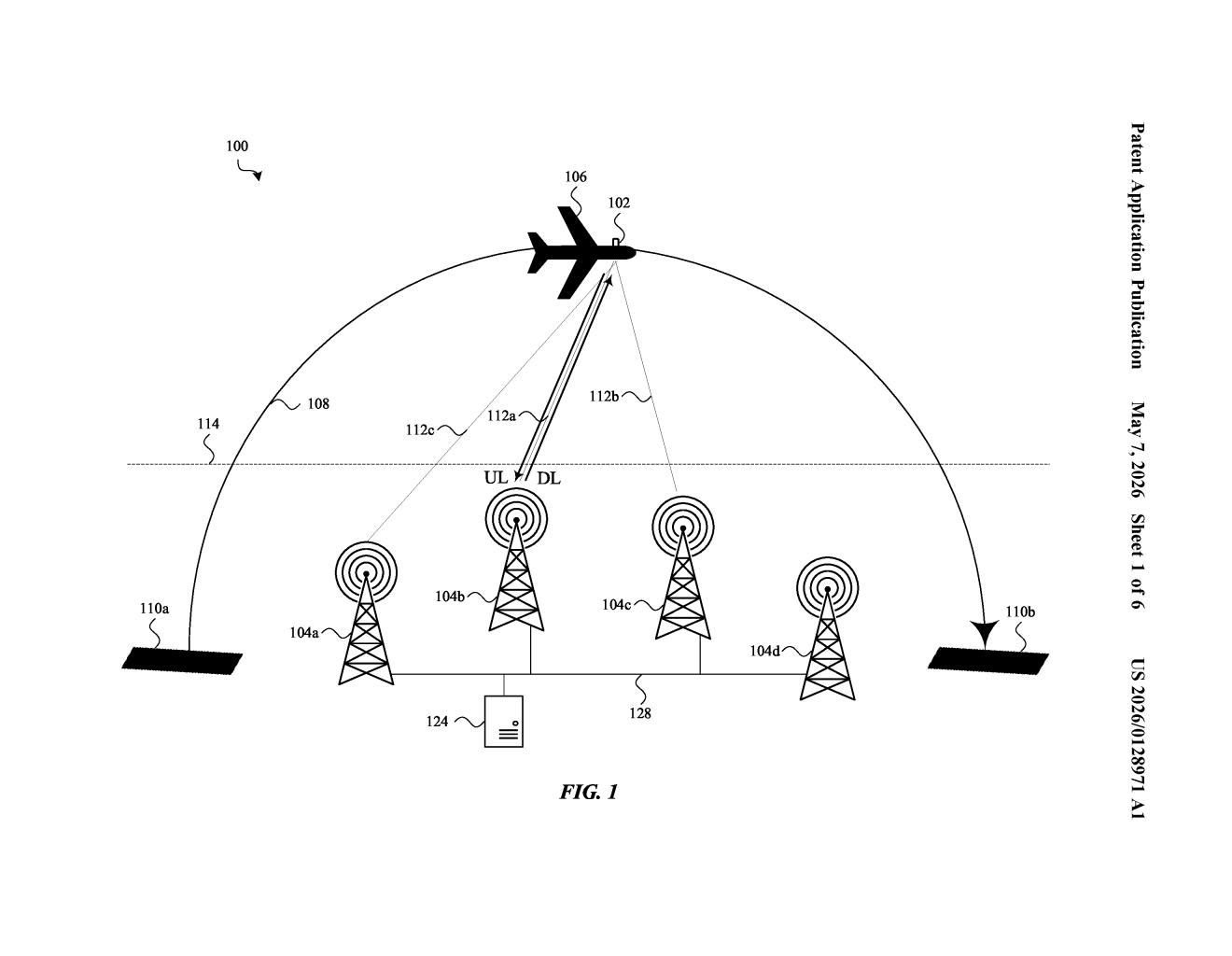
What Apple's in-flight cellular sync system actually does
Imagine you're on a plane and your phone is connecting to a cell tower on the ground thousands of feet below. The signal behaves very differently than when you're standing next to that same tower. The distance is enormous, the geometry is unusual, and the connection can drop in ways that standard cellular rules weren't designed to handle.
Apple's patent describes a system where your device — call it a user equipment (UE), in telecom-speak — tells the network whether it's in "flight mode" or "ground mode" based on its location. The network then sends back customized thresholds for deciding when the connection is good or bad.
Instead of using generic rules that work for walking around a city, the device uses distance-based or time-based thresholds tuned specifically for air-to-ground scenarios. When the signal quality crosses those thresholds, the device reports back whether it's "in sync" or "out of sync" with the tower — so the network can react appropriately.
How the ATG device reports sync status to the network
This patent covers a piece of cellular radio management called Radio Link Monitoring (RLM) — the process by which a device continuously evaluates whether its connection to a base station is healthy enough to use. In standard 5G/LTE, RLM uses fixed thresholds: if signal quality drops below a certain point for long enough, the device declares an "out-of-sync" condition and eventually triggers a radio link failure procedure.
The problem with air-to-ground (ATG) networks is that those fixed thresholds were designed for terrestrial use. At altitude, the propagation delay (the time it takes a signal to travel from tower to device) is much larger, and the device may be hundreds of kilometers from the serving tower. Standard timing assumptions break down.
Apple's approach: the UE first reports its operational mode — ATG flight mode vs. ATG ground mode — to the network, based on GPS or other location data. The network then responds with a custom configuration containing out-of-sync and in-sync thresholds tailored to that mode. These thresholds can be:
- Distance-based — e.g., declare out-of-sync if the UE is farther than X kilometers from the tower
- Time duration-based — e.g., declare out-of-sync if poor signal persists for longer than Y milliseconds
The device then evaluates its link quality against those custom thresholds and reports the result back. This creates a feedback loop that keeps the network informed about link health using parameters that actually make sense for airborne operation.
What this means for next-gen in-flight connectivity
Air-to-ground cellular — where ground towers beam signals upward to serve aircraft — is a real and growing connectivity approach, used by providers like Gogo and being evaluated under emerging 5G standards. The challenge is that existing 3GPP radio protocols weren't written with planes in mind, and retrofitting them requires careful standardization work at exactly this level of detail.
For you as a passenger, this kind of infrastructure-level work is what ultimately determines whether your in-flight connection is stable or constantly dropping. Apple filing in this space signals that it's actively engaged in shaping how 5G-capable devices behave in ATG environments — which matters as more airlines move toward direct device-to-tower connectivity instead of onboard Wi-Fi hubs.
This is deep cellular standards plumbing — not the kind of patent that hints at a flashy new product. But Apple's participation in ATG radio link monitoring is a meaningful signal that it wants iPhones and iPads to be first-class citizens in whatever air-to-ground 5G ecosystem emerges. The distance-based threshold idea in particular is a sensible, practical fix to a real problem that current protocols handle poorly.
There are more where this came from
We read every patent application Big Tech publishes and send you the ones worth knowing. Plain English, free, every week.
Want this weekly breakdown for a company we don't cover? Patentlyze Pro →