
Qualcomm Patents a Cellular Network System for Locating Connected Physical Objects
Your phone already knows where it is — but what about the cheap wireless tag attached to your luggage or warehouse shelf? Qualcomm is working on a way to bring cellular-grade location tracking to those low-power IoT devices.
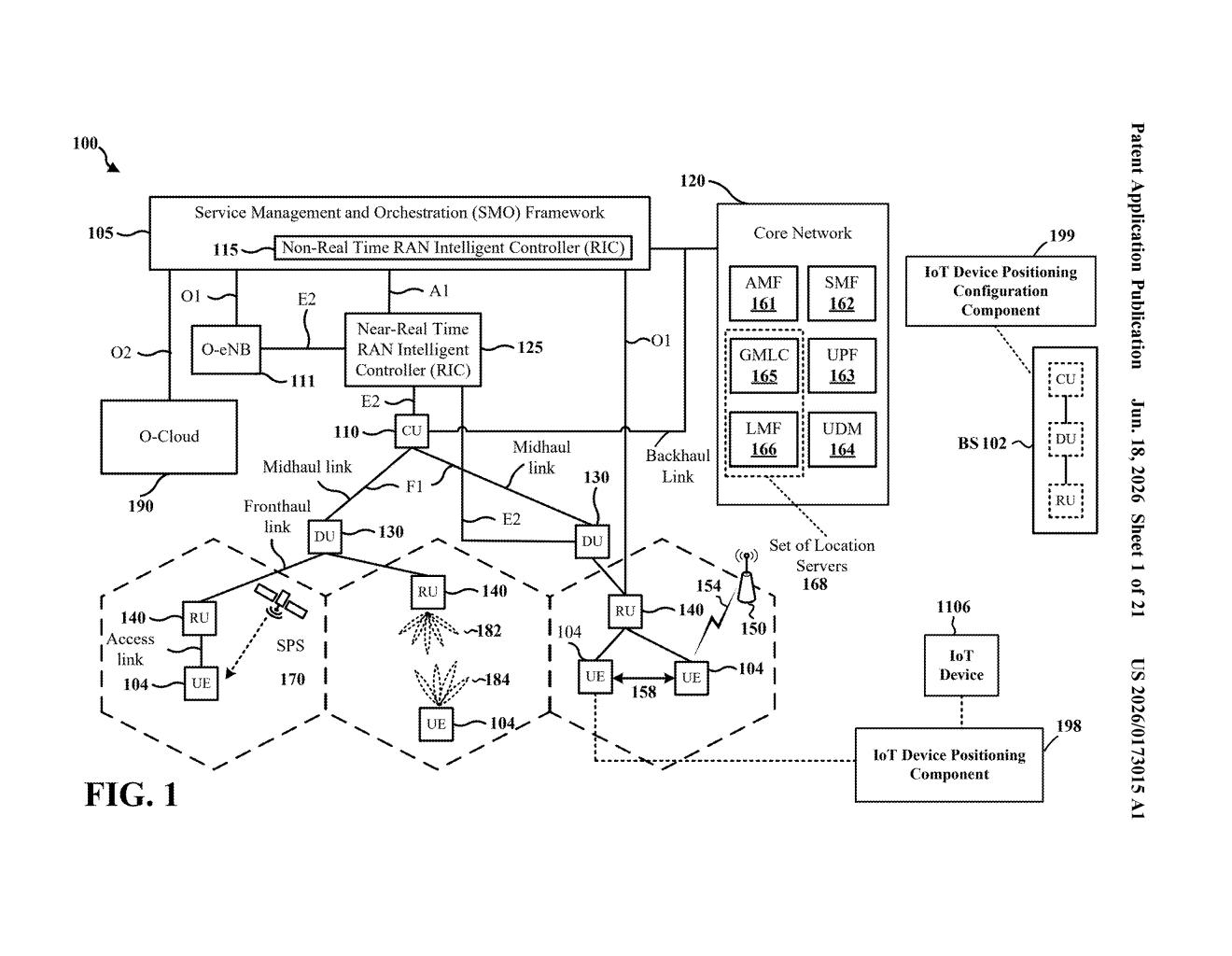
How Qualcomm wants phones to find nearby IoT tags
Imagine sticking a small, cheap wireless tag on a package, a pallet, or a piece of medical equipment. That tag doesn't have GPS — it's too small and too low-power for that. Right now, figuring out exactly where it is requires a lot of guesswork or separate tracking hardware.
Qualcomm's patent describes a system where your phone (or another connected device) coordinates with a cell network to figure out how far away one of those tags is, or exactly where it's sitting. The phone asks the network for permission and settings, the network responds with the right configuration, and then the two devices do the measurement together.
The key idea: the cellular network acts as the referee, handing out instructions so the phone and the IoT tag can run a proper distance or location calculation — rather than each device doing its own thing.
How the request-configure-measure cycle works
The patent describes a three-step protocol between a wireless device (like a smartphone or a dedicated reader), a network entity (a cell tower or network server), and an IoT device (think RFID tags or other low-power sensors).
- The wireless device sends a request to the network, saying it wants to measure the range to — or position of — a nearby IoT device.
- Either the device or the network proposes a positioning method (the specific technique used to calculate distance or location, such as measuring signal timing or signal strength).
- The network responds with a configuration: a set of radio resources — specific channels, time slots, or signal parameters — that both devices should use to carry out the measurement.
The system is built around RFID tags and similar IoT hardware that can't do sophisticated location math on their own. By offloading the coordination to the cellular network, even very simple tags can participate in accurate positioning without needing their own GPS chip or complex firmware.
The patent covers both range estimation (how far away is the tag?) and position estimation (where exactly is it?), and it handles the case where either side — the phone or the network — can initiate the choice of method.
What this means for wireless asset tracking
Asset tracking is a massive industrial problem. Warehouses, hospitals, shipping companies, and retailers spend significant money trying to know where things are in real time. Current solutions — Bluetooth beacons, dedicated RFID readers, private Wi-Fi networks — require their own infrastructure and don't scale easily across large areas or across companies.
If Qualcomm's approach were built into cellular standards, any 5G-connected phone or gateway could double as a location reader for cheap IoT tags, using the existing cell network as the coordination backbone. That would be a meaningful cost reduction for large-scale tracking deployments — and it would push location intelligence down to objects that currently have none.
This is a focused, practical patent aimed squarely at the industrial IoT market — not consumer flash. Qualcomm is one of the key chipmakers behind 5G modems, so a patent like this is genuinely about positioning itself (no pun intended) to have its chips and protocols inside the next generation of warehouse and supply-chain hardware. It's not exciting reading, but it's exactly the kind of standards-layer work that ends up shipping in real deployments.
There are more where this came from
We read every patent application Big Tech publishes and send you the ones worth knowing. Plain English, free, every week.
Want this weekly breakdown for a company we don't cover? Patentlyze Pro →