
Apple Patents a System That Changes How Audio Plays Based on Which Device Asked
Imagine your iPhone asking your HomePod to play music and getting a wide, room-filling sound, while your Apple Watch asking the same HomePod gets a more focused, personal audio mix. That's the core idea behind Apple's latest audio patent.
What Apple's device-aware audio routing actually does
Picture this: you're at home, and you ask your HomePod to play a podcast from your iPhone. Later, your Apple Watch sends the same request. Right now, the HomePod would respond the same way both times. Apple's new patent proposes that it shouldn't.
The idea is that the device doing the asking should influence how the audio comes out. A request from your iPhone might trigger a full, multi-speaker spatial audio experience built for the whole room. A request from your Watch or another device might produce a different kind of output, maybe something more suited to a single listener.
In short, Apple wants its audio hardware to be aware of context, using the identity and likely position of the requesting device as a signal to shape the listening experience automatically, without you having to change any settings.
How the resident device decides which audio mode to use
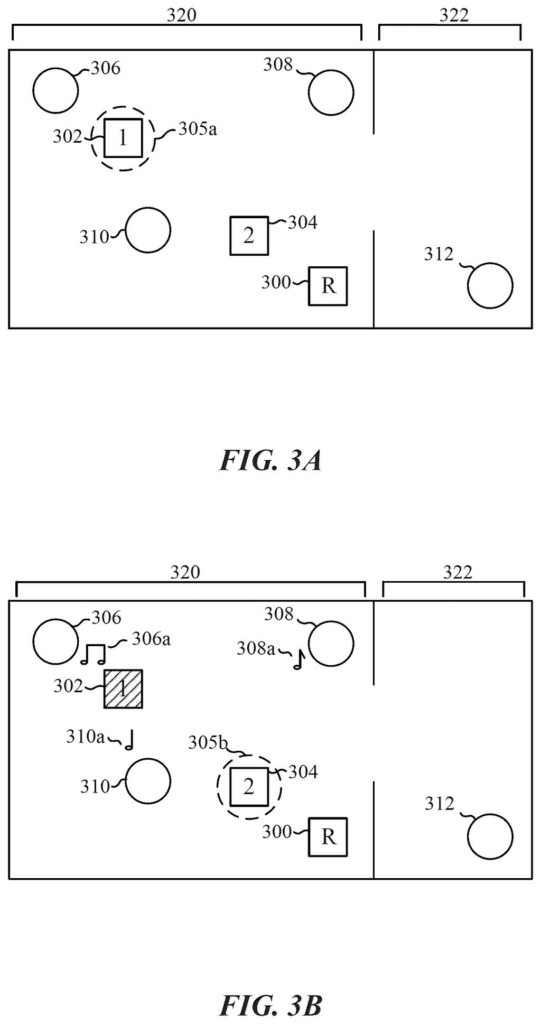
The patent describes a resident device (think a HomePod or a future Apple speaker hub) that receives playback requests from other Apple devices. When it gets one of those requests, it checks which device sent it and applies a different set of rules depending on the answer.
- First device scenario: If the request comes from device type A (say, an iPhone), the resident device plays the audio in "a first manner" through multiple output devices simultaneously.
- Second device scenario: If the request comes from device type B (a different Apple device), the resident device plays the audio in "a second manner" that is explicitly distinct from the first.
The patent also references techniques for using device positioning to alter audio output, generating depth maps remotely (a way to measure spatial distances without a sensor physically present at the location), and re-creating images from those depth readings. That broader scope suggests this isn't just about speaker routing; it ties into Apple's ongoing work on spatial audio and room awareness, where the physical layout of a space shapes what you hear and how.
The core mechanism is essentially a conditional logic tree: the resident device evaluates criteria sets tied to device identity and, potentially, device location, then picks the matching audio output profile.
What this means for Apple's home and spatial audio ambitions
For everyday Apple users, this kind of system could mean your home audio setup automatically adapts to who (or what) is controlling it, without any manual configuration. A family member's iPad kicking off a movie might trigger surround-style playback across multiple speakers, while a quick request from a tiny wearable keeps things simple.
More broadly, this patent signals Apple is building deeper intelligence into how its devices collaborate. The depth-map and image re-creation elements suggest Apple is thinking about rooms as aware environments, where speakers and hubs understand physical space well enough to tailor audio automatically. That connects directly to the HomePod's existing room-sensing features and points toward a more automated, context-driven home audio experience.
This is a practical patent dressed up in abstract language. The real idea, that a speaker should behave differently depending on which device asked it to play something, is genuinely useful and fits Apple's home-ecosystem strategy. The depth-map and image re-creation claims add enough complexity to suggest this is part of a larger spatial-audio platform play, not just a routing tweak.
There are more where this came from
We read every patent application Big Tech publishes and send you the ones worth knowing. Plain English, free, every week.
The drawings
21 drawing sheets from US 2026/0222756 A1 · click any drawing to enlarge


Want this weekly breakdown for a company we don't cover? Patentlyze Pro →
Be the first to weigh in