
Apple Patent Lets Software Choose and Apply Movement Controls Based on Object Appearance
Animating a 3D object today means manually wiring up an invisible skeleton to every part of it, a process that can take hours. Apple's new patent describes a system that looks at an object and picks the right skeleton automatically.
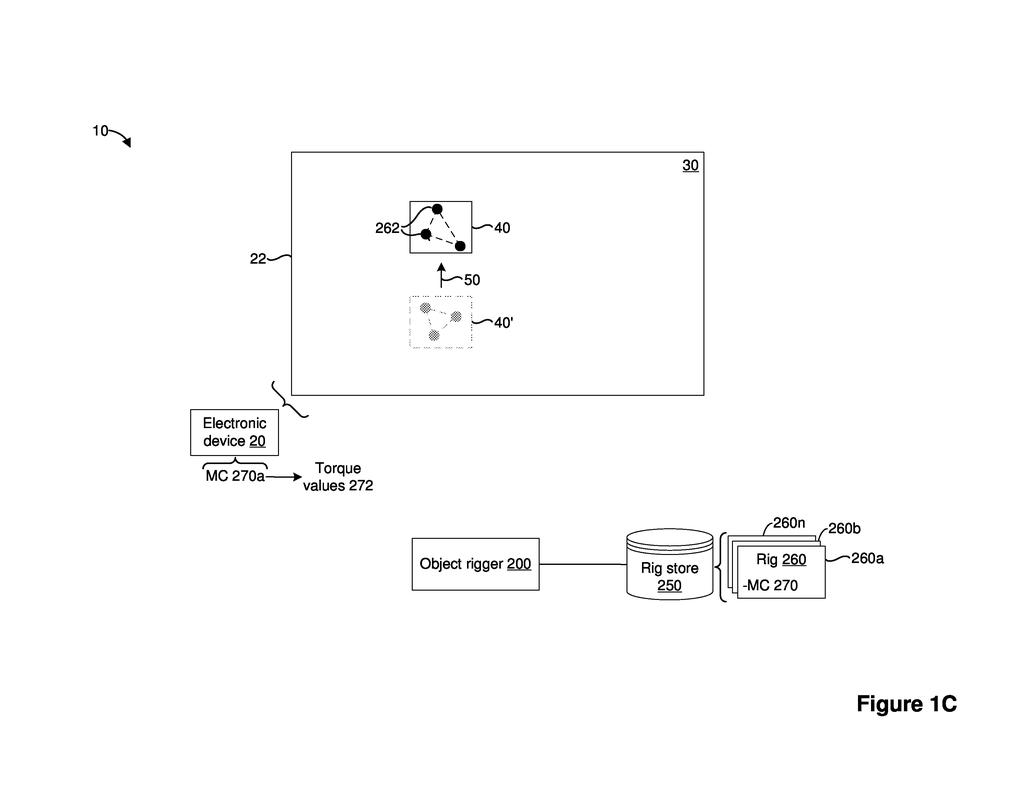
What Apple's auto-rigging system actually does
Imagine you drop a 3D cartoon dog into an augmented reality scene and want it to walk around. Before it can move, an animator has to build an invisible internal skeleton (called a "rig") and carefully attach each bone to the right part of the dog's body. For a professional studio that's routine work; for an everyday app user, it's basically impossible.
Apple's patent describes a system that takes over that process. It looks at the visual appearance of an object, things like its shape, proportions, and structure, and automatically selects a pre-built skeleton that fits. Then it attaches that skeleton to the object so it can move naturally.
The idea is that you shouldn't need animation training to make a 3D object come to life in your environment. You place the object, and the device figures out the rest.
How the system matches visual appearance to a rig
The patent describes a four-step pipeline running on a device with a processor and display:
- Visual appearance analysis: The system reads one or more "visual appearance values" from the object. These are measurable properties that describe what the object looks like, such as its overall shape, symmetry, or structural layout.
- Rig selection: Based on those values, the system picks from a library of pre-built rigs. Each rig has a different arrangement of joints (pivot points) connected in a specific way, so a biped rig (two legs, two arms) looks nothing like a quadruped rig (four legs) or a simple object rig.
- Rig application: The chosen rig is applied to the object by associating each joint with a corresponding portion of the object's geometry, essentially snapping the skeleton into place.
- Animation: Once rigged, the object can be animated inside an environment by manipulating those joints, bending the knee, lifting the arm, rotating the head, and so on.
The key claim is that rig selection is driven by appearance values, not by manual user input. That's the part Apple is staking out as its specific contribution.
What this means for AR and 3D content creation
The obvious home for this is Apple Vision Pro and AR experiences on iPhone and iPad, where users or developers might place 3D objects in real-world scenes. If every placed object needs a manually built rig before it can move, interactive AR stays a tool for professionals. A system that auto-rigs based on appearance lowers the barrier significantly.
For 3D content creation tools (think a future version of Reality Composer or a consumer-facing animation app), this kind of automation could let everyday users animate objects without any knowledge of how skeletal animation works. It also hints at a pipeline where AI-generated or scanned 3D objects can be dropped directly into scenes and made interactive without a manual cleanup step.
This is a solid, practical patent in a real pain point for 3D content creation. Rigging is genuinely one of the most tedious parts of animation, and automating it based on visual appearance is a sensible approach. It's not a flashy AI story, but if this shows up in a future version of Reality Composer or a Vision Pro creation tool, users will notice the difference immediately.
There are more where this came from
We read every patent application Big Tech publishes and send you the ones worth knowing. Plain English, free, every week.
The drawings
11 drawing sheets from US 2026/0220866 A1 · click any drawing to enlarge


Want this weekly breakdown for a company we don't cover? Patentlyze Pro →
Be the first to weigh in