
Apple Patent Reveals Smarter Frequency Negotiation for Wireless Charging Systems
Your phone may soon be able to tell a wireless charger exactly how it wants power delivered, rather than accepting whatever frequency the charger decides to use. Apple's new patent describes a system where the device picks the frequency that works best for its hardware and location.
What Apple's charging frequency negotiation actually does
You set your phone on a wireless charger and it just... charges. You don't think about it. But behind the scenes, the charger is transmitting power at a specific radio frequency, and whether that frequency is the right one for your device matters more than you might expect.
Apple's patent describes a system where your phone actively negotiates. Instead of passively accepting whatever frequency the charger broadcasts, the device checks what frequencies are available, picks the best one for its situation, and sends a request back to the charger. The "best" frequency can depend on where in the world your phone is registered, since different regions have different rules about which frequencies can be used for wireless power.
This matters most at higher power levels. The patent describes two modes: a standard low-wattage mode that only uses one fixed frequency, and a higher-wattage mode that can use multiple frequencies. The negotiation kicks in when you're in that faster-charging mode, giving your phone more control over how it receives power.
… select a particular frequency from the multiple frequencies and send a request to the power transmitting device requesting the power transmitting device to transmit wireless power at the particular frequency, wherein the particular frequency is selected according to a geographic assignment for the power receiving device.
Translation: The device picks a charging frequency based on its geographic location and asks the charger to use it.
How the device selects and requests a charging frequency
The patent defines two distinct charging modes inside a wireless power transfer protocol. Profile 1 is the baseline: it delivers power at a lower wattage and operates only at a single, fixed frequency. Profile 2 is the higher-power mode, and it opens up a range of possible frequencies that the charger can use.
When the receiving device (your phone, watch, or tablet) detects that the charger is operating in Profile 2, the device's control circuitry checks which frequencies the charger can actually support. It then picks one specific frequency from that set based on a geographic assignment, which is essentially a record baked into the device indicating what frequencies are permitted or preferred in the country or region where it's registered.
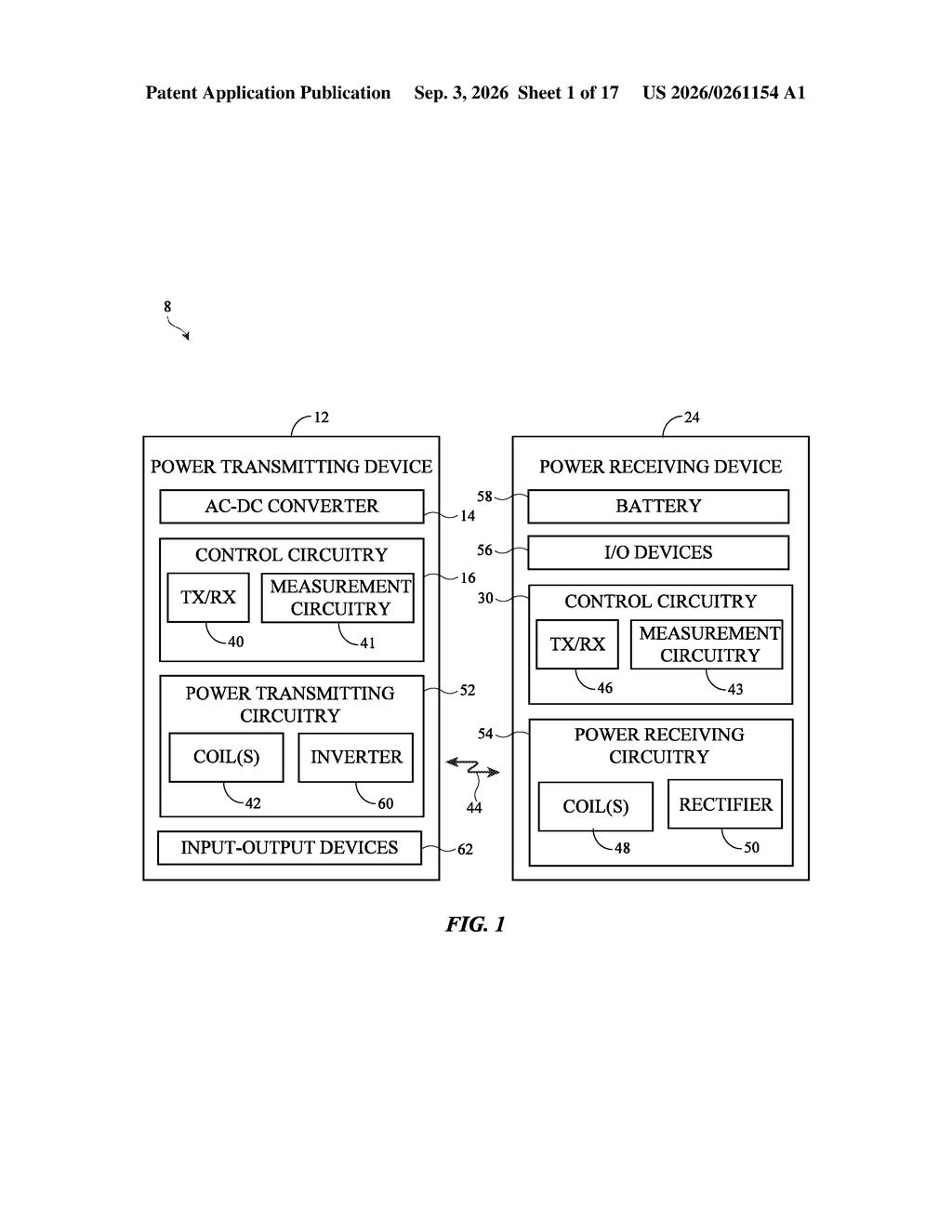
Once the device has made its selection, it sends a formal request back to the charger asking it to transmit at that chosen frequency. The key hardware components involved are:
- A wireless power transfer coil that physically receives the power
- A rectifier circuit that converts the alternating signal from the coil into a stable DC voltage the battery can use
- The control circuitry that handles all the detection, selection, and communication logic
The geographic angle is practically significant. Wireless charging operates in frequency bands that regulators in different countries treat differently, so a device sold in the US may be authorized for different frequencies than the same device sold in Europe.
… a first power profile that delivers wireless power at a first wattage using only a first frequency or a second power profile that delivers wireless power at a second wattage greater than the first wattage using the first frequency and/or a second frequency greater than the first frequency.
Translation: The charger offers a slow mode with one frequency and a fast mode using single or multiple frequencies.
What this means for faster, more efficient wireless charging
For you as a user, the immediate promise is more efficient fast charging. If a phone can land on the frequency it handles best rather than accepting whatever the charger defaults to, there's less wasted energy and potentially less heat generated during a charging session. Heat is one of the main enemies of long-term battery health.
The regional frequency angle also hints at something Apple cares about at scale: selling one device that works correctly everywhere. Apple's ongoing work on wireless power standards If frequency behavior is determined dynamically based on where the device thinks it is rather than hard-coded at the factory, Apple could in theory ship fewer hardware variants globally. That's a supply-chain and support simplification, even if customers never notice it.
Apple's 39th filing in the cell phone patents we've tracked since May adds to a run that includes one on freeing stuck memory and one on optical zoom lenses.
The core idea here is a smarter conversation between a charger and a phone, where both sides agree on a charging speed and radio frequency before power starts flowing. That negotiation lives in software and firmware, not new physical parts, which means the hardware may already exist in devices people own today.
The one piece that adds real ongoing work is location-aware frequency rules. Different countries permit different radio frequencies, so the phone needs to know where it is and choose accordingly, which means Apple would need to maintain a living database of regional rules, not just write code once and walk away.
If the charging coils are already in place, the shortest path to a product is a software update plus the regulatory approvals that come with higher-power charging. Nothing in this document points to a years-away timeline.
Get our take in your Top Stories
Liked this breakdown? Add Patentlyze as a preferred source on Google, and our plain-English take shows up more often in your Top Stories the next time Apple patent news breaks.
There are more where this came from
We read every patent application Big Tech publishes and send you the ones worth knowing. Plain English, free, every week.
The drawings
17 drawing sheets from US 2026/0261154 A1 · click any drawing to enlarge


Show the other 9 sheets


Want this weekly breakdown for a company we don't cover? Patentlyze Pro →
Be the first to weigh in