
Apple Patents a Predictive Cache System for Faster 3D Graphics Rendering
Every frame of a ray-traced 3D scene requires thousands of calculations about how light bounces off surfaces, and the speed of those calculations depends heavily on how well the chip manages a tiny pool of fast memory called a cache. Apple's new patent describes a system that tries to predict, in real time, which data in that cache is worth keeping.
What Apple's ray tracing cache prediction actually does
Every time a game or 3D app draws a scene on your screen, the graphics chip traces millions of imaginary light rays to figure out what each pixel should look like. To do that quickly, it keeps a small stash of working data in a very fast memory area called a cache. When the cache fills up, the chip has to throw something out to make room, and picking the wrong thing to discard means expensive trips back to slower memory.
Apple's patent describes a way to make that eviction decision smarter. Each piece of data in the cache gets a prediction score that estimates how likely the chip is to need that data again soon. New data starts with a score based on what kind of scene geometry it represents, and the score updates as the chip either reuses the data or ignores it. When the cache is full, the item with the lowest score gets dropped first.
The practical effect is fewer wasted cycles fetching data the chip already discarded. For you, that could mean smoother frame rates or better-looking scenes on the same hardware.
maintain, for cache lines of the data cache, respective prediction values that predict likelihood of future re-use, including to: assign an initial prediction value to a first cache line on allocation of the first cache line to a first way of a first set of the data cache …
Translation: The system assigns a score to each piece of stored data to guess how likely it is to be needed again soon.
How Apple's circuitry scores and evicts cache lines
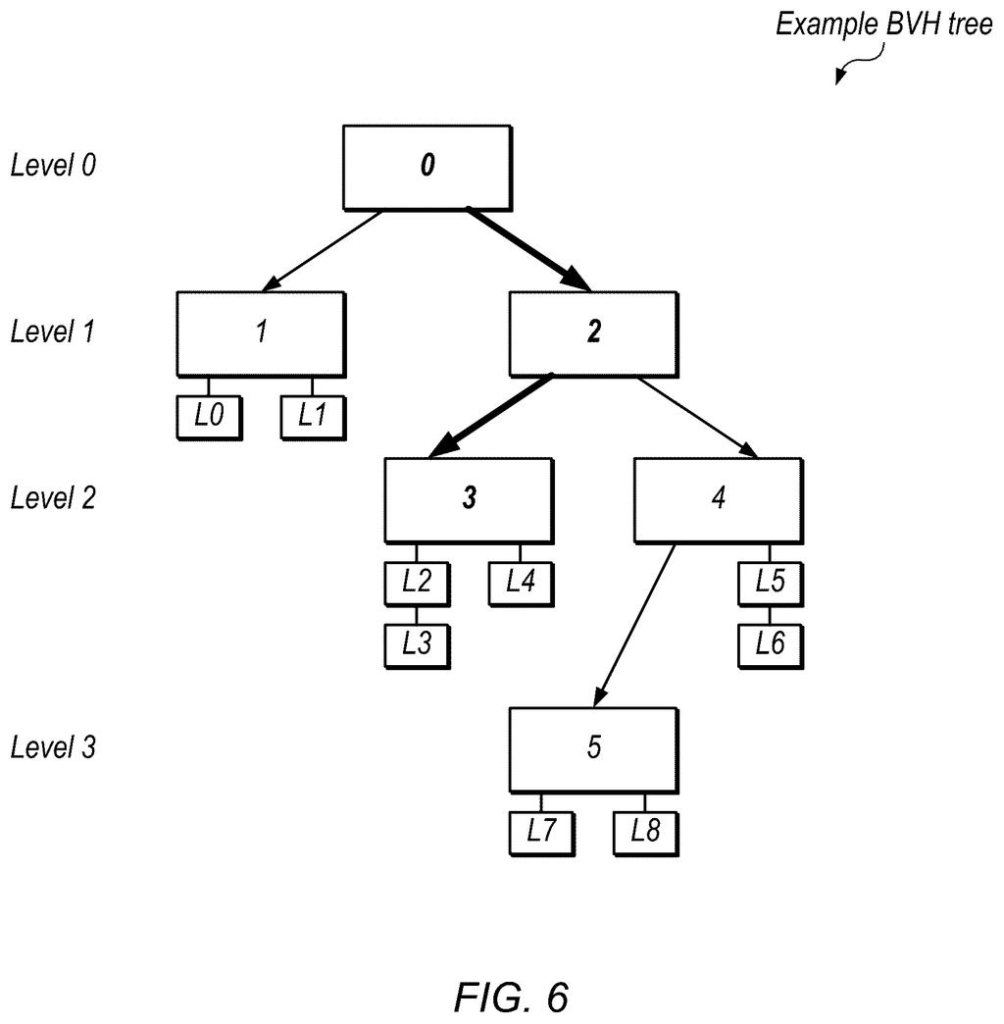
Ray tracing works by walking a tree-shaped data structure called a bounding volume hierarchy (BVH), which organizes a 3D scene into nested boxes. The chip tests each ray against these boxes to narrow down which surfaces it actually hits. That traversal is repetitive and memory-hungry, so caching BVH nodes is critical.
Apple's system attaches a prediction value to every cache line (a small block of cached data). The control circuitry sets an initial score when data first enters the cache, drawing on signals like:
- How deep in the BVH hierarchy the node sits (deeper nodes are visited less often)
- The physical size of the bounding box (larger boxes tend to be tested more)
- Properties of the geometry inside the box
- Characteristics of the rays being tested
When the chip reuses a cache line (a cache hit), the prediction value goes up, reinforcing the idea that this data is worth keeping. Crucially, allocating a new cache line also triggers updates to the scores of other lines sharing the same set, spreading the accounting across neighbors so no single eviction decision is made in isolation.
The victim selection step, where the chip picks what to discard when the cache is full, then simply targets whichever line carries the lowest prediction score. This is more informed than the classical approach of evicting whatever was used least recently.
Control circuitry may assign an initial prediction value to the cache line based on characteristics of data stored by the cache line (e.g., level in a bounding volume hierarchy, size of a bounding volume, characteristics of primitives inside a bounding volume, ray characteristics, tracking ray traversal paths, etc.).
Translation: The computer decides what to keep in memory by analyzing the specific geometry and path of the light rays being rendered.
What this means for Apple's in-house graphics chips
Apple designs its own graphics hardware inside chips like the M-series and A-series, and ray tracing support has been a growing part of those designs. A prediction-based cache management scheme like this one targets a known bottleneck: the memory traffic generated when a ray traversal constantly misses the cache and has to reload data from main memory. Cutting those misses down translates directly into either higher performance at the same power budget or equivalent performance at lower power, which matters a great deal in a laptop or phone.
The patent sits squarely in the hardware-level graphics work Apple has been filing steadily as it pushes its chips toward console- and workstation-class rendering. It joins a broader stream of new Big Tech patents in the GPU and ray tracing space, where Apple, Nvidia, and AMD are all trying to squeeze more from smaller, faster caches rather than simply throwing more silicon at the problem.
The core design trade-off here is prediction overhead versus eviction quality. Maintaining and updating a score for every cache line adds logic and a small amount of power to every cache operation. If the prediction model is wrong often enough, the chip spends resources managing scores while still evicting the wrong data. Apple's approach leans heavily on static signals baked in at allocation time, which is fast but assumes the BVH traversal pattern is predictable from node depth and box size alone. In scenes with chaotic ray distributions, like heavy fog or translucent materials, those static signals could mislead the predictor and actually hurt performance compared to a simpler least-recently-used scheme. The trade reads as worthwhile for the common case of structured geometry, but the edge-case cost is real and the patent does not spell out a fallback.
There are more where this came from
We read every patent application Big Tech publishes and send you the ones worth knowing. Plain English, free, every week.
The drawings
12 drawing sheets from US 2026/0237016 A1 · click any drawing to enlarge


Want this weekly breakdown for a company we don't cover? Patentlyze Pro →
Be the first to weigh in