
New Apple Patent Builds Cleaner 3D Scans by Filtering Bad Frames
Building a 3D model of an object by walking around it sounds simple, but move your phone too fast and the result turns to mush. Apple has a patent for a system that figures out which frames are worth keeping before it ever starts building the model.
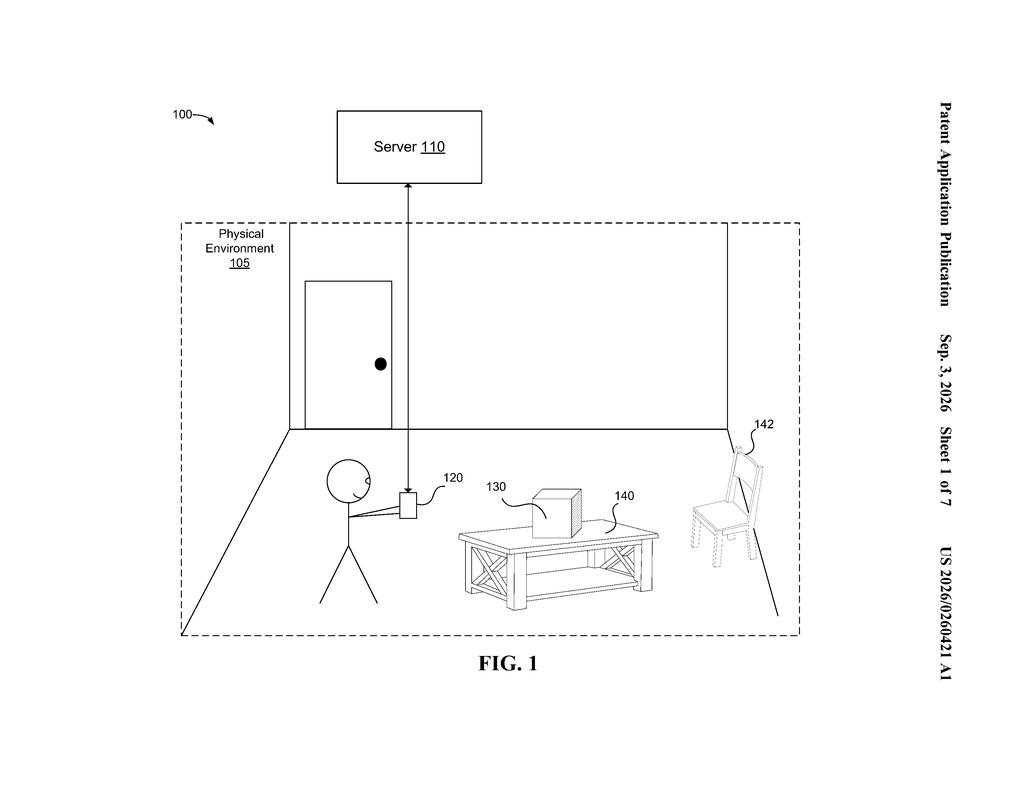
What Apple's single-pass 3D scanning actually does
You're scanning a coffee mug with your iPhone, slowly circling it so an app can build a 3D version. The problem: your hand isn't perfectly steady, and some of those captured frames are slightly blurred or off. Right now, most scanning apps either use all the frames anyway or ask you to redo the whole process.
Apple's patented approach watches how a specific point on the object moves through each frame, comparing where that point sits at one moment versus the next. If the gap is too large (meaning the phone moved too fast and the frame is likely distorted), that frame gets dropped. Only the clean, stable frames make it into the final 3D model.
The practical upside is that you can walk around an object in a single continuous pass rather than making careful, painstaking stops. The phone is doing the quality-control work for you in the background.
… determining a distance between the first location and the second location of the pixel; and selecting a subset of the images based on an assessment of a change in the distance between the first location and the second location of the pixel.
Translation: The system measures how much pixels shift over time to decide which frames to keep for the final scan.
How the system tracks pixels to spot motion distortion
The system uses both the camera and a depth sensor (the kind that fires invisible infrared light to measure distances, already present on newer iPhones) to track object surfaces as the phone moves.
For every frame, the device picks a pixel associated with the target object and records where in 3D space that pixel physically sits, using depth data to convert a flat screen coordinate into a real-world location. It then does the same thing for the next frame and measures the distance between those two locations. A small distance means the phone moved slowly and steadily; a large distance signals a fast, potentially motion-blurred moment.
Frames that pass the motion test are collected into a selected subset. The 3D model is then built only from that curated group, each frame paired with the corresponding depth map so the reconstruction has accurate geometry.
- Acquires camera images and depth data continuously during movement
- Tracks pixel positions in 3D space frame-by-frame
- Flags frames where the tracked point moved too far between captures
- Builds the final 3D model exclusively from motion-stable frames
… selecting a subset of the images based on assessing the images with respect to motion-based defects based on device motion and depth data, and generating a 3D model of the object based on the selected subset of the images and depth data corresponding to each of the images of the selected subset.
Translation: Blurry or distorted frames caused by sudden movement are filtered out so the final 3D model comes out clean.
What this means for iPhone 3D capture and spatial apps
For everyday users, this lowers the skill floor for 3D scanning. You don't need to move with robotic precision. The phone figures out which moments of your walk-around were steady enough to use and discards the rest before stitching anything together.
Apple's run of spatial-computing and 3D-capture filings fits a broader pattern around Vision Pro and iPhone spatial features, where the quality of user-generated 3D content is a real bottleneck. Cleaner scans from casual captures would matter for everything from furniture placement in AR to sharing 3D objects inside apps.
That makes this Apple's 370th filing in our Apple coverage since May, adding to work like the 3D map highlights one and the air quality floor-plan one.
Claim 1 is actually pretty specific. It doesn't just cover '3D scanning on a phone' broadly; it covers a particular technique of tracking a single pixel's 3D position at two points in time , computing the distance between those positions, and using that distance measurement to decide which frames to include. That's a narrower footprint than it might first appear.
The narrowness cuts both ways. A patent this specific is harder to challenge on prior-art grounds because it describes a precise sequence rather than a general concept. But it also means a competitor could sidestep it by choosing a different selection criterion, such as tracking multiple pixels, using motion sensors directly rather than depth-derived position changes, or scoring frames probabilistically rather than with a hard distance threshold.
In practice, if granted, this claim would most directly pressure anyone building a depth-sensor-based scanning app that uses per-pixel, depth-derived displacement as the sole frame-selection gate. That's a real but bounded slice of the scanning software space.
Get our take in your Top Stories
Liked this breakdown? Add Patentlyze as a preferred source on Google, and our plain-English take shows up more often in your Top Stories the next time Apple patent news breaks.
There are more where this came from
We read every patent application Big Tech publishes and send you the ones worth knowing. Plain English, free, every week.
The drawings
7 drawing sheets from US 2026/0260421 A1 · click any drawing to enlarge


Want this weekly breakdown for a company we don't cover? Patentlyze Pro →
Be the first to weigh in