
Zoox Patents a System That Hears and Sees Emergency Vehicles at Once
Spotting an ambulance in traffic is easy for a human who can both see its flashing lights and hear its siren — but most self-driving perception systems rely almost entirely on cameras and lidar. Zoox wants to change that by teaching its vehicles to listen.
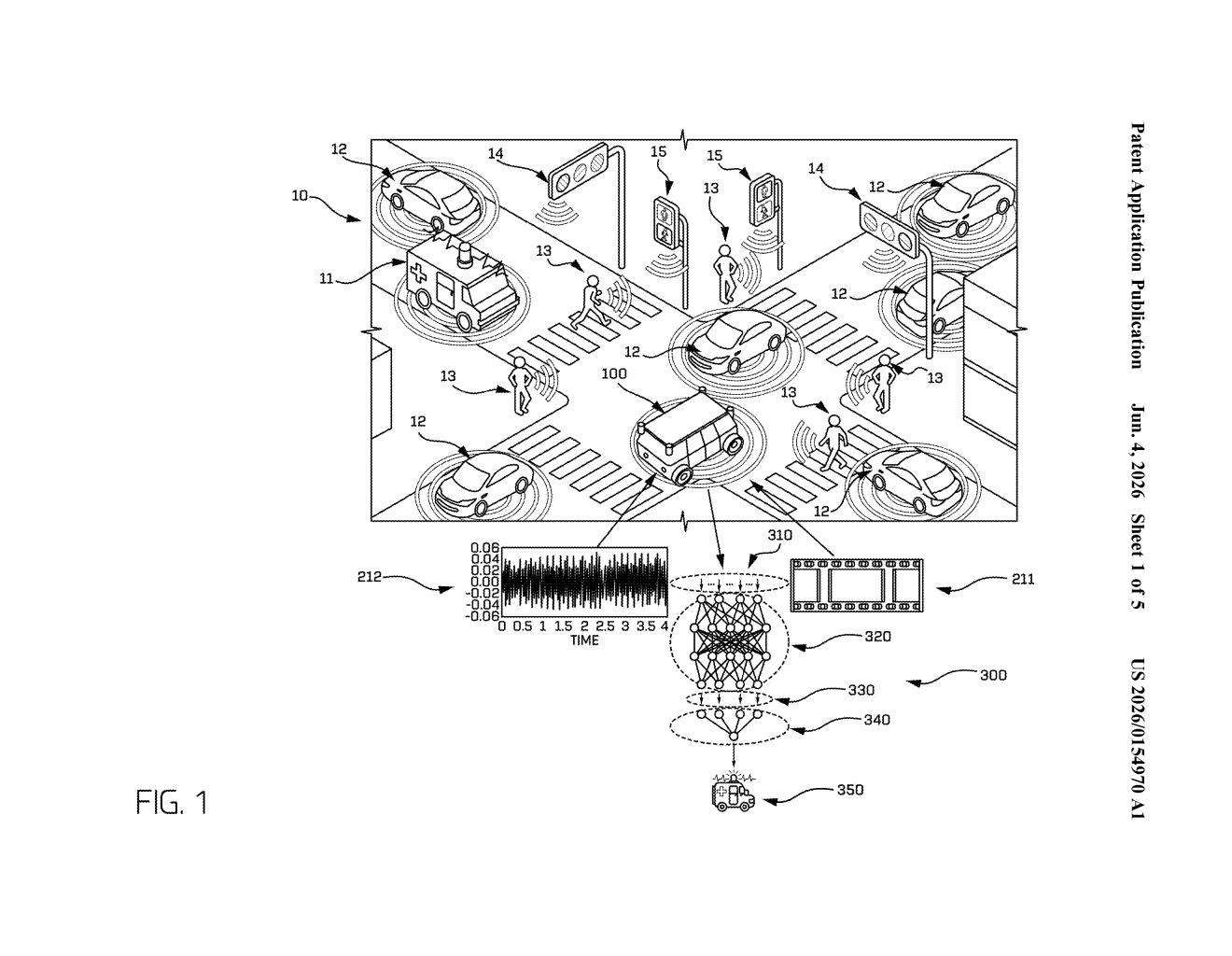
How Zoox's robo-taxi detects a speeding ambulance
Imagine you're driving and an ambulance is coming from around a blind corner. You can't see it yet, but you can hear the siren getting louder. That's enough for most experienced drivers to start pulling over. Zoox's new patent is essentially trying to give its self-driving vehicles that same instinct.
The system combines what the car's cameras see with what onboard microphones hear, then feeds both streams into a machine-learning model to decide whether an emergency vehicle is nearby. The key idea is that neither sensor has to do the job alone — a siren heard but not yet seen, or lights spotted in a noisy environment, can both contribute to a confident detection.
The result is a more robust safety layer. Instead of waiting until an ambulance or fire truck is fully visible, the car can start reacting sooner — which, at city driving speeds, could mean the difference between a smooth yield and a dangerous last-second swerve.
How camera and microphone data get fused into one model
The patent describes a perception pipeline that ingests two independent data streams: visual data from a camera sensor and audio data from a separate microphone. Because the sensors are described as mutually independent — meaning neither triggers the other — the system can act on just one stream if the other fails or is ambiguous.
The core technical step is generating embeddings (think of these as compressed numerical fingerprints) for each modality and then combining them into a joint representation space. Essentially, the model learns a shared language where "siren-shaped audio" and "flashing-lights-shaped image" both point toward the same concept: emergency vehicle present.
A first machine learning model then reads those combined embeddings and outputs a detection decision. The patent doesn't prescribe a specific ML architecture, leaving room for transformer-based or convolutional approaches.
Key components the system covers include:
- Camera-based visual input tied to a specific traffic scene
- Microphone-based audio input from the same scene
- A multimodal embedding layer that merges the two streams
- An ML classifier that outputs emergency-vehicle presence probability
Why sensor fusion changes how robotaxis handle emergencies
For a robotaxi operating in a dense urban environment, missing an emergency vehicle isn't just a traffic violation — it's a serious safety failure. Audio-visual fusion addresses the single biggest weakness of camera-only or lidar-only systems: occlusion. If an ambulance is behind a building or a large truck, its siren may be audible well before it's visible, giving the vehicle precious extra seconds to respond.
This also points to a broader trend in autonomous vehicle perception: adding cheap, lightweight sensors (a microphone costs almost nothing) that dramatically improve reliability in edge cases. If Zoox can make this robust enough for production, it's a real differentiator in how its fleet handles the high-stakes moments that matter most to regulators and riders.
This is a genuinely practical patent, not a moonshot. Emergency-vehicle detection is one of the specific failure modes regulators and safety advocates watch closely in AV deployments, and the audio-plus-vision fusion approach is a clean, defensible solution to a real problem. The fact that Zoox is filing this now — as it ramps up commercial operations in Las Vegas — suggests this isn't just research; it's likely headed into production software.
There are more where this came from
We read every patent application Big Tech publishes and send you the ones worth knowing. Plain English, free, every week.
Want this weekly breakdown for a company we don't cover? Patentlyze Pro →