
Amazon Patents a Privacy Monitor That Catches Alexa Skills Collecting Sensitive Data
Every time you talk to an Alexa skill, you might accidentally share more than you intended — a phone number, a health detail, a credit card. Amazon's new patent describes a system that intercepts that data before the skill ever sees it.
What Amazon's Alexa skill privacy monitor actually does
Imagine you're using an Alexa skill to order a pizza, and in the middle of the conversation you accidentally blurt out your credit card number. The skill you're using was never supposed to collect payment data — but nothing stopped it from hearing you. That's the gap Amazon is trying to close.
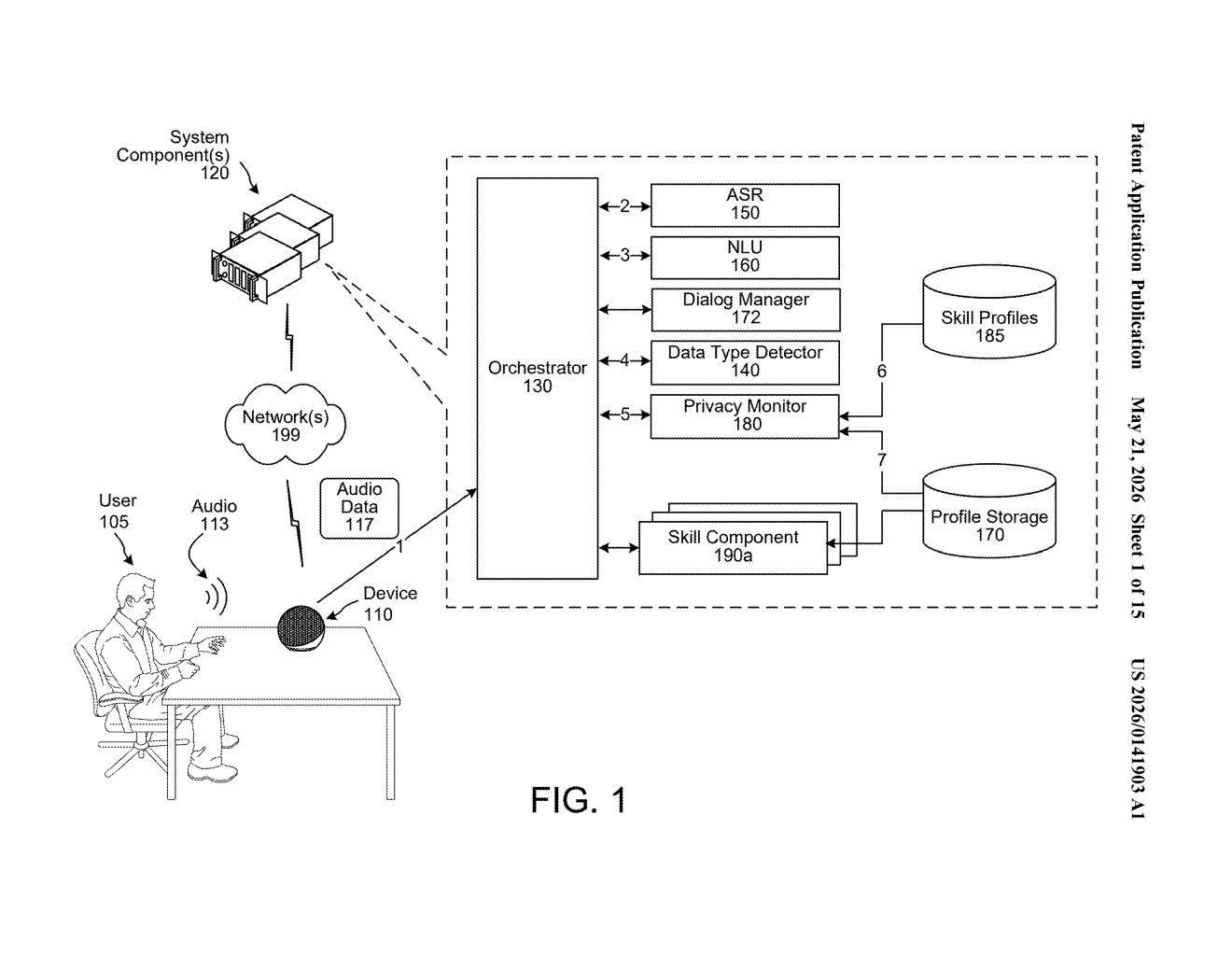
This patent describes a system that sits between you and whatever Alexa skill you're talking to. Before your words reach the skill, the system checks whether what you said contains sensitive data — like personal identifiers, financial details, or health information — and whether the skill is actually authorized to receive that kind of data.
If the skill didn't ask for it, or isn't allowed to have it, the system fires off an alert before anything gets passed along. It can also flag situations where a confusingly worded prompt from the skill caused you to overshare in the first place — which could help Amazon identify poorly designed third-party skills.
How the system flags unexpected sensitive data before it reaches a skill
The patent describes a Privacy Monitor component that intercepts natural language input as it flows through Amazon's voice-processing pipeline — after speech recognition (ASR) and language understanding (NLU) have converted your words into structured data, but before that data is handed off to the third-party skill.
The core mechanism works like this:
- The system identifies the skill or application that's about to receive your input.
- It looks up a Skill Profile — a registered list of data categories the skill is allowed to receive (think: shipping addresses, yes; health records, no).
- It classifies the incoming user data by type, checking whether any portion qualifies as sensitive data (personal identifiers, financial info, medical details, etc.).
- If sensitive data is present and the skill either didn't solicit it or isn't authorized for it, the system generates an alert output — and can block the data from ever reaching the skill.
The patent also describes a smarter layer: distinguishing between data the user volunteered unprompted versus data the skill's confusing prompt accidentally induced. That second case feeds back into improving the skill's dialog design — essentially flagging skills whose conversation flows cause users to accidentally overshare.
What this means for Alexa's third-party skill ecosystem
Alexa's third-party skill ecosystem has always had a trust problem. Unlike a smartphone app that must declare permissions upfront, voice skills operate in a murkier space where users have little visibility into what a skill is capturing from a spoken conversation. This patent suggests Amazon is building guardrails that work at the data-flow level, not just at the policy level — meaning a skill can't receive data it shouldn't have even if a user accidentally provides it.
For developers, this could mean stricter enforcement of data category declarations in skill profiles. For users, it's the kind of background protection that, if implemented well, would make third-party Alexa skills meaningfully safer to use — especially for skills operating in sensitive domains like health, finance, or home security.
This is practical, unglamorous privacy engineering — exactly the kind Amazon needs to do if Alexa is going to stay competitive in a world where voice assistants are increasingly handling sensitive tasks. The 'did the skill cause the oversharing?' detection angle is the most interesting technical wrinkle here; it's rare to see a patent explicitly address bad UX as a privacy vector.
Get our take in your Top Stories
Liked this breakdown? Add Patentlyze as a preferred source on Google, and our plain-English take shows up more often in your Top Stories the next time Amazon patent news breaks.
There are more where this came from
We read every patent application Big Tech publishes and send you the ones worth knowing. Plain English, free, every week.
Want this weekly breakdown for a company we don't cover? Patentlyze Pro →