
IBM
IBM · AI / ML · Filed Mar 3, 2025 · USPTO published May 21, 2026 · May 21 release
IBM Patents a Self-Tuning System for LLM RAG Pipeline Parameters
Getting an LLM to answer questions accurately over your own documents depends heavily on a tangle of configuration knobs — chunk size, overlap, retrieval depth — and IBM is patenting a system that uses machine learning to find the best combination automatically, without a human having to guess.
- Publication number
- US 2026/0140978 A1(US20260140978A1)
- Applicant
- International Business Machines Corporation
- Filed · Published
- Mar 3, 2025 · May 21, 2026
- Inventors
- Lukasz CMIELOWSKI, Daniel RYSZKA, Jakub WALASZCZYK, Dorota LACZAK
- Status when we published
- Waiting for an examiner
- Document
- 23 claims
- US classification
- 704/9
How IBM's system auto-tunes your LLM pipeline
Imagine you're building a chatbot that answers questions using your company's internal documents. The accuracy of that chatbot depends on dozens of fiddly settings: how long the text snippets fed to the AI should be, how much they overlap, how many are retrieved at a time. Getting those settings right today mostly means trial and error by a developer.
IBM's patent describes a system that automates this tuning process. It runs the LLM pipeline many times with different combinations of settings, scores each run by comparing the AI's answers against known correct answers, and then trains a secondary machine-learning model on those results. That surrogate model learns the relationship between settings and quality scores.
Once trained, that surrogate model is used to search for a combination of settings predicted to score even better than anything tested so far — without needing to run the full, expensive LLM pipeline for every possible combination. It's essentially using ML to shop for the best ML configuration.
How the ML module scores and searches parameter space
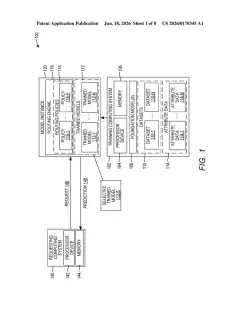
This patent covers a method for optimizing the hyperparameters of a Retrieval-Augmented Generation (RAG) pipeline — the architecture where an LLM is given relevant document chunks as context before answering a question.
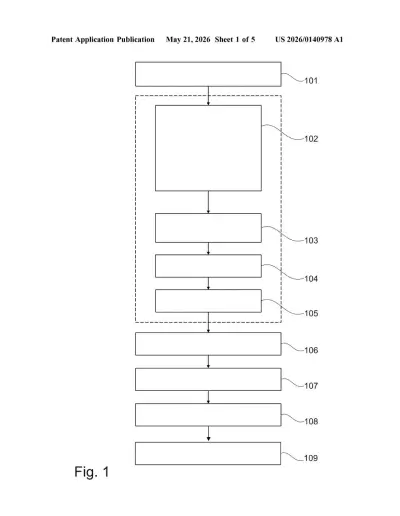
The system works in two phases. In the first phase, it runs repeated experiments: each repetition uses a different "mode" (a specific combination of parameter values) to chunk documents and assemble input context, feeds the resulting prompt to the LLM, and then scores the LLM's provisional answer against a ground-truth answer from a pre-loaded Q&A set. An overall score is computed per mode.
In the second phase, those (parameter-set → score) pairs become training data for an ML surrogate model (think of it as a fast, cheap approximation of the expensive LLM pipeline). This surrogate learns to predict quality scores from parameter configurations.
Finally, the system performs an optimization search over the surrogate model's predictions to find a parameter set expected to yield a score higher than any observed in the training runs — a classic Bayesian optimization-style approach (using a learned proxy function to guide exploration instead of exhaustively testing every combination). The key parameters being tuned likely include things like chunk size, chunk overlap, number of retrieved chunks, and context assembly strategy.
What this means for enterprise LLM deployment costs
For enterprises deploying RAG-based LLM systems — think internal knowledge bases, customer support bots, or document Q&A tools — parameter tuning is a real, time-consuming, and expensive problem. Right now it largely falls on ML engineers running manual experiments. A system that automates this search could meaningfully cut the cost and time-to-deployment for production LLM pipelines.
The deeper strategic angle is that IBM's watsonx platform is squarely aimed at enterprise AI deployments, and tooling that reduces the expertise required to stand up an accurate RAG system is directly on-brand. If this approach ships as part of watsonx, it could be a meaningful differentiator for customers who don't have large ML teams to hand-tune their pipelines.
Source: US 2026/0140978 A1 at the USPTO (PDF). Full patent text and figures are in the official publication.
Get our take in your Top Stories
Liked this breakdown? Add Patentlyze as a preferred source on Google, and our plain-English take shows up more often in your Top Stories the next time IBM patent news breaks.
Add Patentlyze on Google
One click.
There are more where this came from
We read the new patents from Big Tech, carmakers and more and send you the ones worth knowing. Plain English, free, every week.
More from IBM
All 481 IBM patents →
More in AI / ML
All 2,745 AI / ML patents →
Google
Google Patents an Ad-Generation AI That Improves Itself on Ads People Actually Accept
Salesforce
Salesforce Patents a Dashboard for Ranking AI Models by Business Task
Adobe
Adobe Patents a System That Finds the Right Page and Answers Your Document Questions
Google