
Google
Google · AI / ML · Filed Oct 23, 2024 · USPTO published Jul 2, 2026 · Jul 2 release
Google Patents an Ad-Generation AI That Improves Itself on Ads People Actually Accept
Google is patenting an AI that watches which ads get approved, then uses those results to make itself better at writing ads. It's a feedback loop built directly into the ad creation engine.
- Publication number
- US 2026/0187673 A1(US20260187673A1)
- Applicant
- Google LLC
- Filed · Published
- Oct 23, 2024 · Jul 2, 2026
- Inventors
- Xiaohang Li, Feng Yang
- Status when we published
- Examiner raised objections; the company can respond
- Document
- 20 claims
- US classification
- 705/14.43
- Examiner
- CARVALHO, ERROL A (Art Unit 3622)
- Parent application
- National Stage Entry of PCT/US2023/034006 (filed Sep 28, 2023)(PCTUS2023034006)
What Google's self-improving ad AI actually does
Imagine a copywriter who, after every pitch meeting, studies which of their ideas the client picked, then uses those notes to get better at writing pitches. That's essentially what Google is describing here.
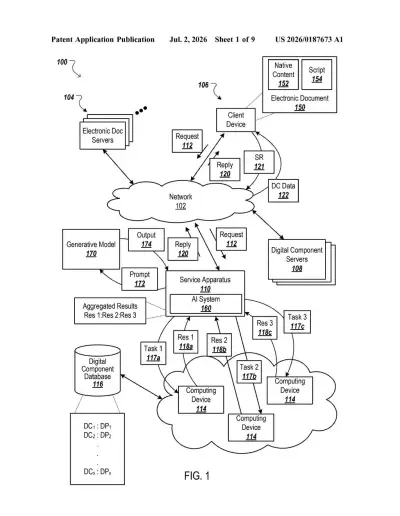
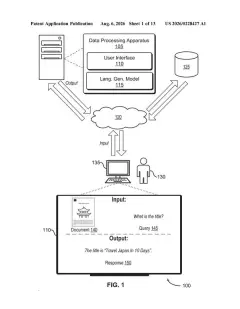
Google's AI system generates a batch of candidate ads in response to a query (say, an advertiser asking for creative for a new sneaker line). It then watches which of those ads get accepted, and the one with the highest acceptance rate becomes the seed for new training data. The model then retrains itself using that data.
The result is an ad-generation system that doesn't stay static. Every round of accepted ads feeds back into the model, nudging it toward the kinds of outputs that humans (or automated systems) actually approve. You end up with an AI that improves on the job, shaped directly by real-world acceptance signals rather than just one-time training data.
How the model picks winners and rewrites its own training data
The patent describes a closed-loop AI system for generating and refining digital components, which in this context almost certainly means ads or ad creatives. Here's how the loop works:
- The system receives a query, which could be an advertiser brief or a targeting request.
- A machine learning model generates multiple candidate digital components in response to that query.
- The system collects performance data indicating the "acceptance level" of each candidate. Acceptance level is likely a proxy for human review approval, click-through rates, or automated policy compliance scores.
- The best-performing candidate is identified, and new training data is generated based on it.
- The underlying machine learning model is then retrained using that new data, completing the feedback loop.
This is a form of reinforcement learning from human feedback (RLHF), the same class of technique used to tune large language models like ChatGPT. The key difference here is that it's applied narrowly to ad generation and uses real-world acceptance signals, not human preference ratings from a separate annotation team. The model is, in effect, shaped by what actually ships.
What this means for advertisers and Google's ad business
For Google's advertising business, this kind of self-improving loop could mean ad creative that gets better at passing review and matching advertiser intent over time, without requiring Google engineers to manually retune the model. The system learns from the market itself.
For advertisers, the implications cut both ways. A model that improves on accepted outputs could produce more usable creative faster. But it also means the AI is optimizing for whatever "acceptance" measures, which may not always align with what makes an ad genuinely effective for the advertiser. If acceptance is defined narrowly (policy compliance, say), the model could become very good at something that isn't quite what advertisers actually want.
Source: US 2026/0187673 A1 at the USPTO (PDF). Full patent text and figures are in the official publication.
Get our take in your Top Stories
Liked this breakdown? Add Patentlyze as a preferred source on Google, and our plain-English take shows up more often in your Top Stories the next time Google patent news breaks.
Add Patentlyze on Google
One click.
There are more where this came from
We read the new patents from Big Tech, carmakers and more and send you the ones worth knowing. Plain English, free, every week.
More from Google
All 1,127 Google patents →
More in AI / ML
All 2,745 AI / ML patents →
Microsoft
Microsoft Patent Covers AI Prompts That Automatically Adapt to Your Document Context
Salesforce
Salesforce Patents a Dashboard for Ranking AI Models by Business Task
IBM
IBM Patents a System That Surrounds Your Real Searches With AI-Generated Decoys
Adobe