
Salesforce Patents a System for Building Custom Automated Assistants Inside Its Sales Software
Salesforce wants to let businesses assemble their own AI agents directly inside the CRM, agents that don't just answer questions but actually take actions, like updating customer records, without a human clicking anything.
What Salesforce's in-CRM AI agent builder actually does
Imagine your sales team gets a new lead at 2 a.m. Instead of waiting for someone to log in and update the account, an AI agent you configured ahead of time wakes up, figures out what needs to happen, and updates the record on its own. That's the core idea behind this Salesforce patent.
The system has a tool called an "agent studio" where a business or user can define exactly what an AI agent is allowed to do, which tasks it can run, which data it can touch, and which rules it has to follow. Once configured, the agent uses a language model (think ChatGPT-style AI) to build a plan and then carries out the steps one by one inside the Salesforce environment.
The key detail: each agent is tied to a specific user account, so it acts within that account's permissions. It isn't a generic AI roaming freely. It's more like a personal assistant that knows its lane and stays in it.
How the orchestration layer plans and runs agent tasks
The patent describes a layered system inside a cloud computing environment (Salesforce's platform) with four main pieces:
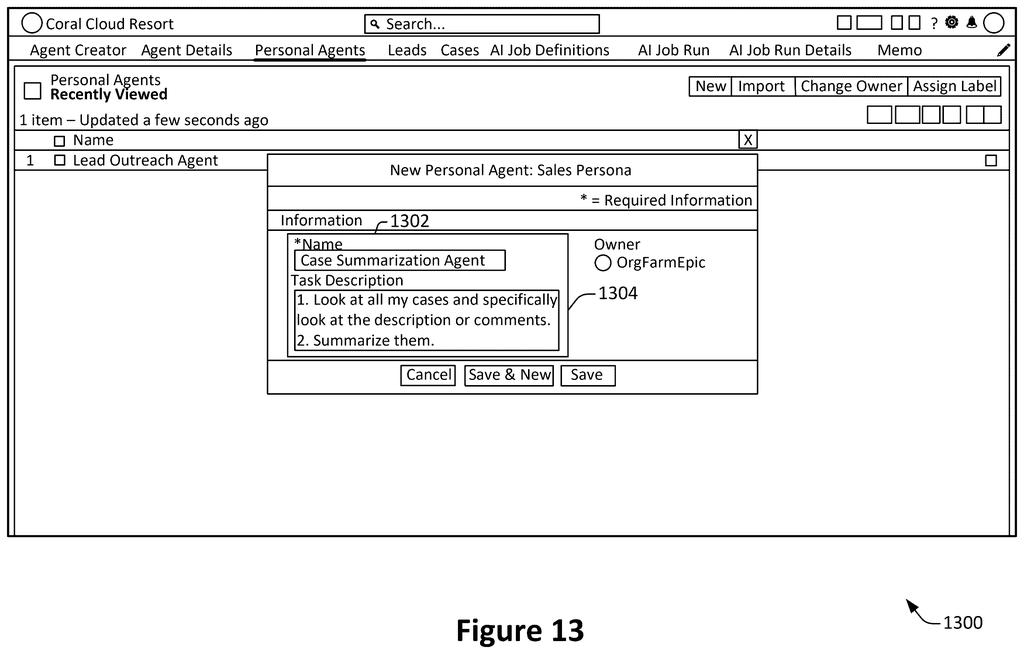
- Agent Studio: A configuration interface where someone sets up a personal autonomous agent definition, basically a blueprint that spells out what the agent can do, linked to a specific user account.
- Unified Metadata Framework: A shared library of action definitions, standardized descriptions of every task the platform supports, like "update a contact record" or "send a notification." Agents pull from this library rather than inventing their own actions.
- Agent Service: The runtime engine that actually launches an agent instance based on its blueprint, giving it a context specific to the user account it belongs to.
- Orchestration Layer: The decision-making core. It sends the user's goal and the agent's configuration to a generative language model (an LLM, like the kind powering modern chatbots), which produces a planning text, essentially a proposed sequence of steps. The orchestration layer then converts that into a concrete execution plan and runs it.
The critical action at the end of any plan is a real write to the database: the agent doesn't just advise, it updates actual records. The whole pipeline runs inside Salesforce's existing permission and account structure, so the agent can only touch data the user account is authorized to access.
What this means for businesses running on Salesforce
For companies that live inside Salesforce, this is a significant architectural shift. Right now, automations in CRM tools tend to be rigid, rule-based workflows: "if X happens, do Y." What this patent describes is an agent that can reason about a situation and construct its own plan, which makes it far more flexible for messy real-world tasks.
For you as an end user or a business administrator, the pitch is that you configure the agent once and it handles follow-through automatically, updating your pipeline, logging calls, or reassigning leads without someone manually doing it. The bounded-permission design (each agent is locked to one user account's access level) is the safeguard that makes this feel less like a liability and more like a practical tool.
This is Salesforce making its Agentforce product strategy concrete in patent form. The architecture here, especially tying LLM-generated plans to a structured action library and real database writes, is exactly the kind of plumbing that separates a demo from a deployable enterprise product. It's not flashy on paper, but it's the kind of foundational filing that shows Salesforce is serious about AI agents being workers, not just assistants.
There are more where this came from
We read every patent application Big Tech publishes and send you the ones worth knowing. Plain English, free, every week.
The drawings
15 drawing sheets from US 2026/0211866 A1 · click any drawing to enlarge


Want this weekly breakdown for a company we don't cover? Patentlyze Pro →
Be the first to weigh in