
Salesforce Patent Reveals System That Builds AI Agents From Flowcharts
Most companies already draw out their business processes as flowcharts. Salesforce is now patenting a way to take that diagram and automatically build an AI agent that carries out every step, no extra coding required.
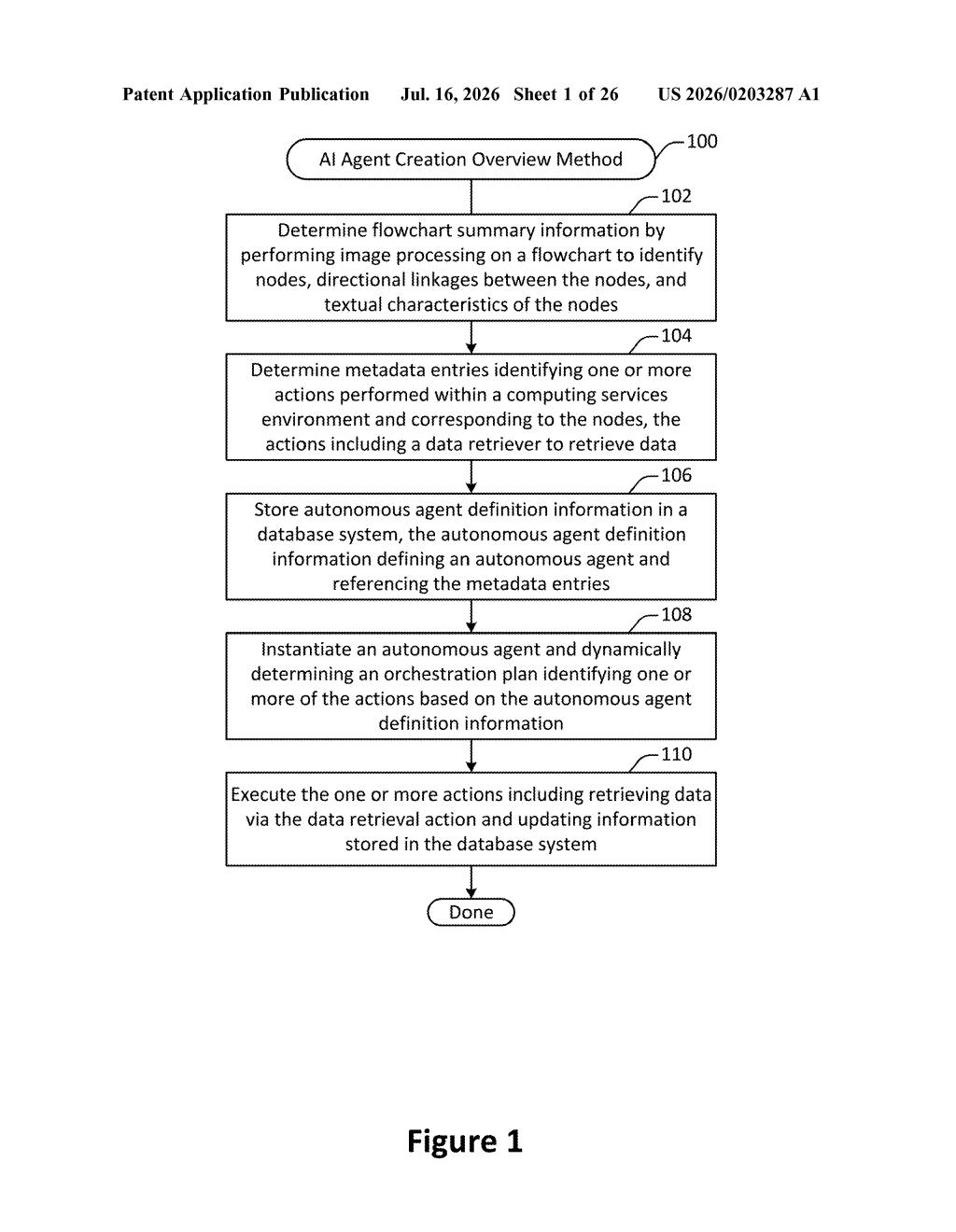
How Salesforce converts diagrams into AI workers
Imagine your company has a flowchart that shows how to handle a customer refund: check the order, verify eligibility, update the account, send a confirmation. Normally, turning that diagram into actual software takes developers weeks. Salesforce's patent describes a system that reads the flowchart and builds a working AI agent from it automatically.
The system uses a language model (similar to the kind that powers chatbots) to understand the boxes and arrows in the diagram. It figures out what each step means, what data needs to be fetched, and what order things have to happen in. Then it packages all of that into a definition that a separate engine can use to actually run the agent.
Once the agent is live, it can look up information in Salesforce's database, make decisions based on what it finds, and update records, all without a human stepping in. The whole idea is that a business analyst who can draw a flowchart should be able to create a functional AI agent without writing a single line of code.
How the flowchart becomes executable agent logic
The patent describes a four-part system inside a Salesforce computing environment.
- Agent Creator: Takes a flowchart (either drawn directly or described in text) and feeds its contents into a generative language model. The model reads the nodes (individual steps), the arrows connecting them (directional linkages), and any labels or notes attached to each step, then converts all of that into structured metadata entries that a computer can act on.
- Database System: Stores the resulting autonomous agent definition, a formal description of what the agent is supposed to do, which actions it can take, and which metadata entries correspond to which flowchart nodes.
- Orchestration Engine: At runtime, this component reads the agent definition and dynamically builds an execution plan, basically deciding in real time which actions need to happen and in what order, based on current conditions.
- Agent Platform: The part that actually does the work: pulling data from the database, processing it, and writing results back. It carries out whatever the orchestration engine decides.
The critical piece is the natural-language interpretation step. Instead of requiring a developer to manually map each flowchart box to a specific code function, the language model handles that translation automatically.
What this means for no-code business automation
For Salesforce, this is a direct play at making its AI agent tooling (branded as Agentforce) accessible to people who aren't engineers. If a business analyst can sketch a process and get a deployable agent back, the barrier to automating back-office work drops considerably. That's a strong pitch to Salesforce's core enterprise customers, who have plenty of documented processes but few developers to spare.
More broadly, this patent signals that the next wave of enterprise software won't be about configuring tools, it will be about describing intent and letting AI do the wiring. Whether Salesforce can execute that vision reliably at scale is a harder question, but the strategic direction is clear.
This is a genuinely interesting patent because it targets a real bottleneck: the gap between how business people describe work (flowcharts, diagrams, written procedures) and how software people implement it (code, APIs, configuration files). If the system works as described, it shortens that gap significantly. The execution risk is high, since language models misread intent all the time, but as a product strategy it makes a lot of sense for a company whose customers live in Salesforce all day.
There are more where this came from
We read every patent application Big Tech publishes and send you the ones worth knowing. Plain English, free, every week.
Want this weekly breakdown for a company we don't cover? Patentlyze Pro →
Be the first to weigh in