
Sony Patent Reveals AI Agents Built From Other Players' Data To Sub In For You
Sony is patenting a way to let an AI play a game on your behalf, but here's the twist: the AI isn't trained on your own habits. It's built from someone else's play data entirely.
What Sony's cross-player AI agent actually does
Imagine you're stuck on a tough level in a game and you need to step away, but you don't want to lose your progress or miss out on a time-limited event. Sony's patent describes a system that sends an AI "agent" in to play for you while you're gone.
The unusual part is where that AI gets its skills. Instead of learning from your own gameplay history, the system pulls in data from a different player, uses their style and behavior as a blueprint, and generates an agent based on that. Think of it like hiring a substitute teacher who was trained by watching your classmate, not you.
The patent covers both the player's profile information and their actual in-game actions as possible sources. Sony has a massive library of PlayStation player data, and this filing suggests the company is thinking about ways to put that collective pool to work in a very direct, personal way.
How the system picks a second user's data to build the agent
The system has two main parts: a recording device that stores a database of player data across many users, and a processor that does two jobs.
First, the processor runs a user identification section that picks a "second user" who is distinct from the player who actually needs the agent. The patent doesn't spell out exactly how that second user is chosen, but the data it can draw on includes two things:
- User information: profile-level details about a player (potentially things like skill level, preferred game genre, or play habits)
- Play data: a recording of actual in-game actions taken during real sessions
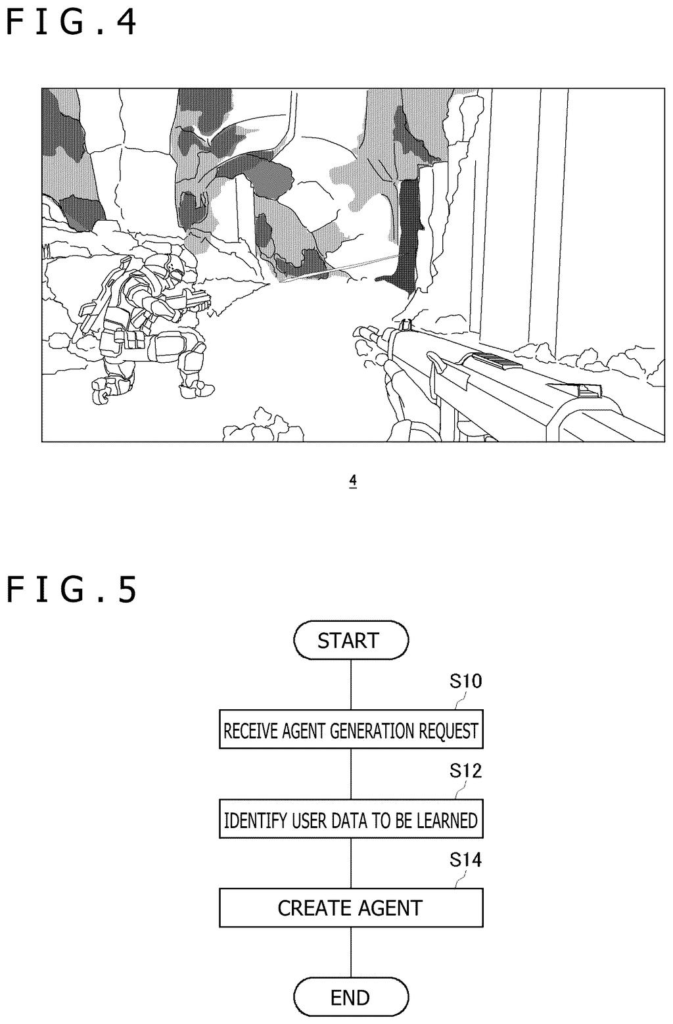
Once a second user is selected, the agent generation section uses that person's data to build an AI that will then play the game on behalf of the first user. The agent is, in effect, an AI impression of a different player.
The patent is written broadly, so it doesn't lock in exactly what "user data" means or how the agent is constructed under the hood. That vagueness is typical of early-stage filings, and it leaves Sony room to apply this concept across many different games and platforms.
What this means for PlayStation players and AI companions
For PlayStation users, this could mean that when you're away, an AI fills in for you in online events or cooperative play, and that AI might actually perform competently because it's drawing on a skilled player's patterns rather than your own (which might be inconsistent or sparse). It could also open the door to social features where you opt in to share your play data so other players' agents can borrow your style.
For Sony, this is a way to make its existing trove of PlayStation Network play data into an active product feature rather than just analytics fuel. The bigger question is consent and transparency: if your playstyle is being used to train someone else's AI stand-in, would you know? The patent is silent on that, which is exactly where the real-world implementation gets complicated.
This is a genuinely interesting idea, and Sony is one of the few companies with enough player data to actually make it work at scale. The mechanics are still vague on paper, but the concept of borrowing one player's identity to power another player's AI agent is novel enough to watch. Whether players will feel comfortable with their data being used this way is a separate problem Sony will have to solve before this ships.
There are more where this came from
We read every patent application Big Tech publishes and send you the ones worth knowing. Plain English, free, every week.
The drawings
7 drawing sheets from US 2026/0208048 A1 · click any drawing to enlarge


Want this weekly breakdown for a company we don't cover? Patentlyze Pro →
Be the first to weigh in