
Samsung Patents a BLE Audio System That Cuts Broadcast Overhead During Active Connections
Samsung is quietly solving a real Bluetooth headache: when your phone is simultaneously broadcasting audio to a crowd AND streaming directly to your earbuds, something has to give — and this patent decides what.
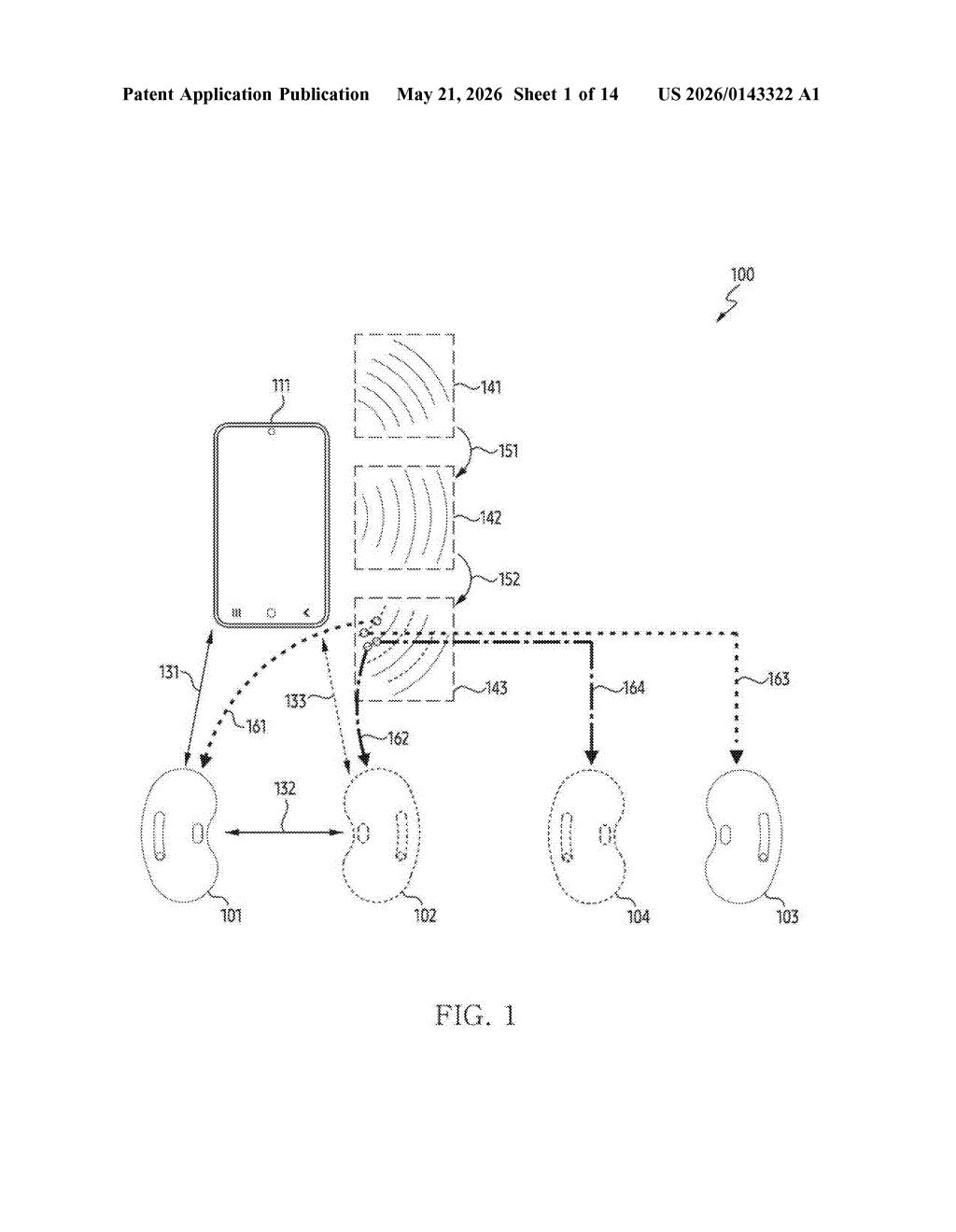
What Samsung's dual BLE audio balancing actually does
Imagine you're using your phone to share audio via Bluetooth to a group of nearby speakers or hearing devices — think airport-style audio sharing — while also staying connected to your own earbuds. Those two audio streams compete for the same radio airtime, and right now that competition can cause glitches.
Samsung's patent describes a way for the device to automatically dial back how many times it repeats a broadcast packet when it detects that a direct, one-to-one audio connection is also active. Normally, broadcast packets get sent multiple times to make sure everyone in range receives them. But when you're also running a private stream, that extra repetition wastes bandwidth.
The fix is elegantly simple: reduce the repeat count (from N retransmissions down to M, where M is fewer) on the broadcast side whenever the direct link kicks in. You still get the broadcast, you still get your private audio — just with smarter use of the available airtime.
How the BIS retransmission count drops from N to M
This patent targets a specific Bluetooth Low Energy (BLE) feature called Broadcast Isochronous Streams (BIS) — the mechanism behind Auracast, Bluetooth's public audio-sharing standard that lets one device beam audio to many listeners at once, like a TV in a gym broadcasting to anyone with compatible earbuds.
The core problem: a BIS sender typically transmits each audio packet N times per BIS event (a scheduled transmission window). Those retransmissions are a reliability buffer — if a receiver misses the first copy, it catches a later one. But they consume radio time.
When the same device also needs to run a Connected Isochronous Stream (CIS) — a private, point-to-point BLE audio link, like streaming to your own earbuds — the two streams compete. The patent's solution is to detect that CIS event and automatically reduce the BIS retransmission count from N down to M (where M ≥ 1 but M < N). This frees up airtime for the private stream without killing the broadcast entirely.
- N = normal retransmission count during broadcast-only mode
- M = reduced retransmission count when a direct connection is also active
- The switch happens dynamically, triggered by detection of the second audio service
What this means for Galaxy buds and Auracast sharing
Bluetooth Auracast — the public audio-sharing spec Samsung and others are building toward — only works well if devices can juggle broadcast and unicast audio simultaneously. Right now, most BLE audio implementations have to make a binary choice. This patent describes the scheduling logic needed to do both at once without sacrificing reliability.
For Galaxy earbuds and Samsung phones, this kind of dynamic retransmission management is table stakes for making Auracast actually usable in real-world scenarios — think sharing audio with a friend while keeping your own private mix. It's not flashy, but it's the kind of firmware-level detail that separates a feature that works from one that drops out every 30 seconds.
This is infrastructure work — the kind that never makes a press release but absolutely determines whether Auracast becomes a feature people actually use or one that gets buried in settings. Samsung is clearly investing in the scheduling layer that makes simultaneous broadcast and unicast BLE audio reliable. That's worth noting, even if the patent itself reads like a particularly dry networking spec.
There are more where this came from
We read every patent application Big Tech publishes and send you the ones worth knowing. Plain English, free, every week.
Want this weekly breakdown for a company we don't cover? Patentlyze Pro →