
Samsung Patents a Circuit That Catches Hackers Trying to Crash Chips on Purpose
Hackers don't always attack software. Sometimes they zap a chip with a voltage spike or laser pulse to force it into a bad state and leak secrets. Samsung's new patent describes a circuit designed to catch that kind of attack the moment it happens.
What Samsung's fault-injection detector actually does
Imagine a thief who, instead of picking a lock, just kicks the door frame hard enough to warp it. That's roughly what a "fault injection" attack does to a computer chip: a physical jolt (a power glitch, a laser, a temperature spike) forces the chip to make an error, and the attacker exploits that error to steal data or bypass security checks.
Samsung's patent describes a built-in watchdog circuit that sits inside the chip itself. While the chip does its normal work, this watchdog continuously compares what the chip is actually outputting against what it should be outputting. If the two don't match, the circuit flags a fault.
The clever part is that the watchdog tracks how an error would travel through the chip's logic stages, so it can catch subtle, hard-to-spot tampering rather than just obvious crashes. It's the difference between a smoke alarm and one that also detects a slow gas leak.
How the compare circuit spots a tampered output
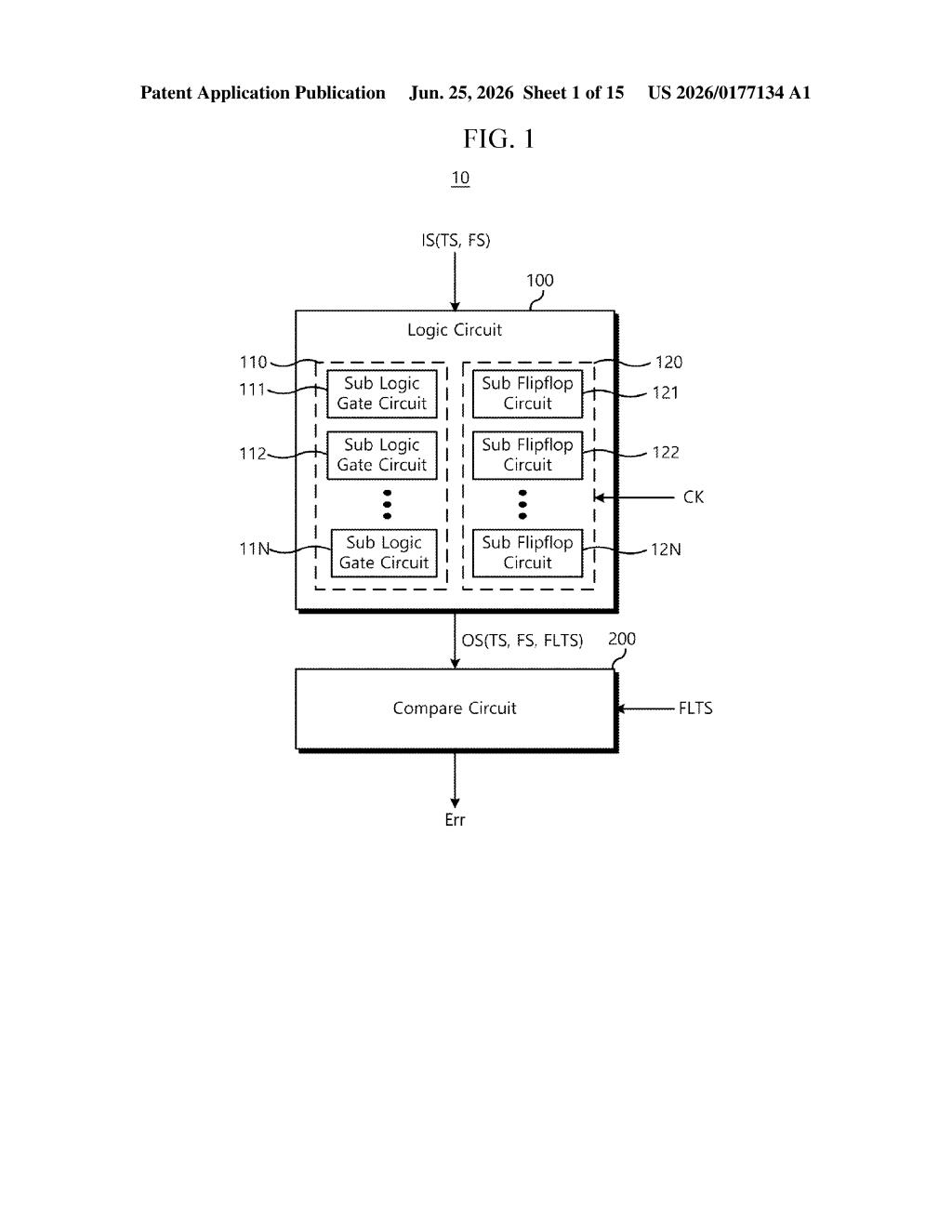
The patent describes a fault detection circuit built around two main pieces working together.
The first piece is the logic circuit being protected. It's made up of a logic gate circuit (the part that does the actual computation, handling multi-bit signals at once) and a flip-flop circuit (a standard digital memory element that holds and passes along data between computation steps). Together these represent a typical building block inside a secure chip.
The second piece is the compare circuit. After the logic circuit produces an output, the compare circuit checks that output against a fault state signal, which is a reference that encodes what the output should look like if no tampering has occurred. If the two don't match, the circuit registers a fault.
The key idea the inventors describe is fault state propagation: rather than just checking a single output, the design accounts for how a fault would move through multiple logic stages over time. This lets the detector catch injected errors that might otherwise hide inside normal-looking intermediate values before corrupting a final result. The approach is meant to work on real production hardware without requiring a full duplicate of the circuit.
What this means for secure chips in phones and payment hardware
Fault injection is a well-documented attack against secure chips: payment terminals, SIM cards, and secure enclaves in smartphones have all been targeted in academic research and real-world attacks. A chip that can catch these attacks internally, without relying on external monitoring, is meaningfully harder to exploit.
For Samsung, which makes chips for its own Galaxy devices and sells them to other manufacturers through its foundry business, a built-in fault detector is a potential differentiator in security-sensitive markets like mobile payments, automotive, and government hardware. If this circuit makes it into production, the practical benefit to you as a user is a device that's harder to physically tamper with even if an attacker has it in hand.
This is real, useful security engineering. Fault injection attacks aren't theoretical anymore, and chip-level countermeasures that don't require duplicating the entire circuit are genuinely worth building. It won't make headlines like an AI feature, but it's the kind of quiet infrastructure work that makes secure hardware actually secure.
There are more where this came from
We read every patent application Big Tech publishes and send you the ones worth knowing. Plain English, free, every week.
Want this weekly breakdown for a company we don't cover? Patentlyze Pro →