
Microsoft Patents a Low-Power Security Method That Protects Data on Small Connected Devices
Locking down a smart thermostat or a cheap sensor with the same encryption used on a laptop is overkill -- and often impossible. Microsoft's new patent tries to fix that with an encryption approach designed specifically for devices that can barely spare a battery tick.
What Microsoft's lightweight encryption actually does
Imagine trying to run the security software from a bank's server on a $3 smart plug. The plug would either crash, drain its battery in hours, or just skip the security entirely. That's a real problem for the billions of small connected devices -- thermostats, sensors, wearables -- that need to send private data but don't have the computing muscle of a phone, let alone a server.
Microsoft's patent describes a way to encrypt messages that does less math overall. The trick is in how it handles the secret key: instead of running heavy operations over and over, it converts the key into a compact number format and then applies only the specific mini-operations that format calls for -- skipping the rest entirely. Fewer steps means less power consumed.
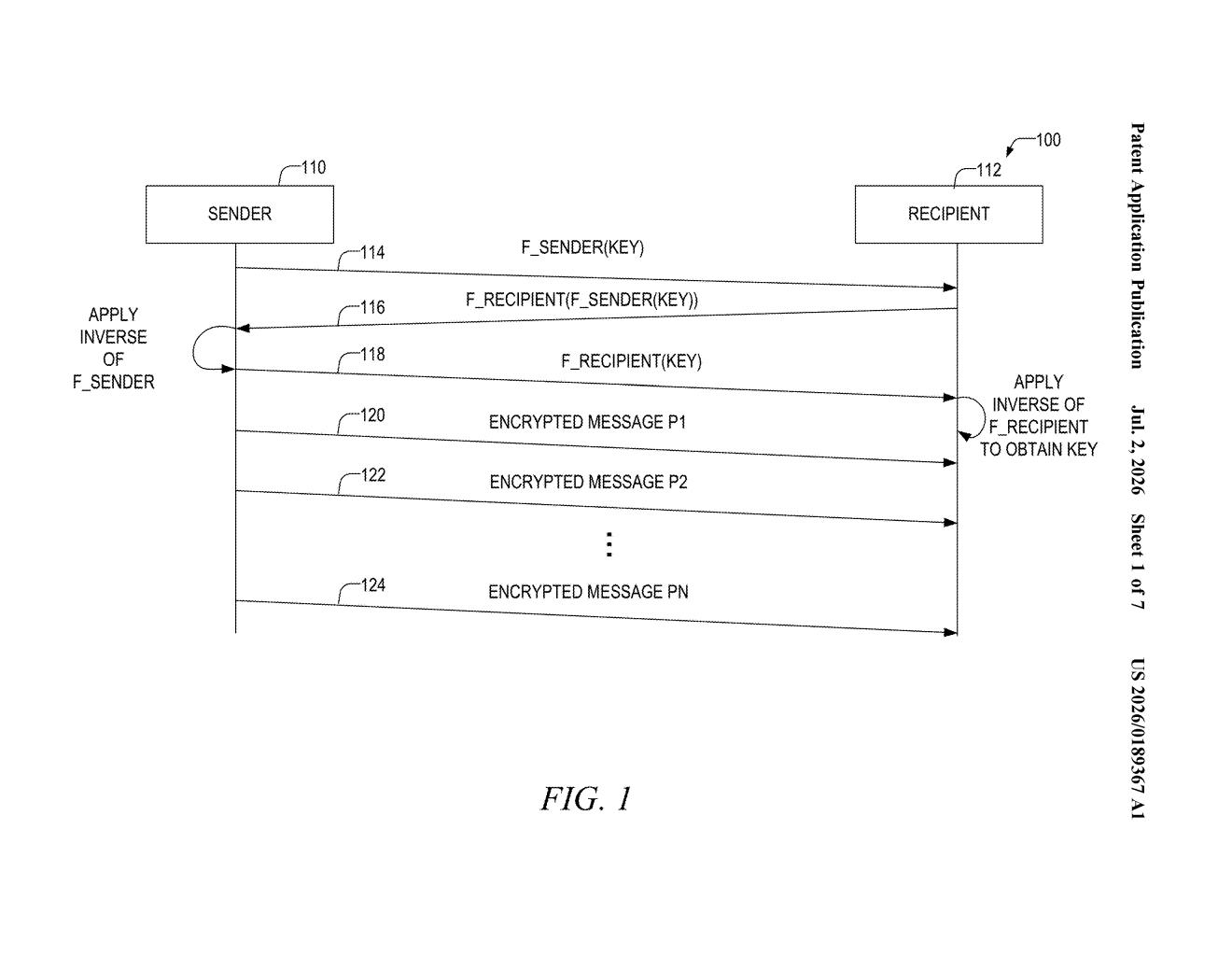
The key exchange itself (the part where two devices agree on a shared secret without ever sending it in the open) borrows a well-known technique called Shamir's three-pass protocol, which lets two parties build a shared secret by passing an encrypted message back and forth three times -- no pre-shared secret required. Microsoft's contribution is in what happens after that handshake, making the actual message encryption lighter on resources.
How the signed-digit key drives the encryption steps
The patent covers two distinct phases: establishing a shared encryption key and then using that key to encrypt the actual message.
Key exchange uses Shamir's three-pass protocol, a method where sender and recipient each apply their own encryption function to a message and pass it back and forth. Because both functions are commutative (meaning the order they're applied doesn't change the result), each side can "peel off" its own layer without ever seeing the other's private key. Think of it like two people putting locks on a box in sequence -- each can remove only their own lock.
Message encryption is where the lightweight innovation lives. The key is converted into a signed-digit representation using an odd number base (a compact way to write numbers where some digits can be negative, which reduces how many non-zero digits appear). Each digit position in that representation maps to a specific mathematical function.
For each chunk of the message, the system then walks through those digit positions and applies:
- The function for that position (if the digit is positive)
- The inverse of that function (if the digit is negative)
- Nothing at all (if the digit is zero)
Because signed-digit representations naturally have more zero digits than standard binary, the system skips a large share of operations entirely -- doing less work per message without weakening the encryption.
What this means for small connected devices
The patent targets a genuine gap in the IoT security story. Most strong encryption standards were designed for hardware that's orders of magnitude more powerful than a cheap sensor or a battery-powered tracker. Devices that can't run those standards often end up with weak or no encryption, which is a known attack surface across smart homes, industrial sensors, and medical wearables.
For Microsoft specifically, this connects to its Azure IoT platform and its broader push into edge computing, where devices process data locally rather than sending everything to the cloud. A patented lightweight encryption method could become a component of its device-management and security toolkit -- though patents describe approaches, not shipping features, and it's a long road from a filing to production code.
This is a real engineering problem being addressed in a technically credible way -- signed-digit representations reducing operation counts is a legitimate optimization, not a gimmick. That said, lightweight encryption is a well-researched field with established standards like NIST's Ascon already in play, so Microsoft will need to show this approach offers something those don't before it moves from interesting patent to adopted standard.
There are more where this came from
We read every patent application Big Tech publishes and send you the ones worth knowing. Plain English, free, every week.
Want this weekly breakdown for a company we don't cover? Patentlyze Pro →
Be the first to weigh in