
New Samsung Display Patent Tackles Screen Flickering During Vivid Color Shifts
When a screen tries to show a color more vivid than its standard pixels can handle, you can get an ugly flash or pop. Samsung's latest patent describes a way to hand off that color to a different set of pixels before the problem ever appears.
What Samsung's two-mode color display actually does
Imagine your TV is playing a nature documentary and a bright tropical bird suddenly fills the frame. The blue in its feathers is so intensely vivid that your screen's normal pixels can't quite render it cleanly, causing a brief flicker or color jump. It's subtle, but once you notice it, it's hard to ignore.
Samsung's patent describes a display that contains two types of pixels: standard ones that cover everyday colors, and supplementary ones that can reach further into more extreme, vivid ranges. A built-in processor watches the color coordinates of each pixel frame by frame. The moment it detects that a color is crossing from the normal zone into extreme territory, it smoothly switches which pixel type takes over.
The key word is smoothly. Rather than waiting until the color is already past the boundary and causing a glitch, the system anticipates the crossing and issues a mode-change signal before the trouble starts. The result, in theory, is a display that expands its color range without any visible hiccup.
How the display detects a color crossing its safe zone
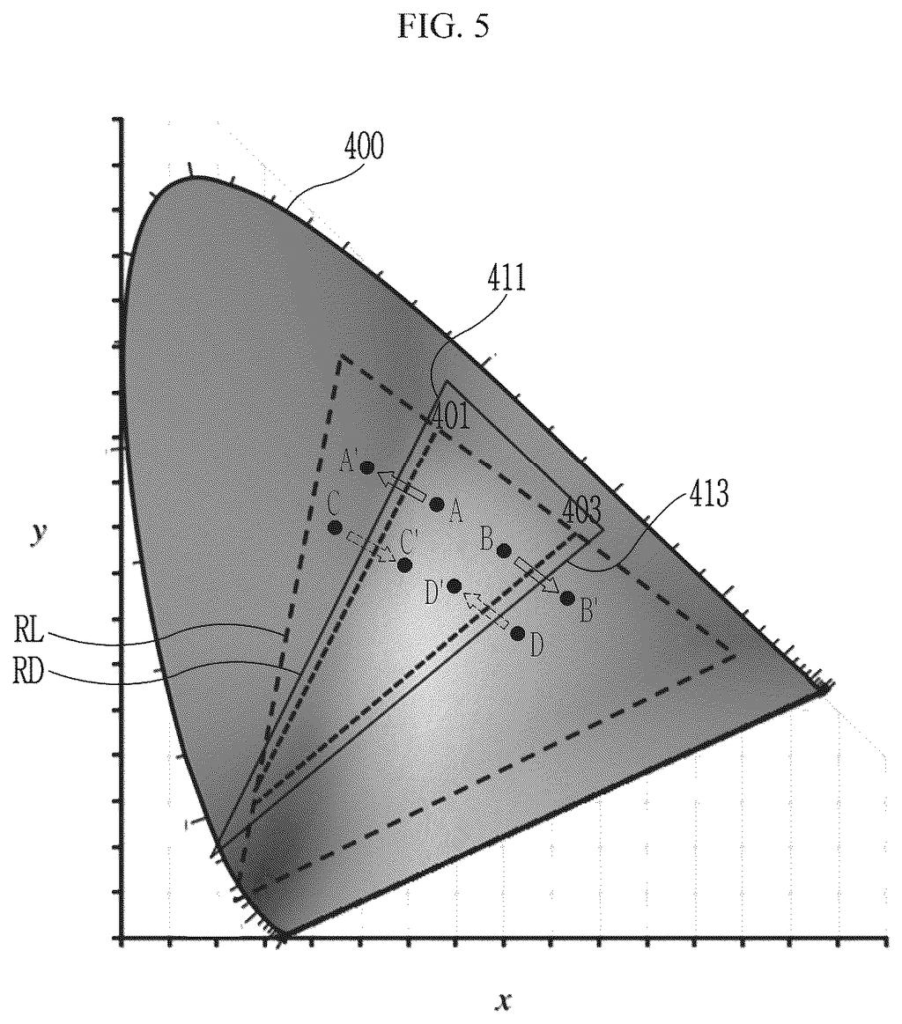
The patent describes a display panel that contains two distinct sets of pixels. Normal pixels cover a standard color gamut (the range of colors a screen can reproduce), and supplementary pixels cover a second, different gamut, presumably extending into more saturated or otherwise unusual colors the normal pixels can't accurately produce.
A data processing circuit monitors the color coordinates of individual pixels on a frame-by-frame basis. Color coordinates are essentially the numeric address of a color in a defined color space, like a GPS location for a specific hue and saturation.
When the circuit detects that a pixel's color coordinate is moving across a defined threshold region (a boundary zone between the two gamuts) from one frame to the next, it generates a mode selection signal. That signal tells the data driver, the hardware component that feeds electrical signals to pixels, to switch which type of pixel is handling that color.
- Frame 1: color falls inside the normal gamut, normal pixels drive it.
- Transition detected: color coordinate crosses the threshold region between frames.
- Frame 2: mode selection signal fires, supplementary pixels take over.
The threshold region itself acts as a buffer zone, giving the system a small margin to detect the crossing before it causes a visible artifact.
What this means for high-end Samsung displays and TVs
Display makers have been expanding color gamuts for years, moving from sRGB to DCI-P3 to Rec. 2020 and beyond. But wider gamuts create a real engineering problem: different pixel technologies or sub-pixel configurations that cover different ranges have to hand off cleanly when content crosses from one zone to another. A bad handoff shows up as a brief flash or color shift that breaks immersion, especially in HDR video.
This patent suggests Samsung is working on displays where the pixel array itself is physically heterogeneous, meaning different pixels are built to serve different color ranges. If that approach reaches consumer products like Samsung OLED monitors, Galaxy phones, or QD-OLED TVs, the frame-level detection system described here would be the logic layer that keeps the handoff invisible to you.
This is a focused, specific engineering solution to a real problem that anyone who has watched HDR content on a wide-gamut display has probably seen without knowing what caused it. It's not a splashy concept patent. The threshold-region detection approach is genuinely clever because it acts on the trajectory of a color across frames, not just its current position, which is the right way to solve an anticipation problem.
There are more where this came from
We read every patent application Big Tech publishes and send you the ones worth knowing. Plain English, free, every week.
The drawings
19 drawing sheets from US 2026/0212799 A1 · click any drawing to enlarge


Want this weekly breakdown for a company we don't cover? Patentlyze Pro →
Be the first to weigh in