
Qualcomm Patents a Low-Data Way to Train AI Across Wireless Devices
What if your phone could help train an AI model without ever sending your personal data to a server, and without clogging the network doing it? That's the core idea behind this Qualcomm patent.
How Qualcomm trains AI without sending your data
Imagine a company wants to improve an AI model, say a keyboard that predicts what you'll type next, using data from millions of phones. The obvious approach (sending everyone's data to a central server) raises privacy concerns and burns through mobile data. Federated learning is the alternative: each phone does its own local training and only sends back a summary of what it learned.
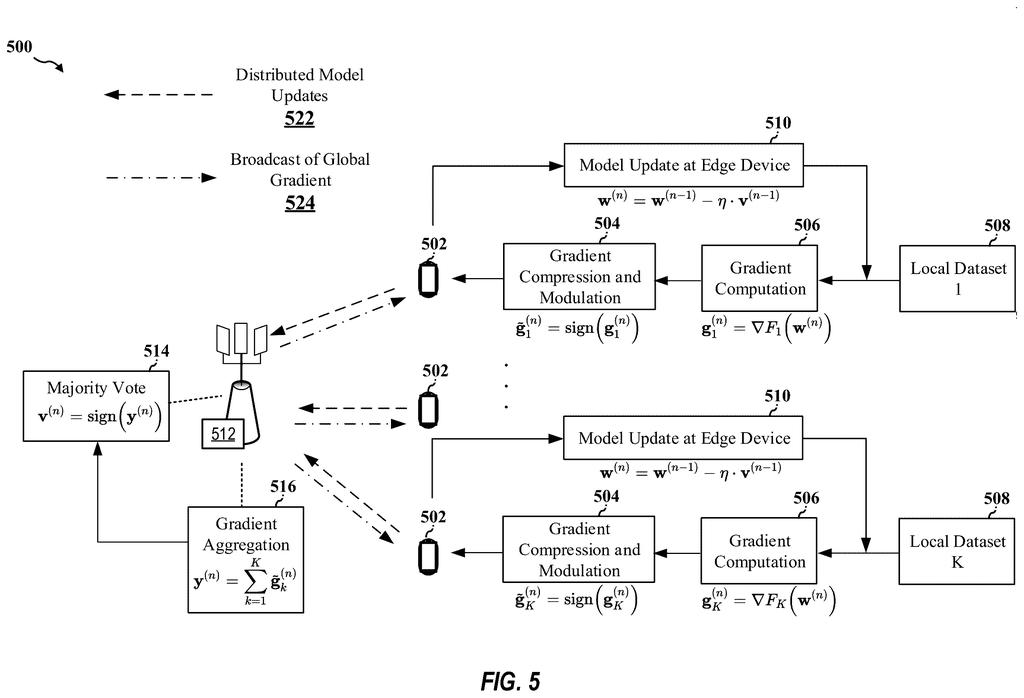
The problem is that even those summaries, called gradients, can be large and expensive to transmit over a cellular connection. Qualcomm's patent describes a clever way to shrink that transmission drastically. Instead of each device sending its full gradient number, it just sends a simple signal: is my number positive or negative? The network server uses those yes/no answers to make a guess, then asks a follow-up question. The devices answer again, and the server refines its guess. This back-and-forth continues until the server has a good-enough estimate.
The result is that devices send only a handful of bits instead of full numbers, which matters a lot when you're coordinating AI training across thousands of phones on a mobile network.
How the binary back-and-forth narrows down the gradient
The patent describes a protocol where a central network entity (think a base station or edge server) acts as an auctioneer, running a rapid binary search across a set of wireless devices participating in federated learning.
Here's the basic flow:
- Each device computes a local gradient value (a number representing how the shared AI model should be nudged based on that device's data).
- Devices send only the sign of their value, positive or negative, to the server. That's one bit per device.
- The server picks a candidate value and broadcasts it. Each device responds with a direction indication: is my value above or below that candidate? Again, one bit per device.
- The server updates its candidate based on the majority response and repeats, narrowing in on a value that best represents the group's gradients.
This is essentially a distributed binary search over gradient space. The patent covers the signaling structure for both uplink (devices to server) and downlink (server to devices) messages, fitting the protocol into standard wireless communication frames. The claimed apparatus is the server-side processing system that orchestrates these rounds.
What this means for on-device AI on cellular networks
Federated learning is already used by companies like Google (for Gboard) and Apple (for on-device models), but most implementations assume a reliable, high-bandwidth connection. Doing this over a cellular network, where bandwidth is shared and precious, is a harder problem. Qualcomm's approach cuts the per-device transmission cost to just a few bits per training round, which could make it practical to run federated AI training across standard 5G or even 4G devices.
For Qualcomm, which makes the chips inside most Android phones and a huge share of cellular modems, this sits squarely in their interest: they want AI training workloads to run on the wireless infrastructure they power. If this technique (or something like it) makes it into a 5G standard, it could give Qualcomm a meaningful role in how on-device AI evolves.
This is a genuinely useful engineering contribution to a real problem, but it's incremental rather than surprising. Binary search over distributed gradients is a known idea in the federated learning research literature, and the novel part here is fitting it into wireless signaling protocols, which is more standards-engineering than invention. The patent matters most as a standards positioning move for Qualcomm.
There are more where this came from
We read every patent application Big Tech publishes and send you the ones worth knowing. Plain English, free, every week.
The drawings
17 drawing sheets from US 2026/0220523 A1 · click any drawing to enlarge


Want this weekly breakdown for a company we don't cover? Patentlyze Pro →