
Google Patents a Method to Build 3D Models From Photos Without Knowing Where the Camera Was
Building a 3D model from photos normally requires knowing exactly where every camera was when each shot was taken. Google is working on a system that skips that requirement entirely, letting AI figure out the camera positions on its own.
What Google's no-position-data 3D modeling actually does
Imagine you want to turn a pile of old vacation photos into a 3D walkthrough of a place you visited, but the photos have no GPS data, no timestamps, and no record of which direction the camera was pointing. Today, that's a serious problem for most 3D reconstruction software.
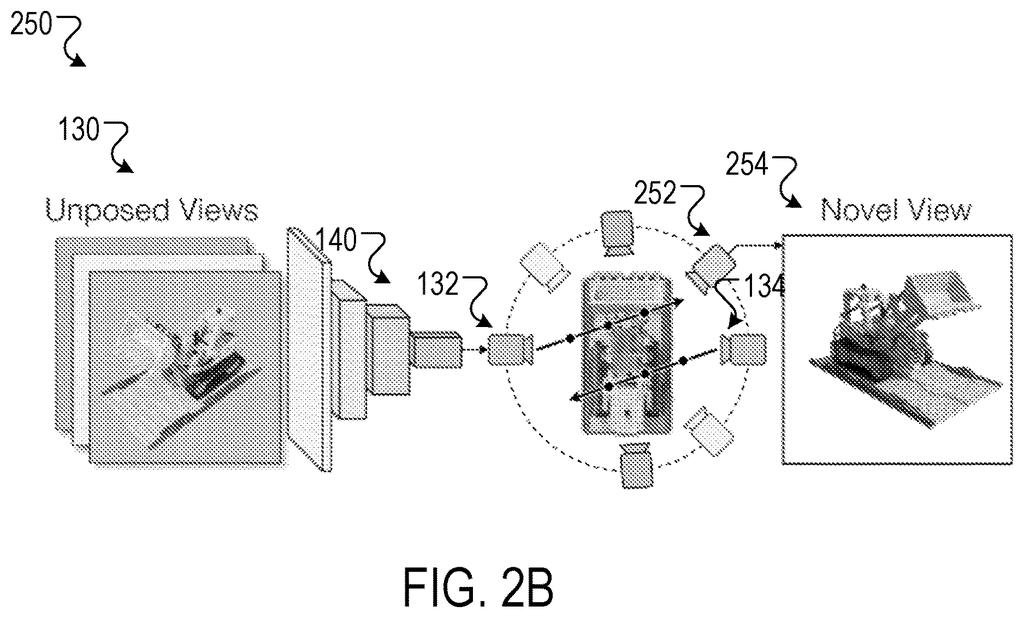
Google's patent describes an AI system that teaches itself two things at once: how to guess the camera position for any photo, and how to use those guesses to rebuild what the scene looks like in 3D. The two parts train together, each making the other better as training progresses.
The clever part is that the system doesn't just commit to one camera-position guess per photo. It generates a whole family of plausible positions and tests all of them, picking whichever produces a reconstruction that most closely matches the original image. Over time, both the guesser and the 3D model sharpen up without anyone supplying a single GPS coordinate.
Methods, systems, and apparatus, including computer programs encoded on a computer storage medium, for training a neural radiance field (NeRF) model on unposed images.
Translation: This patent covers software that trains 3D imaging systems using photos that lack camera location data.
How the encoder and NeRF model train each other simultaneously
The core problem in 3D scene reconstruction is that building a neural radiance field (NeRF, a type of AI model that represents a scene in 3D and can render it from any angle) traditionally requires knowing the exact position and orientation of every camera that took the source photos. Gathering that data, a process called camera pose estimation, usually requires running a separate pipeline before training even starts, and it can fail on tricky image sets.
Google's method trains two neural networks at the same time:
- An encoder network that looks at a photo and outputs a guess for where and at what angle the camera was when the picture was taken.
- A NeRF model that takes that camera-position guess and tries to reproduce the original photo from it.
The key innovation is the equivalence class step. Rather than generating one camera-position guess and hoping it's right, the encoder produces a guess, and then the system automatically expands it into a set of mathematically equivalent poses (think: rotating or reflecting the guess in ways that should produce the same scene). Every pose in that set is fed into the NeRF model, which tries to reconstruct the image from each one.
The training loss (the measure of how wrong the reconstructions are) is calculated across all those poses. By rewarding the pair of networks when any pose in the equivalence class leads to a good reconstruction, the system avoids getting stuck on a single wrong guess and trains more reliably.
What this means for 3D scanning and AI-generated scenes
The barrier of needing pre-labeled camera data has long limited who can use NeRF-style 3D reconstruction. Professional photogrammetry setups, specialized scanning rigs, or careful photo-taking protocols are usually required. A system that works on unposed images, meaning ordinary photos with no position metadata, could make high-quality 3D scene capture accessible to far more applications, from e-commerce product pages to cultural heritage archiving.
Google's steady investment in neural radiance field research shows up repeatedly in its AI imaging work. Removing the camera-data requirement is one of the remaining practical obstacles to deploying this technology at scale, so a training approach that sidesteps it is a concrete step toward that goal, even if the gap between a research patent and a shipping product remains wide.
That makes this Google's 17th filing we've tracked in our AI simulation coverage since May, joining ones on rehearsing future scenarios and hidden 3D video layers.
The problem this patent attacks is real and underappreciated. Camera pose estimation is the step that breaks most casual attempts at 3D reconstruction. It requires either controlled capture conditions or a separate software pipeline that routinely fails on crowded scenes, low-texture surfaces, or images taken years apart. That failure point walls off NeRF technology from enormous categories of real-world photo collections.
The equivalence-class approach is a considered answer to a specific failure mode: a single wrong camera-position guess early in training can send the whole model in the wrong direction. Generating a family of plausible guesses and scoring all of them gives the system more ways to find a good path, which is a principled response to an optimization problem that genuinely stumps current methods.
The abstract and claim are fairly narrow and academic in scope, which makes this feel more like a research contribution being protected than a product feature in development. Whether it scales to messy, real-world photo sets the way the patent implies is the open question, and that's where the real difficulty lives.
There are more where this came from
We read every patent application Big Tech publishes and send you the ones worth knowing. Plain English, free, every week.
The drawings
5 drawing sheets from US 2026/0268588 A1 · click any drawing to enlarge


Want this weekly breakdown for a company we don't cover? Patentlyze Pro →