
Sony Patents an AI That Fixes Corrupted Body-Movement Recording Data for Animation
Motion-capture suits record actors' every twitch, but the data they produce is riddled with noise and glitches. Sony has filed a patent for an AI system that uses real physics to clean that data up before it ever reaches an animator's desk.
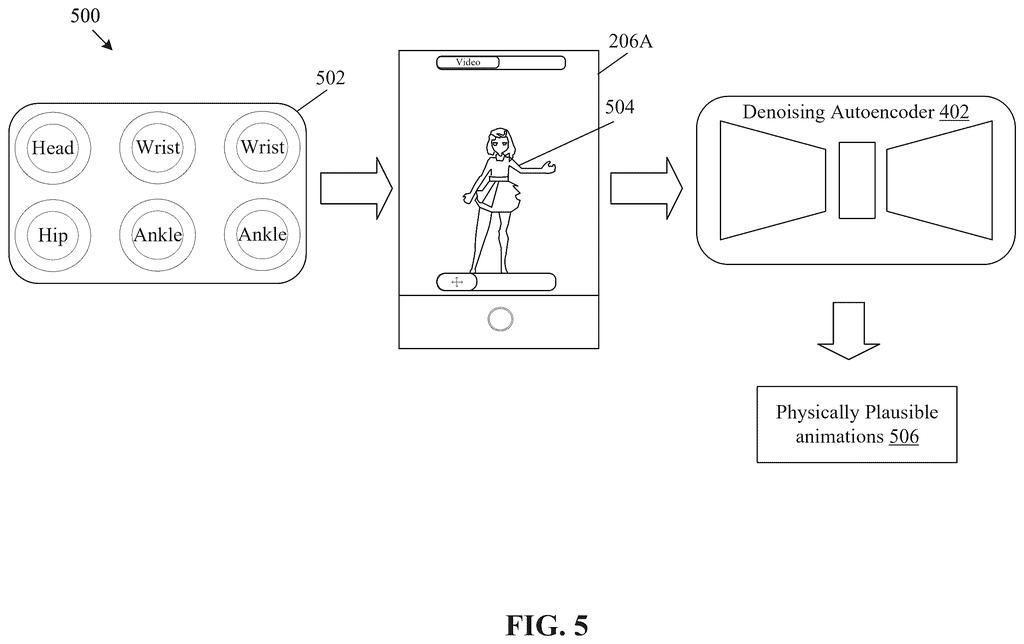
How Sony's system cleans up a performer's recorded movements
Ever tried to film something in a wobbly room and watched the footage come out shaky, even though the actors were perfectly still? Motion-capture has the same problem: the sensors on performers' bodies pick up real movement and a lot of random jitter, making the resulting animation look jerky or unnatural.
Sony's patent describes a system that acts like a physics-aware proofreader for that messy data. It takes the raw recordings from a performer, runs them through an AI that has learned how human joints actually move, and produces a corrected version that obeys the rules of real-world physics. The AI is trained by comparing its guesses against a physics simulation until it gets good enough to predict what a clean movement should have looked like.
The practical result: animators working on games, films, or virtual characters spend less time manually scrubbing artifacts from their motion data, and the characters they produce move more like real people.
… apply a policy network on the received first humanoid model and the received motion-capture data, based on noise data associated with the motion-capture data; determine a humanoid action associated with the received motion-capture data, based on the application of the policy network …
Translation: The system uses an AI network to clean up messy motion capture data and figure out what movement is happening.
How the policy network and motion filter work together
The system centers on two connected pieces: a policy network (an AI that learns to decide what joint movements make physical sense) and a motion filter (a module that predicts what the body's physics should look like at any given moment).
Here is how they interact:
- The device receives a baseline 3D humanoid model, essentially a digital skeleton, paired with raw motion-capture data from a real performer.
- The policy network looks at that data alongside a measurement of how noisy it is, then proposes a corrected set of joint-motion parameters (the angles and velocities at each body joint that define a pose).
- The motion filter takes those proposed corrections and checks them against physics-based kinematics (the science of how joints can and cannot physically move) to produce a state model, a snapshot of where the body should be.
- The policy network is then trained against that state model in a feedback loop, getting progressively better at predicting plausible human motion from noisy input.
The claim covers the whole closed loop: receiving data, applying the network with awareness of noise, resolving joint parameters, filtering through physics, and feeding results back into training. That tight coupling between the noise-awareness step and the physics-filter step is the core of what the patent is protecting.
The motion filter is configured to predict physics-based kinematics information of the motion-capture data, based on the trained policy network.
Translation: The filter forecasts realistic physical movements using the trained AI system.
What this means for game and film animation pipelines
Motion-capture is behind nearly every realistic human character in big-budget games and films, and cleaning up its output is one of the most labor-intensive parts of any production pipeline. A system that automates physics-based correction could reduce the manual cleanup work that costs studios significant time and money, and it could make high-quality motion data accessible to smaller studios that can't afford large cleanup teams.
For Sony specifically, the filing sits at the intersection of its PlayStation game studios, its film visual-effects work, and its broader interest in virtual characters, giving it potential relevance across multiple business lines. Motion-capture cleanup is one of many areas where new Big Tech patents are showing AI being inserted directly into creative production workflows rather than kept at the research stage.
That makes this Sony's 12th filing we've tracked in AI simulation since May, a topic that already includes painting styles onto 3D scenes and one on avatar neck movement.
Claim 1 is written broadly. It covers any electronic device whose circuitry performs this specific four-step loop: receive noisy motion-capture data, apply a noise-aware policy network, filter through physics, retrain from the result. That scope is wide enough to potentially apply to real-time game engines, offline animation software, and cloud-based post-production services alike. The practical consequence of that breadth is that if the claim survives examination, it could create friction for any competitor building a physics-informed motion-cleanup tool using a reinforcement-style training loop.
The key question a patent examiner will ask is how much prior art already exists for combining neural policy networks with physics-based kinematic filters, because that combination is an active research area with published academic work dating back several years.
Taken on its own terms, the claim is a reasonable attempt to patent a specific workflow architecture rather than a vague idea. Whether it is narrow enough to survive prior-art challenges is the real open question, and that makes this one to watch more for its legal outcome than for any immediate product announcement.
Get our take in your Top Stories
Liked this breakdown? Add Patentlyze as a preferred source on Google, and our plain-English take shows up more often in your Top Stories the next time Sony patent news breaks.
There are more where this came from
We read every patent application Big Tech publishes and send you the ones worth knowing. Plain English, free, every week.
The drawings
6 drawing sheets from US 2026/0253300 A1 · click any drawing to enlarge


Want this weekly breakdown for a company we don't cover? Patentlyze Pro →
Be the first to weigh in