
Google Patents a Robot Arm That Steers Itself by Watching Its Own Movements
Google has patented a system that lets a robot arm guide itself to an object simply by watching where its own hand is going, using a neural network that adjusts its instructions every fraction of a second based on live camera footage.
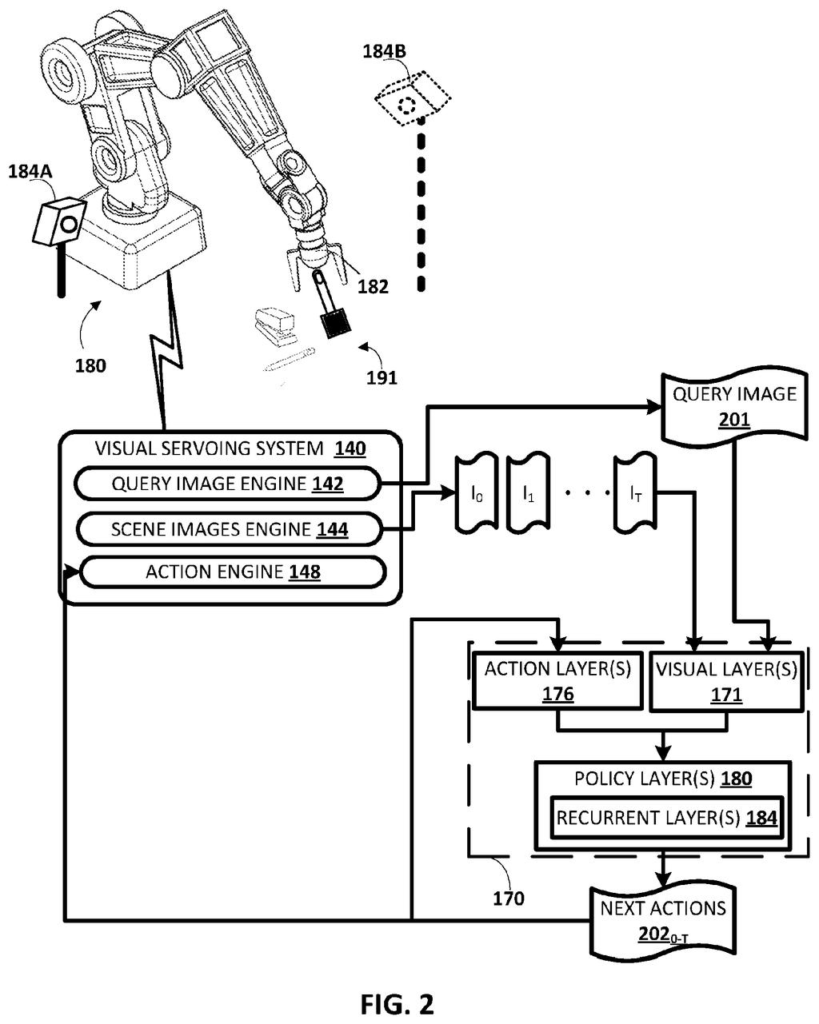
How Google's robot arm finds and grabs objects
Imagine telling a robot to grab your coffee mug. The tricky part isn't the grab itself, it's getting the arm to the right spot without bumping into everything else on the desk. Most robot arms today need to be told exactly where things are in 3D space, which is expensive and fragile. Google's approach is different: the robot watches its own arm through a camera and keeps asking, "Is my hand closer to the target than it was a moment ago?"
You can actually give the robot a typed or spoken instruction, like "pick up the red cup," and a neural network takes it from there. Every fraction of a second, it looks at a fresh camera frame, checks where the arm just moved, and decides the next small nudge to make.
The system was trained mostly on simulated data, meaning Google ran millions of virtual pickup attempts in a computer before ever moving a real arm. Only a small amount of real-world training was needed on top of that, which makes the approach much cheaper to scale.
determine a query that is based on typed or spoken user interface input, the query indicating a target object to be interacted with by an end effector of the robot …
Translation: The robot figures out what you want it to grab based on what you type or say.
How the neural network loops vision into each move
The patent describes a real robot with an arm (called an end effector) and a camera (called a vision component). A recurrent neural network (a type of AI that carries memory from one moment to the next, unlike a model that treats each frame as completely new) runs in a continuous loop to steer the arm.
Here's the cycle the system runs through:
- The robot receives a user query, either typed or spoken, naming the object to grab.
- At each time step, it feeds the neural network three things: the query, a fresh camera image showing both the target object and the arm, and a record of what move it just made.
- The network outputs an action prediction, a small instruction about how to move the arm next.
- The arm moves, a new image is captured, and the loop starts again immediately.
A key design goal is viewpoint invariance, meaning the model doesn't break if the camera shifts angle or is mounted differently on a different robot. Most visual systems are brittle when the camera moves; this one is trained to handle that.
Training relied heavily on simulated episodes (virtual robot trials in a physics simulator), with only a smaller layer of real-world data added afterward. That mix lowers the cost and time required to train a capable robot.
… generate, at each of a plurality of time steps, an action prediction that represents a prediction of how the end effector should be moved to cause the end effector to move toward a target object …
Translation: It continuously calculates the next tiny movement needed to guide its hand toward the goal.
What this means for real-world robot deployment
The practical barrier to deploying robot arms in homes or small businesses isn't raw mechanical capability, it's adaptability. A robot that can only work if its camera is bolted in exactly the right spot, or that needs a full re-training session every time it moves to a new room, isn't useful outside a factory. Google's patent directly targets that problem by making the vision model tolerant of camera position changes.
The sim-to-real training approach (train mostly in simulation, fine-tune on a little real data) is also significant for cost. If this works at scale, it means you could theoretically retrain a robot for a new task without needing a warehouse full of expensive real-world trial data.
This is serious robotics research from a team (Toshev, Sadeghi, Levine) with genuine academic credibility in the field. The viewpoint-invariance angle is the most commercially meaningful part: it's the kind of fix that sounds boring but actually determines whether these systems ship in the real world or stay in the lab. Worth tracking.
There are more where this came from
We read every patent application Big Tech publishes and send you the ones worth knowing. Plain English, free, every week.
The drawings
7 drawing sheets from US 2026/0225237 A1 · click any drawing to enlarge


Want this weekly breakdown for a company we don't cover? Patentlyze Pro →
Be the first to weigh in