
Microsoft Files Patent for Swappable Add-Ons That Give One On-Device AI New Skills
Microsoft has filed a patent for keeping one general-purpose AI model on your device and teaching it new jobs through small downloadable add-ons, instead of installing a full-size AI model for every feature.
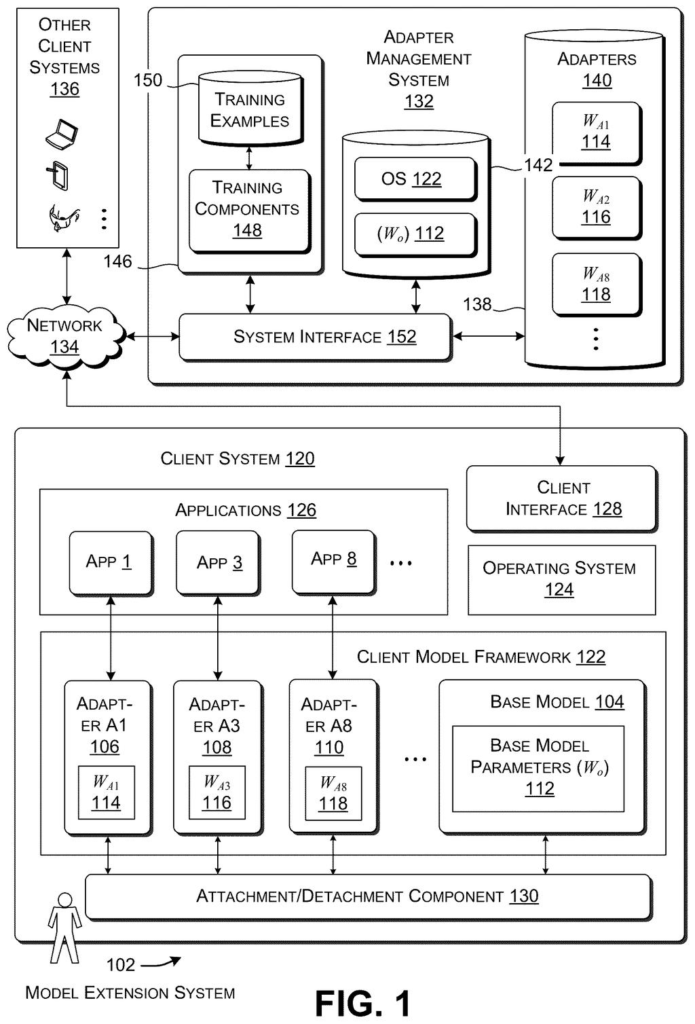
What Microsoft's add-on AI setup actually does
Today, every AI feature you run on your own computer tends to bring its own huge model along. These models can have billions of parameters (the numbers that hold an AI's learned knowledge), so a laptop or phone can run out of memory fast, and updating each one takes time. That's a big reason many apps send your data to a server instead.
Microsoft's filing describes a different setup. Your device keeps one shared base model. Each new skill, such as summarizing text or judging the sentiment of a video call, arrives as a small add-on that plugs into it. In one example, the base model takes about 6 GB of storage, while all the add-ons together use hundreds of megabytes.
Update a skill and you only download its add-on. Several add-ons can even work at the same time, and your data can stay on your device.
… mapping an input item to a task-specific response using the base neural network in conjunction with the adapter neural network, wherein both the base neural network and the adapter neural network have quantized weights, and are configured to receive and produce quantized activations …
Translation: Combining the main AI with a small plug-in to handle specific jobs efficiently.
How one frozen base model teams up with add-ons
The setup has a base model (a large, general-purpose AI, such as a language model) that stays frozen on the device, plus adapters, small add-ons trained to steer it toward one job. When an app calls a feature, the base model and the adapter each process the same input, their results are added together, and a small final "head" network turns the total into an answer for the app.
Everything is quantized, meaning numbers are stored as small whole numbers instead of long decimals. That saves space and suits the device's neural processing unit (NPU, a chip built for AI math). In one example, adapter weights use 8-bit integers while the base model uses 4-bit ones. The claims require that the adapter be trained and shrunk against the already-shrunk base model, so it learns to compensate for rounding errors.
The filing describes a three-stage training recipe:
- Fine-tuning: adjusting the adapter's weights on examples for the task.
- Post-training quantization: shrinking the finished adapter's numbers.
- Quantization-aware training: practice runs with rounding simulated, to recover lost accuracy.
Adapters stay separate in memory instead of being merged into the base model's weights. That lets two or more run at once. The system can also pick shared scaling settings wide enough that future adapters fit.
The technique includes receiving one or more adapter models from a network-accessible source. The base model and each adapter model have quantized weights and are configured to receive and produce quantized activations.
Translation: Downloading lightweight task add-ons from the internet to work with the core AI model.
Why this could put more AI on your laptop
If this works the way the filing describes, your laptop or phone could run several AI features locally from a single stored model. That means smaller downloads, quicker updates (only the add-on changes while the base stays put), and less need to send your text or calls to a server. It could also work when you have no internet connection.
The filing also sketches an add-on marketplace, with listings showing each add-on's function, price, age appropriateness and popularity, plus a compliance check for public uploads. It names Microsoft's Phi models, which it calls small language models, as example bases. It also describes a consistent protocol so any add-on stays compatible with the base model, whenever it was made.
Microsoft's 21st filing we've tracked since August on on-device AI privacy builds on earlier applications including a chip-level AI vault and hiding names from group chats.
Claim 1 is wide in some directions and tight in others. It covers a device that receives a task-specific add-on and runs it together with a base network. It does not say the base must be a language model (that narrowing waits until claim 2), and it does not require a special AI chip (claims 3 and 4).
The tight part is the shrunken-numbers condition. Both pieces must use small whole numbers, and the add-on must have been trained against the already-shrunk base. Add-on systems built on full-size models fall outside that wording as written.
Claim 15 adds the idea with the most everyday payoff: two add-ons held apart in memory so they can run side by side. Overall, this is a sensible plan for fitting more AI on a device, with a first claim written broadly enough to matter if it is granted.
Get our take in your Top Stories
Liked this breakdown? Add Patentlyze as a preferred source on Google, and our plain-English take shows up more often in your Top Stories the next time Microsoft patent news breaks.
There are more where this came from
We read every patent application Big Tech publishes and send you the ones worth knowing. Plain English, free, every week.
The drawings
9 drawing sheets from US 2026/0349807 A1 · click any drawing to enlarge


Show the other 1 sheets

Want this weekly breakdown for a company we don't cover? Patentlyze Pro →
Be the first to weigh in