
Google Patents a Two-Factor Source-Picking System for AI-Generated Answers
When Google's AI gives you an answer, how does it decide which sources to pull from? A new patent reveals that relevance alone isn't the whole story — there's a second score in play.
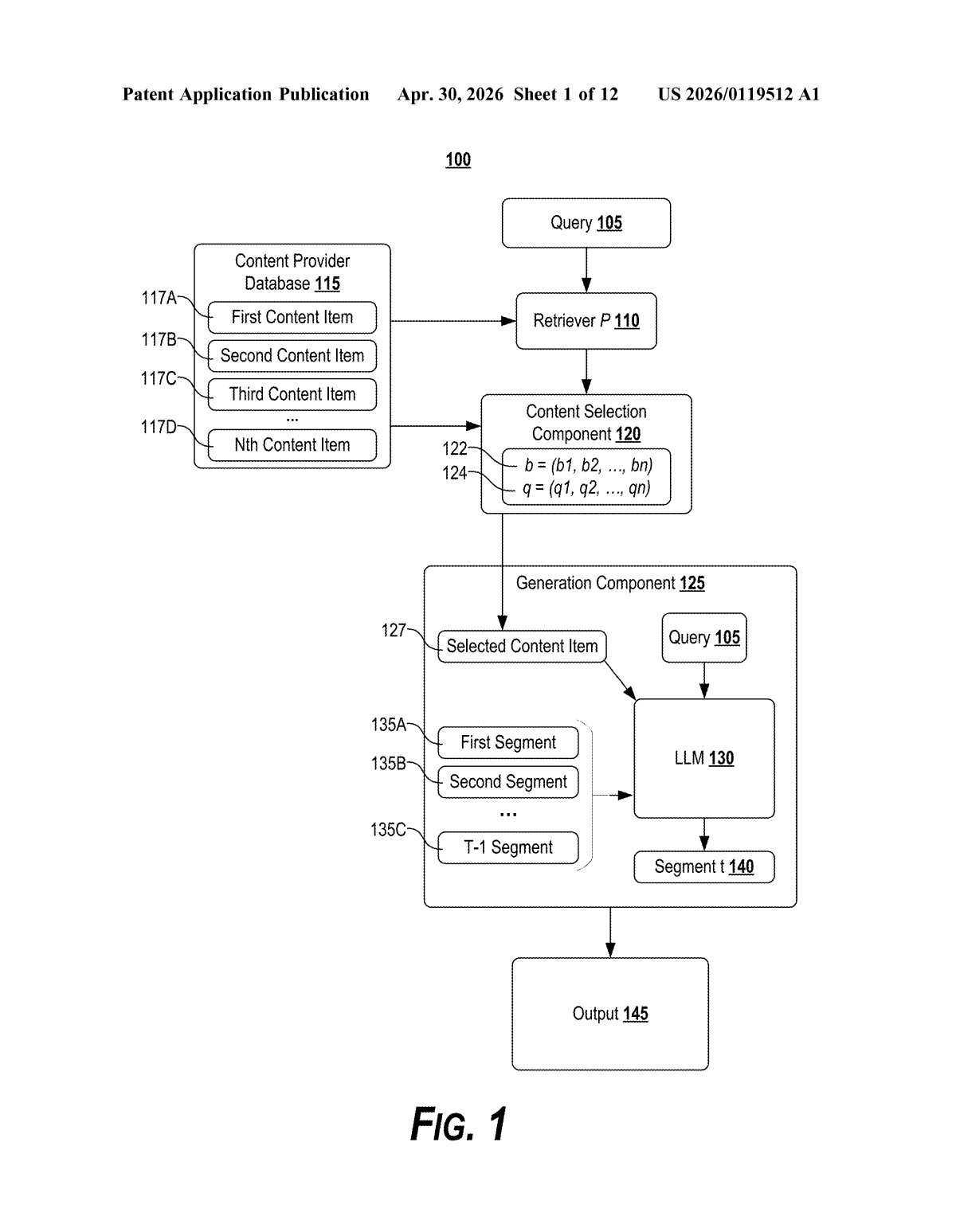
What Google's adjusted source-selection system actually does
Imagine you ask Google a question and it gives you an AI-generated answer with a little citation link at the bottom. Behind the scenes, Google had to pick which website or source to pull that answer from. Right now, you might assume it just grabs the most relevant result. This patent says it's more nuanced than that.
Google's system scores each candidate source on two separate dimensions: how relevant it is to your query, and something called a "provider selection value" — a score tied to the source itself, not just the content. Both scores feed into the final pick. Think of it like hiring: a candidate might be perfectly qualified (relevance), but you also weigh their fit with the team (provider score).
The selected source then gets handed to a large language model alongside your original question, and the AI generates a response segment that includes a clickable link back to that source. You see the answer; the source gets the citation.
How relevance scores and provider values combine to pick a source
This patent describes an adjusted retrieval-augmented generation (RAG) system — RAG being the technique where an AI doesn't just rely on its training data but actively fetches external documents to ground its answers in real, citable content.
The core innovation is the content selection step. A retriever component queries a database of content items and produces two things for each candidate source:
- A relevance score — how well the content matches the user's query (standard RAG behavior)
- A provider selection value — a separate score attached to the content's provider, which could encode things like source quality, diversity, or commercial weighting
The system then selects a source based on both scores together, not just relevance alone. The patent doesn't fully specify what drives the provider selection value, but the framing suggests it could be used to balance which publishers or data providers get cited — a significant lever.
Once a source is selected, it's bundled with the query and "segment data" (context about where in the response this chunk belongs) and sent to an LLM (large language model). The model returns a natural-language response segment, which is then displayed in the UI with a selectable component — a clickable citation — tied back to the original source.
What this means for publishers feeding Google's AI results
For everyday users, this is mostly invisible plumbing. But for publishers and content providers, the "provider selection value" is the thing to watch. If Google can tune that second score — boosting or suppressing certain sources independent of pure relevance — it has a structural mechanism to favor some publishers over others in AI-generated answers. That's a meaningful policy lever dressed up in engineering language.
It's also a signal that Google is thinking carefully about RAG at scale as AI Overviews become a bigger part of Search. A smarter source-selection layer could reduce the hallucination risk that comes from grabbing irrelevant content, while also giving Google more control over the citation ecosystem it's building.
The 'provider selection value' is doing a lot of quiet work here — it's the kind of second-order parameter that looks like a technical detail but could end up being one of the most consequential knobs Google ever turns. Publishers who've been asking 'how does Google decide to cite me in AI answers?' now have a partial, if opaque, answer: there's a score for that, and it's separate from relevance.
There are more where this came from
We read every patent application Big Tech publishes and send you the ones worth knowing. Plain English, free, every week.
Want this weekly breakdown for a company we don't cover? Patentlyze Pro →