
Google Patents a Plain-English Interface for Configuring AI Voice Bots
Imagine telling your company's AI phone bot 'stop reading the refund policy out loud' — and it just works. That's the core idea behind Google's latest patent filing.
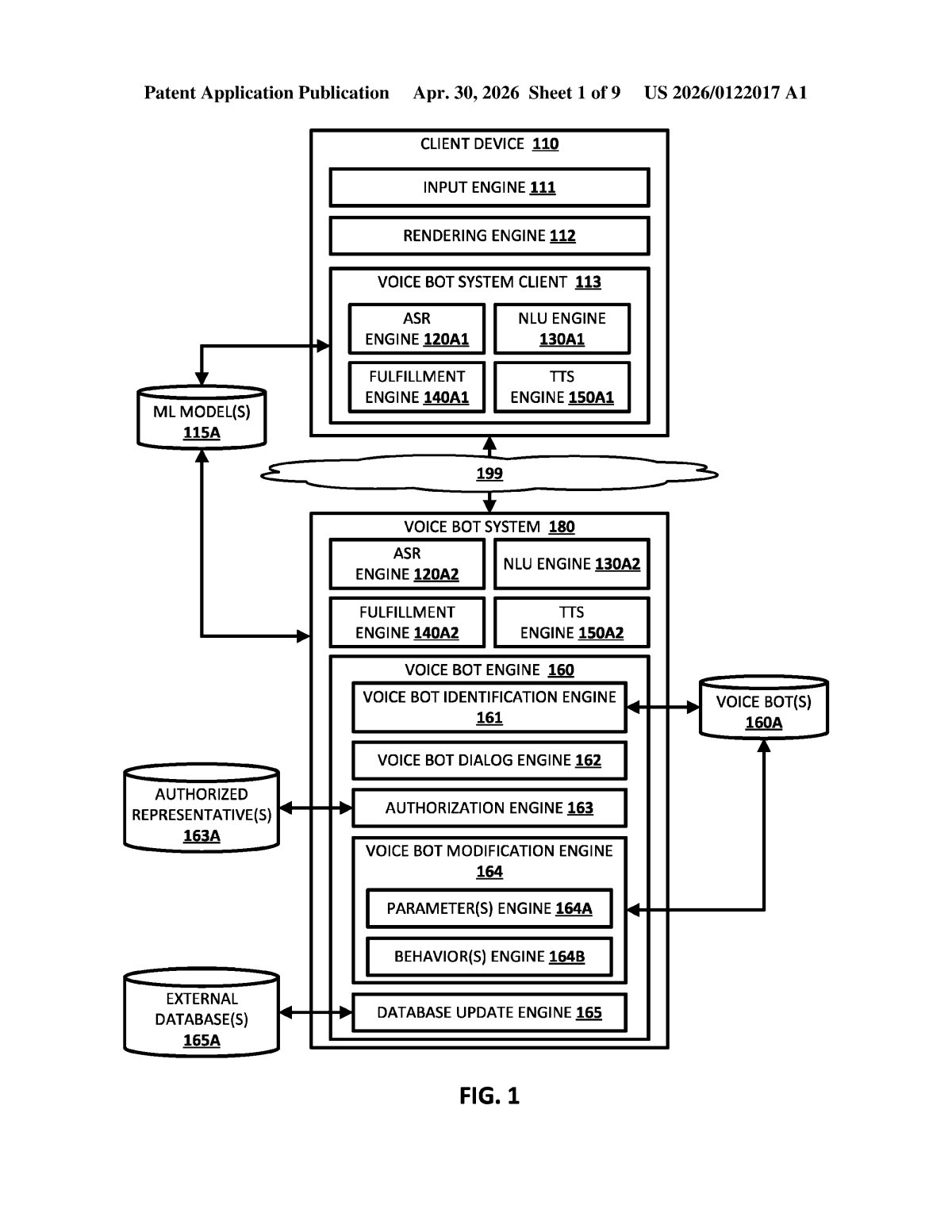
What Google's natural-language bot editor actually does
Picture a business that uses an AI voice bot to handle customer calls. Right now, if a manager wants to change how that bot behaves — say, make it stop offering a promotion that ended last week — they probably need a developer to dig into configuration files or retrain the model. It's slow, technical, and annoying.
Google's patent describes a system where a business representative (think: a customer service manager, not an engineer) can simply talk to the bot or type a plain-English instruction to update its behavior. The same channel the customers use — phone, chat app, messaging — is the one the manager uses to issue the change.
The system checks whether that person is actually authorized to make changes, then interprets their plain-language request and updates the bot's settings automatically. No code, no tickets, no waiting on IT.
How Google's system parses rep commands into bot parameters
At its core, this patent covers a conversational configuration interface — a meta-layer on top of a voice or chat bot that lets authorized humans reshape its behavior using natural language, through the same communication channels the bot's end-users already use.
Here's what the system does step by step:
- Identifies the conversational agent tied to a specific business entity.
- Presents a configuration interface to an authorized representative — this could be the same phone line or chat widget customers interact with, just gated to admin users.
- Receives natural language input (e.g., "Don't mention the extended warranty on calls lasting under two minutes") and parses it to identify which underlying parameters need to change.
- Verifies authorization — the system checks that the person issuing commands has the rights to make those changes before anything is updated.
- Applies the updates so future user interactions immediately reflect the new behavior.
The key technical move is that natural language input maps to structured bot parameters — the system has to understand what "don't mention X" means in terms of the bot's actual configuration. That translation layer is where most of the complexity lives.
What this means for businesses running AI phone agents
Businesses using AI-powered call centers or chat agents — increasingly the norm at mid-to-large companies — currently face a real operational bottleneck: the people who know what the bot should say (customer service leads, product managers, compliance teams) usually can't directly change it without engineering support. This patent targets that exact gap.
For Google, this fits neatly into its Contact Center AI (CCAI) platform strategy. Making bot management accessible to non-technical operators would be a meaningful competitive advantage over rivals like Amazon Connect or Twilio, and could accelerate enterprise adoption of Google's AI infrastructure.
This is a genuinely useful, practical idea — not flashy AI research, but exactly the kind of tooling that determines whether enterprise AI actually gets adopted or sits unused. The real technical challenge is in the natural-language-to-parameter mapping layer, and the patent is vague enough about that part to suggest Google is still figuring it out. Worth watching if you care about how AI tooling gets productized, not just built.
There are more where this came from
We read every patent application Big Tech publishes and send you the ones worth knowing. Plain English, free, every week.
Want this weekly breakdown for a company we don't cover? Patentlyze Pro →