
Google Patents AI Method for 3D Scene Building That Filters Out Distractions
When Google's AI tries to build a 3D model of a street, every passing car and wandering pedestrian is a problem. This patent describes a training method that teaches the model to recognize and ignore those distractions automatically.
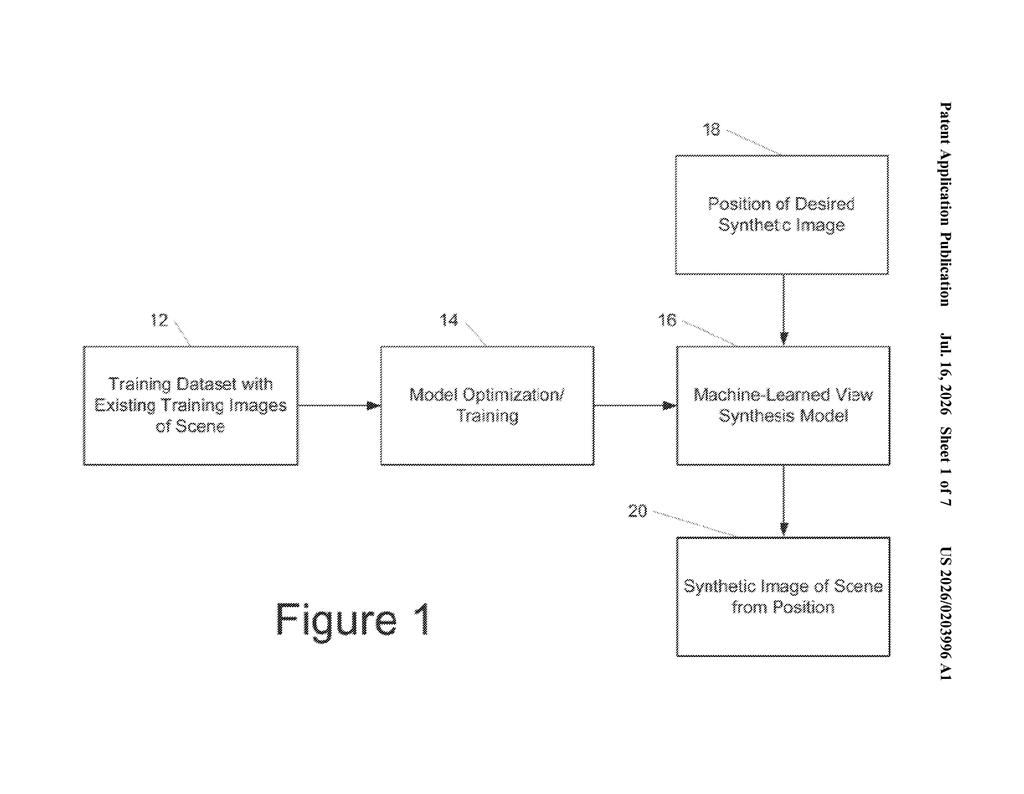
What Google's distraction-filtering 3D scene tech actually does
Imagine trying to take a perfect photo of a building, but people keep walking in front of your camera. If you took dozens of photos and combined them, the ghosts of those people would blur across your final image. That's exactly the problem Google's AI faces when it tries to reconstruct a 3D scene from a collection of photos or video frames.
The technology described here teaches the AI to figure out, on its own, which parts of any given image are distractions, things like moving cars, people, or shifting shadows, and give those pixels less weight when learning about the scene. It's a bit like letting the AI vote on which parts of a photo to trust, neighborhood by neighborhood.
The result is a 3D model that better represents the actual, permanent scene rather than a confused average that includes whatever happened to be in the way during filming. Google is filing this as a method for training its neural radiance field models, a type of AI used to generate photorealistic synthetic views of real places.
How the model learns to spot and downplay distracting pixels
The patent covers a training method for neural radiance fields (NeRFs), a class of AI model that learns to generate photorealistic images of a 3D scene from any angle, based on a collection of real photos taken from multiple positions.
The core problem: when you train a NeRF on images that include distractor objects, anything transient, like a passing truck or a person walking by, the model gets confused. Those objects appear in some training images but not others, so the model doesn't know whether to treat them as part of the permanent scene.
Google's fix is a smarter loss function (the formula the AI uses to measure how wrong its guesses are during training). Specifically, the patent describes:
- An iteratively reweighted least-squares approach: the model keeps refining which pixels to trust, giving lower weight to pixels that look like outliers (that is, pixels that don't match the expected scene).
- A trimmed least-squares variant: the model can outright discard the most suspicious pixels rather than just downweighting them.
- A spatial smoothness bias: instead of judging each pixel in isolation, the model also looks at neighboring pixels when deciding whether something is a distractor. This prevents noisy, patchy decisions about what counts as a distraction.
Together, these techniques push the model toward ignoring transient objects without ever being explicitly told what those objects are.
What this means for Maps, Street View, and virtual worlds
Google uses NeRF-style technology across products like Street View, Maps immersive views, and various AR tools. Any improvement in how cleanly these models handle messy, real-world capture conditions translates directly into better-looking and more accurate 3D reconstructions of real places.
More broadly, the challenge of handling distractors is one of the genuine hard problems in 3D AI. If Google can make its training process significantly more tolerant of real-world clutter, that reduces the cost and effort of capturing usable training data. You wouldn't need to clear a street of traffic to get a clean 3D model of it, which opens the door to faster, cheaper, and more complete coverage of the physical world.
This is a genuinely useful piece of engineering work addressing a well-known headache in 3D AI. It won't make headlines at a product launch, but the kind of training-quality improvement it describes is exactly what separates a 3D reconstruction tool that works in the lab from one that works on an actual street corner. Worth paying attention to if you follow Google's Maps or AR ambitions.
Get our take in your Top Stories
Liked this breakdown? Add Patentlyze as a preferred source on Google, and our plain-English take shows up more often in your Top Stories the next time Google patent news breaks.
There are more where this came from
We read every patent application Big Tech publishes and send you the ones worth knowing. Plain English, free, every week.
Want this weekly breakdown for a company we don't cover? Patentlyze Pro →