
Nvidia Patents an AI That Builds a Secret 3D Model Behind Every Image It Generates
When Nvidia's AI draws a picture, this patent says it should also be building a 3D skeleton of that picture at the same time. That hidden skeleton is what makes the image editable in ways a flat photo never could be.
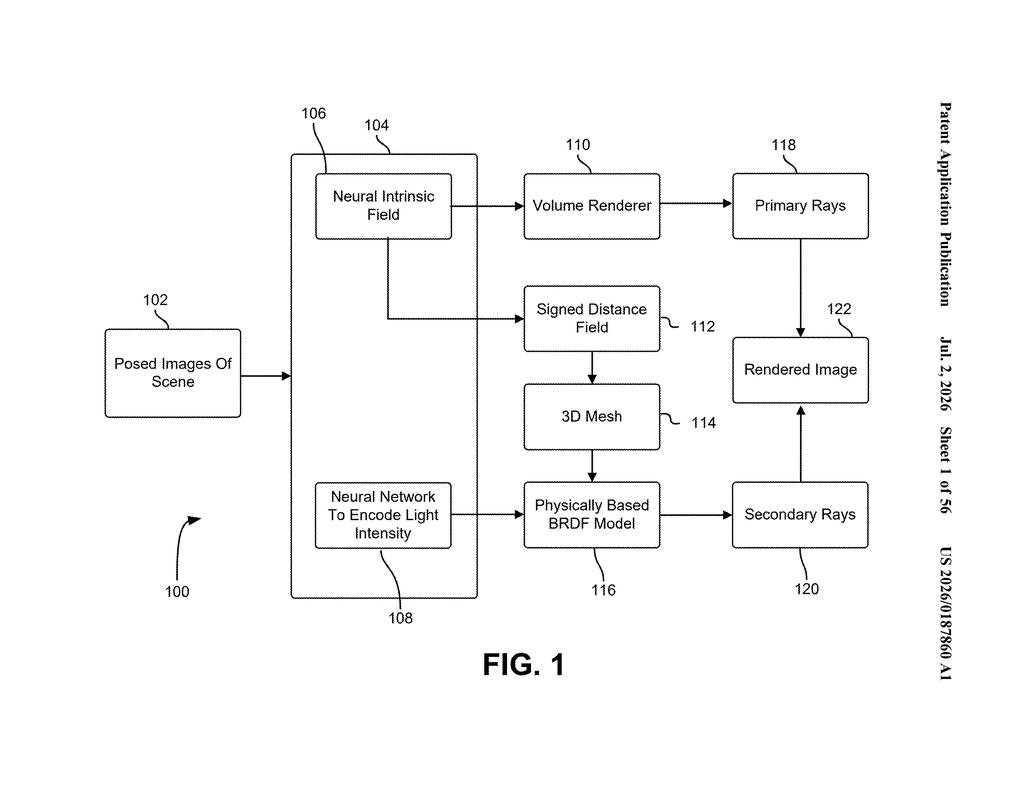
What Nvidia's dual 2D-and-3D image generator actually does
Imagine you ask an AI to generate a portrait of a person. You get a flat image, just like a photograph. But if you want to change the lighting, tilt the head, or add a shadow, you're basically stuck because the AI has no idea what's "behind" that face.
Nvidia's patent describes a system that solves this by doing two things at once. When the AI generates your image, it also builds a 3D model underneath, like a digital sculpture that matches the picture exactly. That 3D structure is called a mesh, and it's the same kind of skeleton used in video games and animated movies.
With that hidden mesh in hand, you can do things to the image that would normally be impossible: add realistic shadows, change the camera angle, or warp the surface as if a light source moved. The flat image becomes something closer to a 3D scene you can actually manipulate.
How the neural network ties a 3D mesh to a flat image
The patent describes a processor-level system where one or more neural networks (AI models trained on large amounts of data) generate two outputs simultaneously: a standard 2D image and a 3D mesh representation of the same subject.
A 3D mesh is a wireframe model made up of connected triangles or polygons that define the surface geometry of an object. Think of it as the invisible armature inside a CGI character. In this system, the mesh is not something a user builds by hand; the neural network infers it automatically from the same generation process that produces the flat image.
The mesh is then used to apply effects to the 2D image. The patent does not enumerate every possible effect, but the architecture implies things like:
- Relighting (changing where shadows fall based on a new light source position)
- Geometric deformation (bending or tilting the surface)
- View synthesis (simulating what the subject looks like from a slightly different angle)
The key insight is that the 2D image and the 3D mesh are produced jointly, so they are guaranteed to align. You do not need a separate step to "fit" a 3D model to an already-generated image, a process that often introduces errors.
What this means for AI-generated visuals in games and creative tools
For anyone working with AI-generated images, the big frustration today is that the output is a static, flat file. You can repaint it, but you cannot easily relight it or change the perspective without regenerating from scratch. Nvidia's approach would change that by making the 3D information a native output of generation, not an afterthought.
For Nvidia specifically, this fits directly into its existing tools for game developers and 3D artists, including its Omniverse and generative AI platforms. A system that outputs mesh-backed images could mean AI-generated assets that drop straight into a game engine or film pipeline, ready to be lit and animated, without extra manual work.
This is a genuinely useful idea, not a speculative one. The gap between AI-generated images and production-ready 3D assets is a real, daily frustration for game studios and VFX teams. A neural network that closes that gap in a single pass is exactly the kind of thing Nvidia would build to sell more of its data-center hardware to creative-industry customers.
Get our take in your Top Stories
Liked this breakdown? Add Patentlyze as a preferred source on Google, and our plain-English take shows up more often in your Top Stories the next time Nvidia patent news breaks.
There are more where this came from
We read every patent application Big Tech publishes and send you the ones worth knowing. Plain English, free, every week.
Want this weekly breakdown for a company we don't cover? Patentlyze Pro →