
Google Files Patent for Ad-Making AI That Keeps Each Advertiser's Data Private
Some big advertisers avoid AI ad tools because they don't want their design ideas and sales data feeding a shared system. Google's patent describes giving each one a private copy of a base model that learns their style and keeps what it learns to itself.
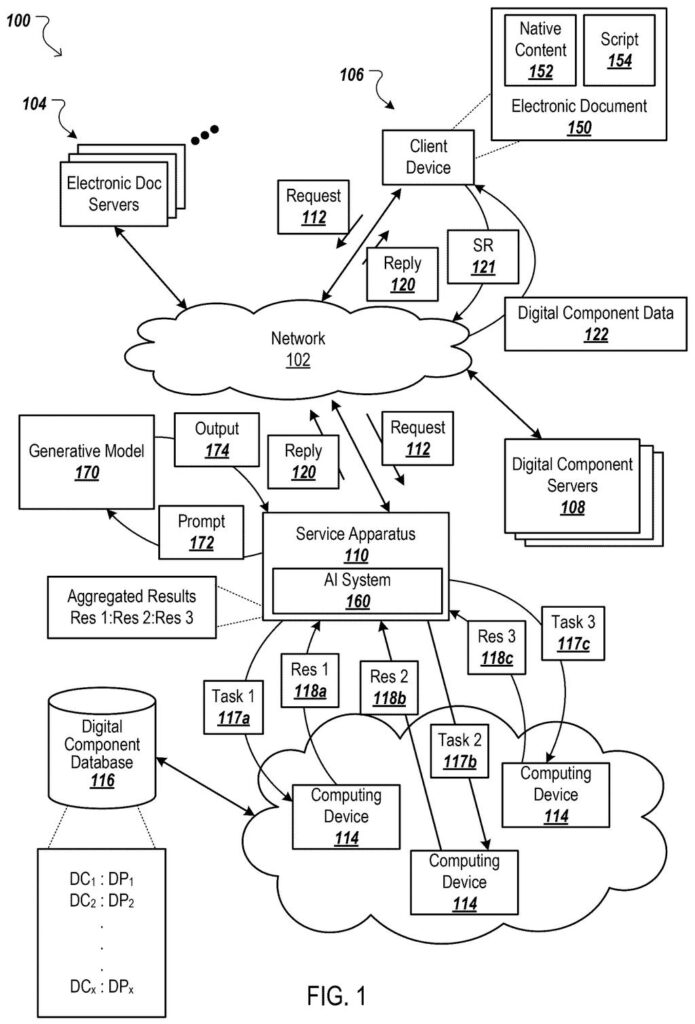
What Google's private ad-model copies actually do
Every time a company asks an AI tool to whip up an ad, it hands over a bit of its playbook: product details, design taste, and which ads actually get clicks. Some big advertisers don't love that, and the filing says some skip these tools altogether for that reason.
Google's patent describes a workaround. Start with one general-purpose base model trained on generic data. When an advertiser wants privacy, the system makes a copy of that model just for them, then keeps teaching the copy with their own material. What the copy learns stays locked in: it can't flow back to the original or over to anyone else's copy.
The same trick works for whole industries. A fashion copy can learn fashion's look, an automobile copy can learn cars, and each can split again into narrower versions, like coats or jewelry.
obtaining, by an artificial intelligence (AI) system, first model parameters associated with a first machine learning model at a first hierarchical layer; generating, by the AI system, a second machine learning model comprising the first model parameters, the second machine learning model at a second hierarchical layer beneath the first hierarchical layer …
Translation: The AI builds a smaller sub model using base settings from a larger main model.
How a base model spawns advertiser-only copies
The claims cover a parent-and-child arrangement of AI models. The system takes the settings of a first model (the base model) at the top layer of a hierarchy, builds a second model that starts with those same settings at a layer beneath it, then refines that second model (keeps training it on new data). Afterward, at least one setting differs from the parent's, and the child's settings are unshareable with the parent.
The settings can include the model type, its weights (the numbers a model adjusts as it learns), its loss function (how it scores its own mistakes) and its optimization algorithm (how it improves). The filing also describes:
- Two data-sharing options: keep everything locked, or share some data back up the chain. The data covers the child's settings, the queries, the outputs and the training data.
- Training that turns each request and the ad it produced into new lessons, either with the ad as the right answer (supervised learning) or with a reward score (reinforcement learning, which learns by trial and error).
- Chains deeper than two layers, such as base, fashion, then clothes or jewelry.
In the ad example, the system can test several candidate ads, track clicks and purchases, and screen out clickbait that earns clicks but few sales. It can also look at an uploaded product photo and pick a layer: a coat photo goes to the coat model, while a mix of clothing goes to the broader clothing model.
… refining, by the AI system, the second machine learning model to obtain an updated second machine learning model including second model parameters, where the first model parameters and the second model parameters have different value for at least one model parameter, and the second model parameters are unshareable with the first machine learning model.
Translation: The system tweaks the child model with private data that never gets shared back upward.
Why advertisers may care about this ad AI filing
If you run a business, the pitch is simple: use AI to make ads without feeding your playbook to a shared system. The filing says some big advertisers hold back from these tools over exactly that worry, so a private copy that learns only from your material answers a real objection. Industry-specific copies could also produce ads that look right for fashion or cars on the first try.
There is an efficiency angle too. The filing argues that picking a pre-trained model at the right layer cuts the editing needed after an ad is generated, and building a new model from a parent's settings avoids training from scratch. For everyday users, the effect would mostly show up indirectly, in the ads you see.
Google's 57th filing we've tracked since May in our on-device AI privacy watchlist follows earlier applications like hiding your location from apps and a face recognition off-switch.
The ship path here is short, because nothing in the filing needs new hardware. It is all software: a base model, a way to copy it, more training on one customer's material, and a lock on what flows back. Copying a general model and teaching the copy a specialty is a familiar move in AI, so most of the engineering is assembly.
What has to exist first is trust. The claim says the copy's settings are unshareable, but the filing says little about how that lock is enforced or proven to a nervous advertiser. The shortest route to a product is a paid tier for big advertisers who ask for privacy, and the description itself mentions users subscribing to a personal model.
As a patent, the idea is broad and simple, which makes it useful for any ad platform and hard to call a deep invention. Our read: a sensible, close-to-shippable plan whose success depends on the privacy promise holding up.
Get our take in your Top Stories
Liked this breakdown? Add Patentlyze as a preferred source on Google, and our plain-English take shows up more often in your Top Stories the next time Google patent news breaks.
There are more where this came from
We read every patent application Big Tech publishes and send you the ones worth knowing. Plain English, free, every week.
The drawings
7 drawing sheets from US 2026/0320471 A1 · click any drawing to enlarge


Want this weekly breakdown for a company we don't cover? Patentlyze Pro →
Be the first to weigh in