
New Patent Scores AI Answers by Readability
Microsoft is exploring a way to tell you how much to trust an AI's answer, not by checking its math, but by analyzing how clearly and consistently the text reads.
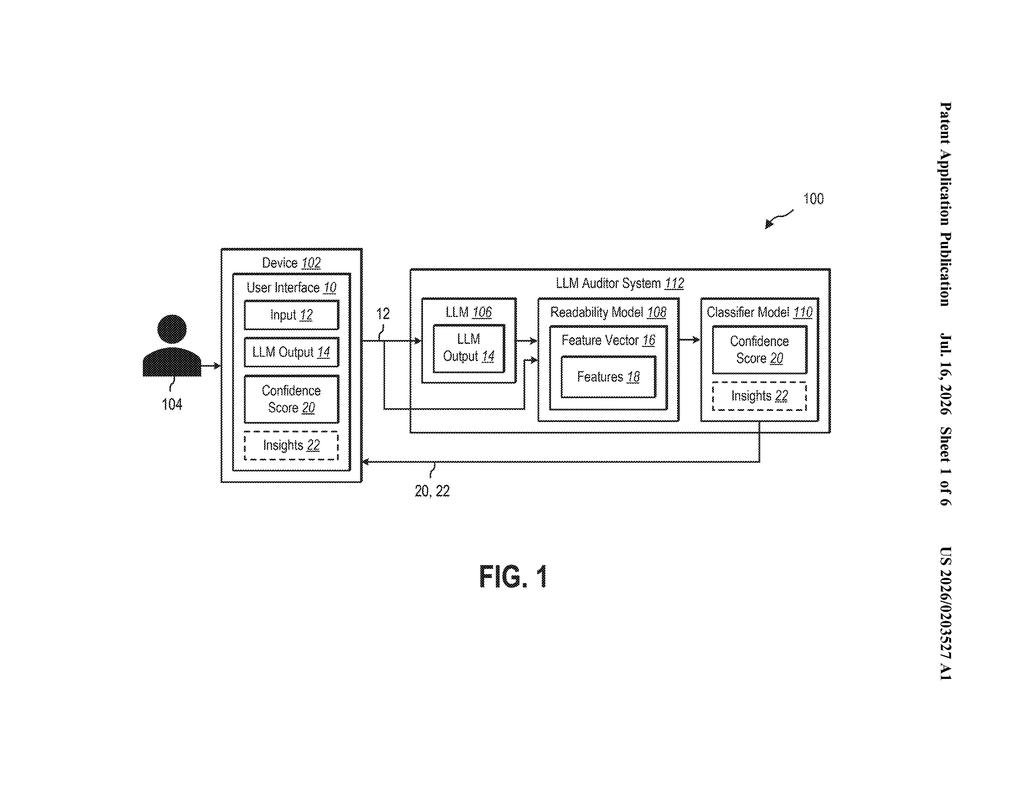
How Microsoft's readability confidence score works
Imagine you ask an AI a question and get a long, confident-sounding answer. How do you know if it actually got it right? That's a real problem with AI tools like chatbots today, and Microsoft is working on a way to attach a trust score to every AI response.
The idea here is surprisingly simple: instead of trying to verify the facts in an AI answer, Microsoft's system looks at the readability of both your question and the AI's response. If the writing quality, structure, and clarity of the output match up well with the input, the system awards a higher confidence score.
That score is meant to give you (or the app using the AI) a quick signal about whether the response is likely to be useful or whether it might be garbled, off-topic, or low quality. Think of it as a spell-checker for AI reliability, judging how well the AI wrote, not just what it wrote.
How the feature vector encodes input and output readability
The patent describes a pipeline that takes the text of a user's prompt and the AI-generated response, then builds what it calls a feature vector (essentially a structured list of numeric measurements) that captures readability characteristics of both texts.
- Readability metrics might include things like sentence length, word complexity, and structural coherence.
- The system encodes both the input and output into this feature vector, capturing how the two texts compare.
- That vector is then fed into a model that outputs a single confidence score representing the estimated quality of the AI's response.
The key insight is that a well-functioning large language model (LLM), the type of AI behind tools like ChatGPT or Microsoft Copilot, tends to produce output that is readable and internally consistent when it genuinely understands the task. When the model is uncertain or goes off the rails, the text often degrades in measurable ways.
This approach sidesteps the harder problem of fact-checking AI output, which requires external knowledge sources. Instead it treats readability as a proxy signal for quality, something that can be computed quickly and automatically from the text alone.
What this means for trusting AI-generated text
Right now, most AI tools give you an answer with no indication of how much you should trust it. A confidence score attached to every response would let apps flag low-quality answers before they reach you, or let you decide whether to double-check something important.
Microsoft already embeds AI across its products, from Word and Outlook to GitHub Copilot and Bing. A lightweight, text-based quality filter like this could slot into any of those tools to catch AI responses that look fluent but are likely unreliable, without needing a fact-checking database or a second AI to review the first one.
This is a sensible, modest idea for a real problem. Using readability as a proxy for AI confidence is not a complete solution, since a confidently wrong AI can still write clearly, but it's a practical first filter that doesn't require expensive extra computation. The canceled first claim is a flag worth noting: it suggests the patent has already hit some prior-art friction, and the final scope may be narrower than described here.
Get our take in your Top Stories
Liked this breakdown? Add Patentlyze as a preferred source on Google, and our plain-English take shows up more often in your Top Stories the next time Microsoft patent news breaks.
There are more where this came from
We read every patent application Big Tech publishes and send you the ones worth knowing. Plain English, free, every week.
Want this weekly breakdown for a company we don't cover? Patentlyze Pro →