
Google Patent: Smart Button That Changes Function Based on Context and User
Imagine pressing one physical button and having your home figure out whether to pause the TV, answer the front door, or switch your music to a different speaker, depending on what's already happening. That's the idea behind this Google patent.
What Google's adaptive assistant button actually does
Picture this: you have a little physical button sitting on your desk. Sometimes you want it to mute your TV. Other times you want it to pick up a call on your phone. Right now, a button like that does one thing, the one you programmed it to do.
Google's patent describes a button that's aware of what your devices are currently doing. Instead of always running the same command, it checks the state of each connected device and picks whichever action makes the most sense right now. If your TV is playing, it pauses it. If your phone has an incoming call, it answers that instead.
The system can also adapt based on who's using it and where the button is, so the same button might behave differently in a bedroom versus a living room, or when a different family member picks it up.
How the button reads device states to pick the right action
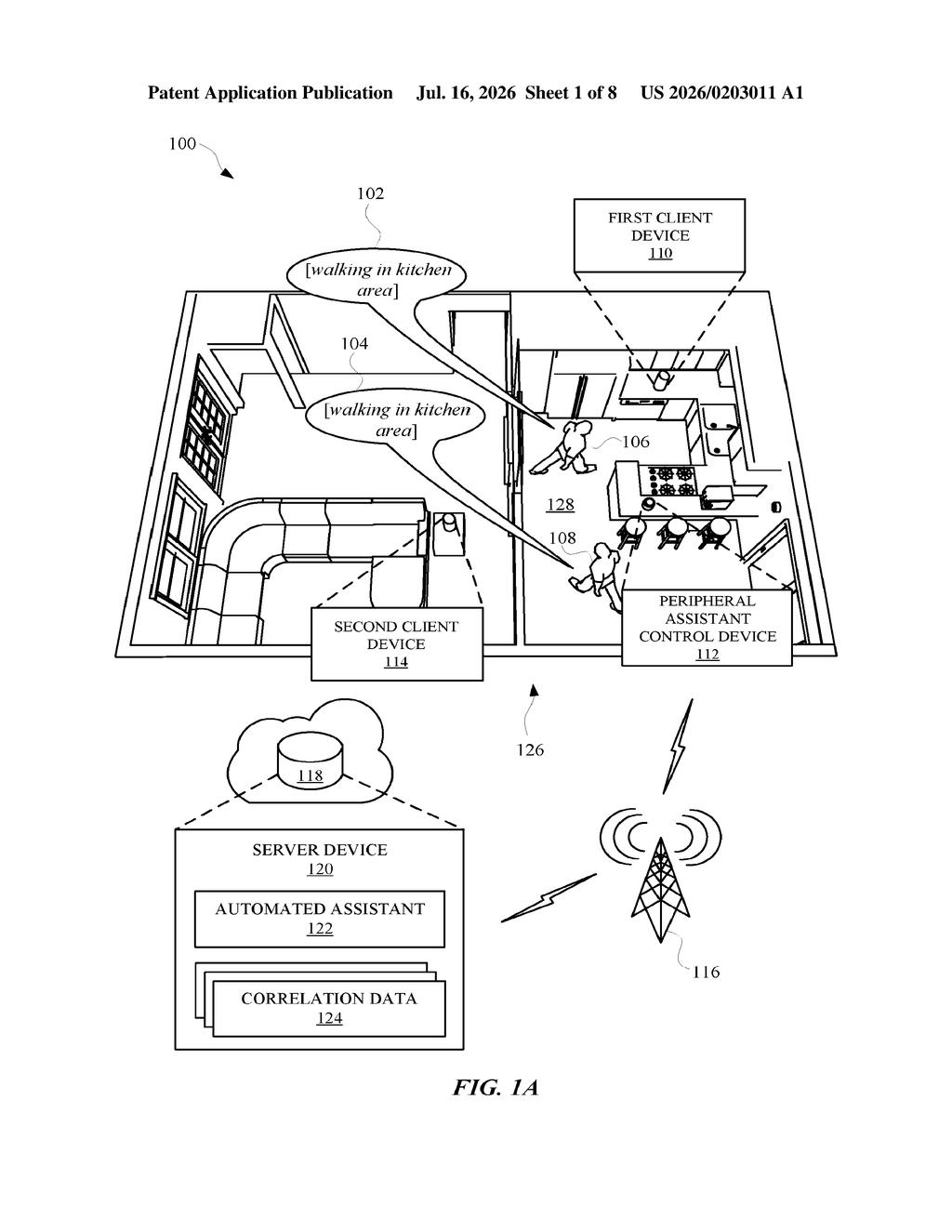
The patent describes a physical control device (think a small button or clicker) that connects to at least two different client devices at the same time, say a smart speaker and a phone, or a TV and a tablet.
When you press it, the system doesn't just fire off a pre-set command. Instead, it checks the current state of each connected device. If Device A is active and Device B is idle, it routes the action to Device A. If the states are reversed, it routes to Device B instead. The logic is conditional: the outcome depends on what combination of states the devices are in at that moment.
- Who's using it: Different users can have different configured behaviors for the same button.
- Where it is: The button can infer its location based on which device it's currently paired with, and adjust accordingly.
- Smart home awareness: The patent mentions checking a "device topology" (basically a live map of what devices are on and active) to help decide what to do.
The patent also notes that the system can go beyond what the user specifically set up, automatically extending its usefulness to cover situations the user didn't explicitly configure.
What this means for smart home and Google Assistant hardware
Physical buttons for digital assistants have always been pretty dumb: one button, one job. Google's filing suggests the company is thinking about hardware controls that behave more like an attentive assistant than a simple switch. For anyone juggling multiple smart devices in a home or office, that's a meaningful quality-of-life change.
This also hints at a potential direction for Google's Nest and Assistant hardware line. A small, programmable physical button with this kind of conditional logic built in could make Google's ecosystem stickier, since the button only works as well as the devices it's connected to. It's a subtle way to reward users who own more Google hardware.
This is a genuinely practical idea dressed up in dense patent language. The core insight (that a physical button should know what's happening around it, not just what you told it to do at setup) is the kind of small improvement that makes an ecosystem feel polished. Whether Google ships this as a standalone accessory or bakes it into existing Nest hardware is the real question.
Get our take in your Top Stories
Liked this breakdown? Add Patentlyze as a preferred source on Google, and our plain-English take shows up more often in your Top Stories the next time Google patent news breaks.
There are more where this came from
We read every patent application Big Tech publishes and send you the ones worth knowing. Plain English, free, every week.
Want this weekly breakdown for a company we don't cover? Patentlyze Pro →