
New Patent Lets Speakers Amplify Audio Without Pairing
What if your Google speaker could pick up audio playing nearby — from a TV, a phone, or a laptop — and amplify it in sync, without you ever connecting the two devices? That's the core idea in this Google patent.
What Google's no-pairing spatial audio actually does
Imagine you're watching a movie on your laptop across the room, but the sound is too quiet. Normally, you'd need to pair your laptop with a Bluetooth speaker first. This Google patent describes a way to skip that step entirely.
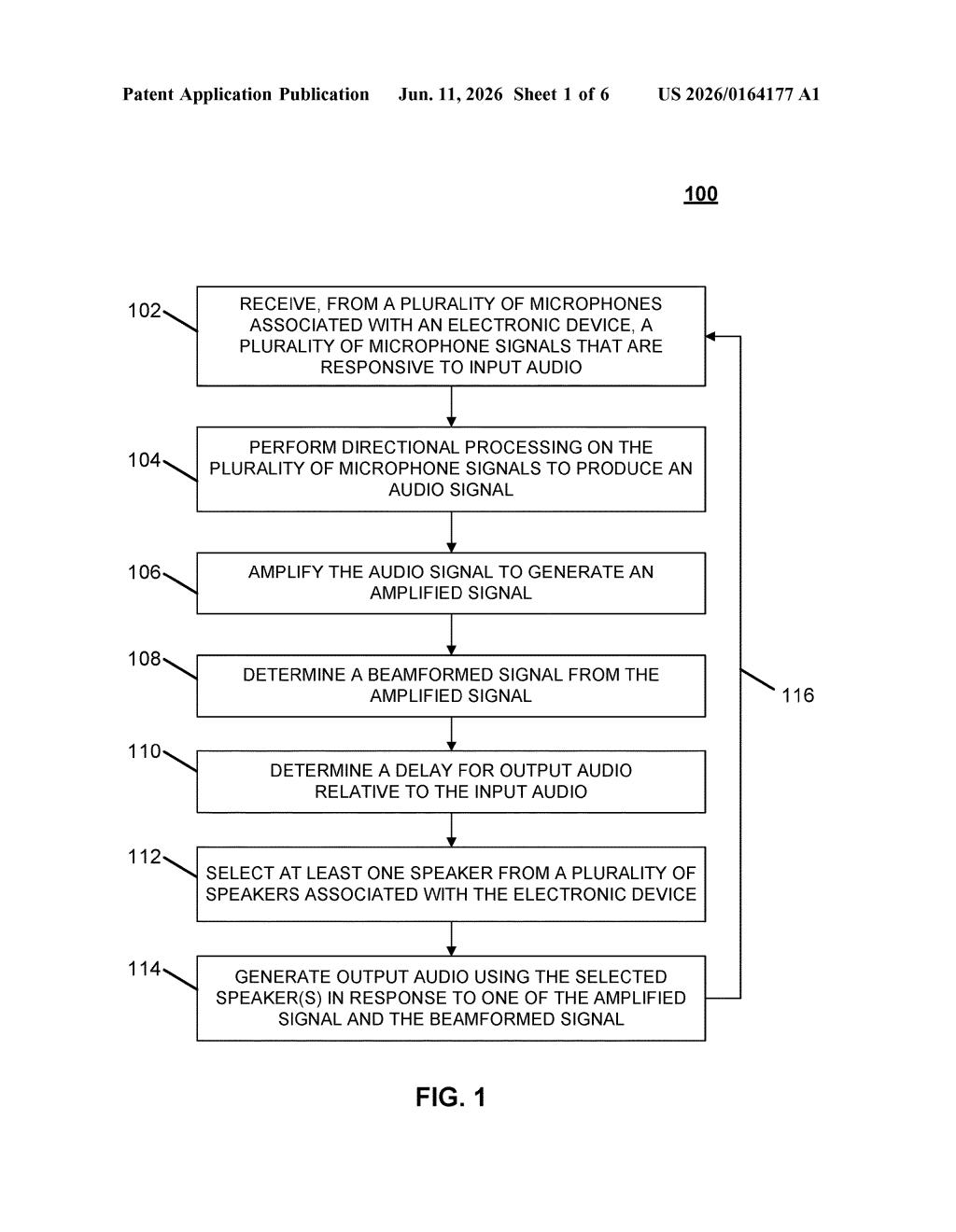
The speaker uses its built-in microphones to listen to the audio coming from whatever device is playing nearby. It figures out the direction the sound is coming from, isolates it from background noise, and then plays it back through its own speakers — essentially acting as a real-time amplifier for a source it has never been formally connected to.
The result is that any speaker with a microphone array could potentially boost or rebroadcast nearby audio on the fly, without you doing anything at all. You just put it in the room and it works.
How the speaker isolates and reproduces directional audio
The patent describes a method where an electronic speaker device — think a smart speaker or a soundbar — uses an array of microphones to capture audio coming from a nearby media source that it is not paired with over Bluetooth, Wi-Fi, or any other connection.
- Directional processing (a technique that uses multiple microphones to figure out where a sound is coming from and filter out everything else) is applied to the raw microphone signals. This lets the speaker isolate just the audio from the target device, even in a noisy room.
- The isolated audio signal is then amplified internally.
- The speaker plays back the amplified version in real time, while it is still listening — meaning the output is synchronized with the live input rather than recorded and played back later.
The key technical challenge here is avoiding a feedback loop: the speaker must listen and play simultaneously without its own output corrupting the microphone input. The patent's directional processing is central to solving that problem — by pointing the microphone array's focus away from the speaker's own drivers and toward the source device.
What this means for wireless speaker setups at home
For everyday users, this could mean Google speakers become more useful as general-purpose audio extenders. You wouldn't need to fumble with Bluetooth settings or app connections — just place a speaker near a TV or laptop and it handles the rest automatically. That's a meaningful quality-of-life improvement for older TVs with poor built-in audio, shared spaces, or accessibility scenarios where louder, clearer sound matters.
For Google, it's a way to make Nest Audio and similar devices more sticky in the home without requiring a tightly controlled ecosystem. A speaker that works with anything nearby, not just Google Cast or Bluetooth-paired devices, is a much easier sell — and it nudges users deeper into a Google-hardware home without demanding they overhaul how every device connects.
This is a genuinely useful idea. The friction of pairing is one of the most annoying parts of home audio, and a speaker that just listens and amplifies whatever is nearby solves a real problem elegantly. The hard part is execution — real-time directional audio isolation while playing back sound in the same room is an acoustics challenge, not just a software one. If Google can pull it off reliably, this is worth paying attention to.
There are more where this came from
We read every patent application Big Tech publishes and send you the ones worth knowing. Plain English, free, every week.
Want this weekly breakdown for a company we don't cover? Patentlyze Pro →