
Qualcomm Patents a Hidden Audio Check That Catches Speaker Failures Before They Matter
Every time your car's speaker plays a navigation warning or a collision alert, there's an assumption that the speaker actually works. Qualcomm's new patent is about verifying that assumption, automatically, in real time.
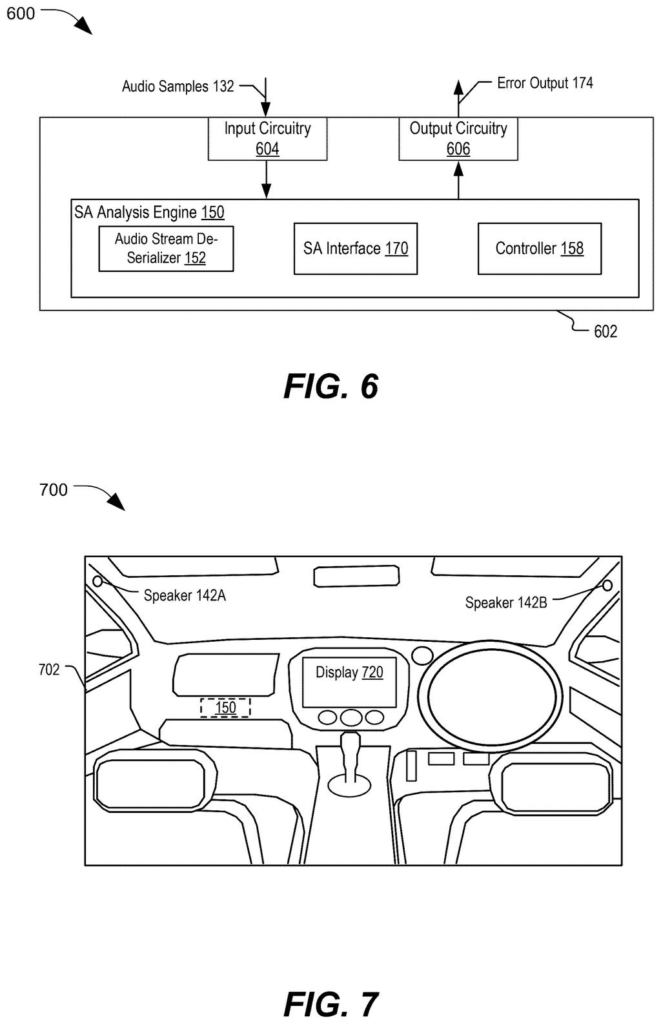
How Qualcomm's hidden audio check signal works
Imagine your car's audio system is supposed to warn you when someone's in your blind spot. But what if the speaker is broken and the warning never plays? You'd have no idea. That's the problem this patent addresses.
Qualcomm's idea is to weave a hidden test signal into the regular audio stream. When your car (or any device) plays sound, it secretly mixes in a known reference tone at specific, fixed positions inside the audio data. A monitoring system then pulls those reference samples back out and checks whether they came through correctly.
If the extracted samples don't match what was originally put in, the system raises an error flag. Think of it like a built-in quality-control inspector that rides along with every sound the device plays, silently confirming the audio pipeline is working properly.
How the interleaved sample extraction detects errors
The patent describes a device with a memory that stores two types of audio data simultaneously: the actual content audio (music, voice, etc.) and a separate safety-alert audio signal used as a verification reference.
The system places audio samples from both streams into a shared buffer, interleaving them (mixing them together in alternating positions). The safety-reference samples occupy specific, predetermined positions within that combined stream, defined by an audio sample position configuration (essentially a lookup map that says which slots in the buffer belong to the test signal).
At the output stage, the processor:
- Pulls the combined audio samples from the buffer
- Extracts only the safety-reference samples using the known position map
- Compares them against the original reference data
- Generates an error output if the extracted samples don't match expectations
The practical effect is that the audio pipeline is continuously self-testing. Any corruption, dropout, or hardware fault that touches the safety-reference samples gets caught and flagged without requiring a separate dedicated test channel.
What this means for safety-rated audio in cars and devices
This kind of self-checking audio is a requirement in functional safety standards (like ISO 26262, the automotive safety spec) that govern safety-critical systems in cars. If a speaker is supposed to deliver collision warnings or pedestrian alerts, regulators and automakers want proof that the system can detect its own failures. A patent like this addresses exactly that certification need.
For you as a driver or passenger, it means the infotainment or driver-assistance system in a future car could confirm its own audio hardware is healthy every time it plays a sound, rather than waiting for a scheduled diagnostic or a human to notice something is wrong.
This is unglamorous but genuinely useful work. Automotive functional-safety requirements create real demand for exactly this kind of continuous self-verification, and building it into the audio buffer layer rather than a separate test mode is an elegant approach. It won't generate headlines, but it's the kind of patent that ends up in Qualcomm's automotive chip stack.
There are more where this came from
We read every patent application Big Tech publishes and send you the ones worth knowing. Plain English, free, every week.
The drawings
8 drawing sheets from US 2026/0221010 A1 · click any drawing to enlarge


Want this weekly breakdown for a company we don't cover? Patentlyze Pro →