
Google Patents a Way to Tap Pieces of an AI Answer for Instant Follow-Up Detail
Instead of typing a follow-up question to your AI chatbot, what if you could just tap the sentence you wanted explained further? That's exactly what Google is patenting.
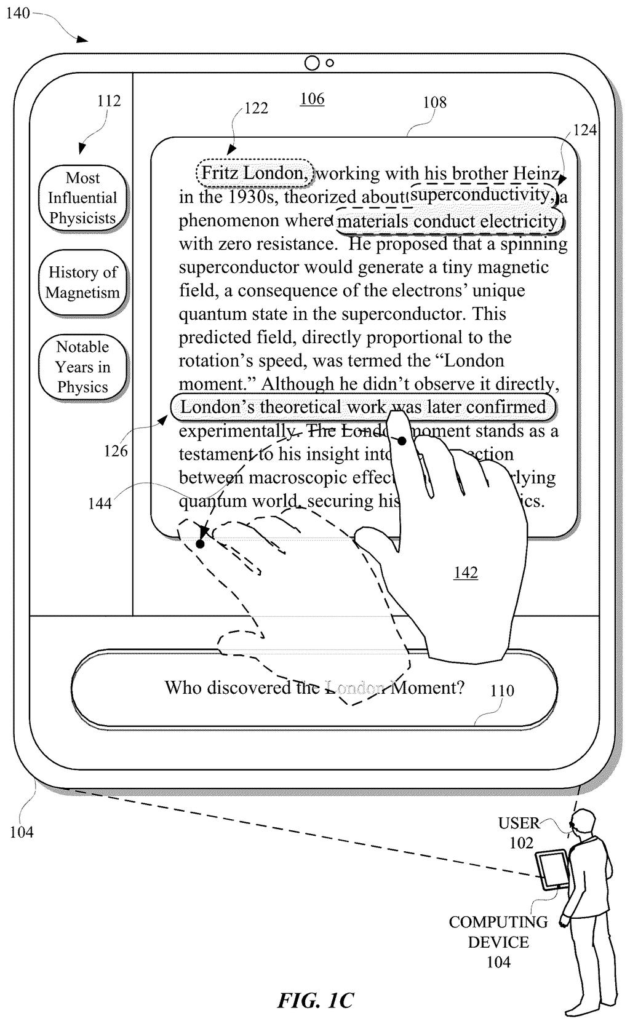
What Google's tappable AI response chunks actually do
Imagine you ask Google's AI a question and it gives you a three-paragraph answer. One sentence catches your eye, but you want more detail on just that part. Right now, you'd have to type out a whole new question. Google's patent describes a system where parts of the AI's response are automatically highlighted or marked up so you can tap them directly.
When you tap one of those highlighted chunks, the app figures out what that section is about and instantly generates more content about it, without you needing to type anything. The AI essentially reads the context of what you tapped and treats that as your next prompt.
Think of it like footnotes that expand when you touch them, except the footnote is written on the spot by AI based on exactly what you were curious about. The system can identify these tappable sections either ahead of time or the moment you start interacting with the text.
How the system picks and highlights selectable content portions
The patent describes a system built into a generative AI application (think Google's Gemini or a Search AI overview) that automatically breaks its own output into semantically meaningful chunks. Semantically meaningful just means the system groups words and sentences that belong together in terms of meaning, not just by paragraph breaks.
Once those chunks are identified, the interface renders GUI features (graphical cues like highlights, underlines, or buttons) on top of or next to each chunk to signal that it is interactive. The user does not have to do anything to trigger this step; the markers appear automatically.
When the user taps or gestures at one of those marked sections, the system passes that specific chunk, along with its surrounding context, to one or more AI models. Those models then generate additional content that expands on, clarifies, or supplements just that portion. The new content appears in the interface without the user having to write a new prompt.
The claim also covers two timing modes:
- Pre-determined portions: the app segments the response before the user touches anything
- On-demand portions: the segmentation happens in response to where the user's gesture lands
What this means for how you interact with Google's AI tools
Right now, AI chat interfaces are basically a back-and-forth text box. You type, the AI answers, you type again. That friction stops a lot of people from drilling deeper into an answer. If Google ships this, your interaction with an AI response starts to look more like reading a Wikipedia article with expandable inline citations, except the expansions are generated fresh for you rather than pre-written.
For Google specifically, this fits neatly into the AI Overviews feature already showing up in Search. If those summaries became directly tappable and expandable, it could keep users inside Google's ecosystem rather than clicking through to source pages. That has real implications for publishers and advertisers, not just for your search experience.
This patent is genuinely useful as a UX idea, not just a filing-to-file. The core frustration it targets, having to re-type context you already have on screen, is real and annoying. Whether it ships as a polished feature or gets buried is another question, but the underlying interaction model is one of the more sensible AI interface proposals to come out of Big Tech recently.
There are more where this came from
We read every patent application Big Tech publishes and send you the ones worth knowing. Plain English, free, every week.
The drawings
7 drawing sheets from US 2026/0219771 A1 · click any drawing to enlarge


Want this weekly breakdown for a company we don't cover? Patentlyze Pro →
Be the first to weigh in