
Google
Google · AI / ML · Filed Oct 21, 2024 · USPTO published Jul 2, 2026 · Jul 2 release
Google Patent Reveals Hidden AI Signals That Could Shape Ads You See
Google has figured out a way to read the hidden internal state of an AI chatbot mid-conversation and use that signal to decide which ad to show you, without waiting to fully analyze what you typed.
- Publication number
- US 2026/0187172 A1(US20260187172A1)
- Applicant
- GOOGLE LLC
- Filed · Published
- Oct 21, 2024 · Jul 2, 2026
- Inventors
- Nicholas James Reid
- Status when we published
- Examiner raised objections; the company can respond
- Document
- 21 claims
- US classification
- 707/732
- Examiner
- TO, BAOQUOC N (Art Unit 2154)
- Parent application
- National Stage Entry of PCT/US2023/028041 (filed Jul 18, 2023)(PCTUS2023028041)
How Google's AI picks ads from inside a chatbot conversation
Imagine you ask an AI assistant a question like "what's the best running shoe for knee pain?" Google wants to know more than just the words you used. It wants to understand where you are in your decision process: are you just starting to research, or are you ready to buy?
This patent describes a system that reads a kind of internal snapshot from the AI model while it is generating your answer. That snapshot captures subtle signals about your intent that the words alone might not reveal. Based on that, the system maps your position onto a "user journey" (think: awareness, consideration, purchase) and picks an ad that fits that stage.
The result is that the ad appearing alongside the AI's response isn't just matched to your keywords. It is matched to what the AI's own internal workings suggest about where you are in making a decision. Google is essentially letting the chatbot's brain, not just its output, drive ad targeting.
How the intermediate embedding drives ad selection
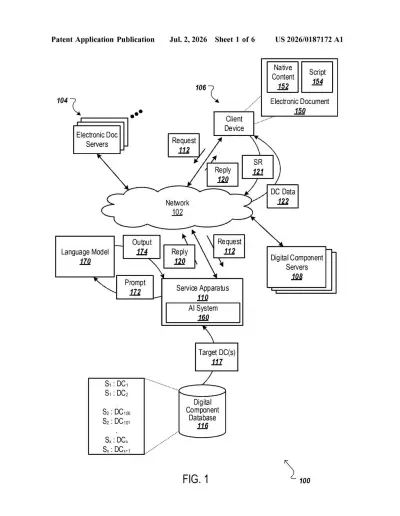
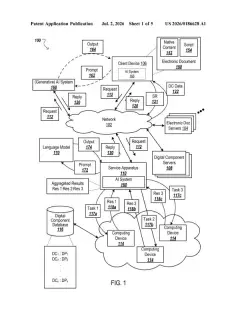
The patent describes a pipeline that intercepts a signal called an intermediate embedding from inside a language model neural network. An embedding is a dense numerical representation that a neural network builds up internally as it processes text. An intermediate embedding is captured partway through that process, before the model finishes generating its response, and it tends to encode richer contextual meaning than the raw input text alone.
That embedding is then fed into a separate classification step that maps it to one or more stages in a user journey. A user journey here is a structured sequence of states a person moves through when completing a task online (for example: researching a product, comparing options, deciding to purchase). Google maps candidate digital components, meaning ads or other content units, to each stage in advance.
Once the system determines which stage best matches the embedding, it selects the corresponding digital components (the patent's term for ads or sponsored content) and surfaces them alongside the AI-generated response.
- The language model processes the user's prompt as normal
- An intermediate embedding is captured mid-process
- That embedding is classified against predefined user-journey stages
- Ads mapped to the matching stage are selected and displayed with the response
What this means for ads inside Google's AI products
For users, this means the ads shown next to an AI response could be significantly more context-aware than what keyword-based targeting delivers. A query about "knee pain running shoes" at the research stage might surface an informational comparison tool; the same query phrased as "buy Brooks Ghost size 10" might surface a direct retailer ad. The system is designed to make that distinction automatically, based on the AI's internal read of your intent rather than a rules-based keyword match.
For Google's business, this is about making AI-generated search results monetizable in a precise way. As AI answers displace traditional search result pages, the old click-on-a-blue-link ad model loses relevance. This patent describes one concrete mechanism for keeping ad revenue tied to AI-driven interactions, which is the direction Google's core products are clearly heading.
Source: US 2026/0187172 A1 at the USPTO (PDF). Full patent text and figures are in the official publication.
Get our take in your Top Stories
Liked this breakdown? Add Patentlyze as a preferred source on Google, and our plain-English take shows up more often in your Top Stories the next time Google patent news breaks.
Add Patentlyze on Google
One click.
There are more where this came from
We read the new patents from Big Tech, carmakers and more and send you the ones worth knowing. Plain English, free, every week.
More from Google
All 1,127 Google patents →
More in AI assistant & agent
All 436 AI assistant & agent patents →
OpenAI
OpenAI Patents a Web-Browsing Bot You Can Take Over at Any Moment
OpenAI
OpenAI Patents a System That Teaches AI Chatbots to Read Time and Schedule Tasks
Intel
Intel Patent Uses Fading Semantic Tags to Maintain Accurate Data Relevance
Salesforce